

What Kindergarten Report Card Grades Actually Mean (Quick Answer)
Decoding kindergarten report cards starts with knowing that most schools no longer use A, B, C letter grades for kindergarteners. Instead, they use a standards-based system that shows how your child is performing right now against grade-level expectations.
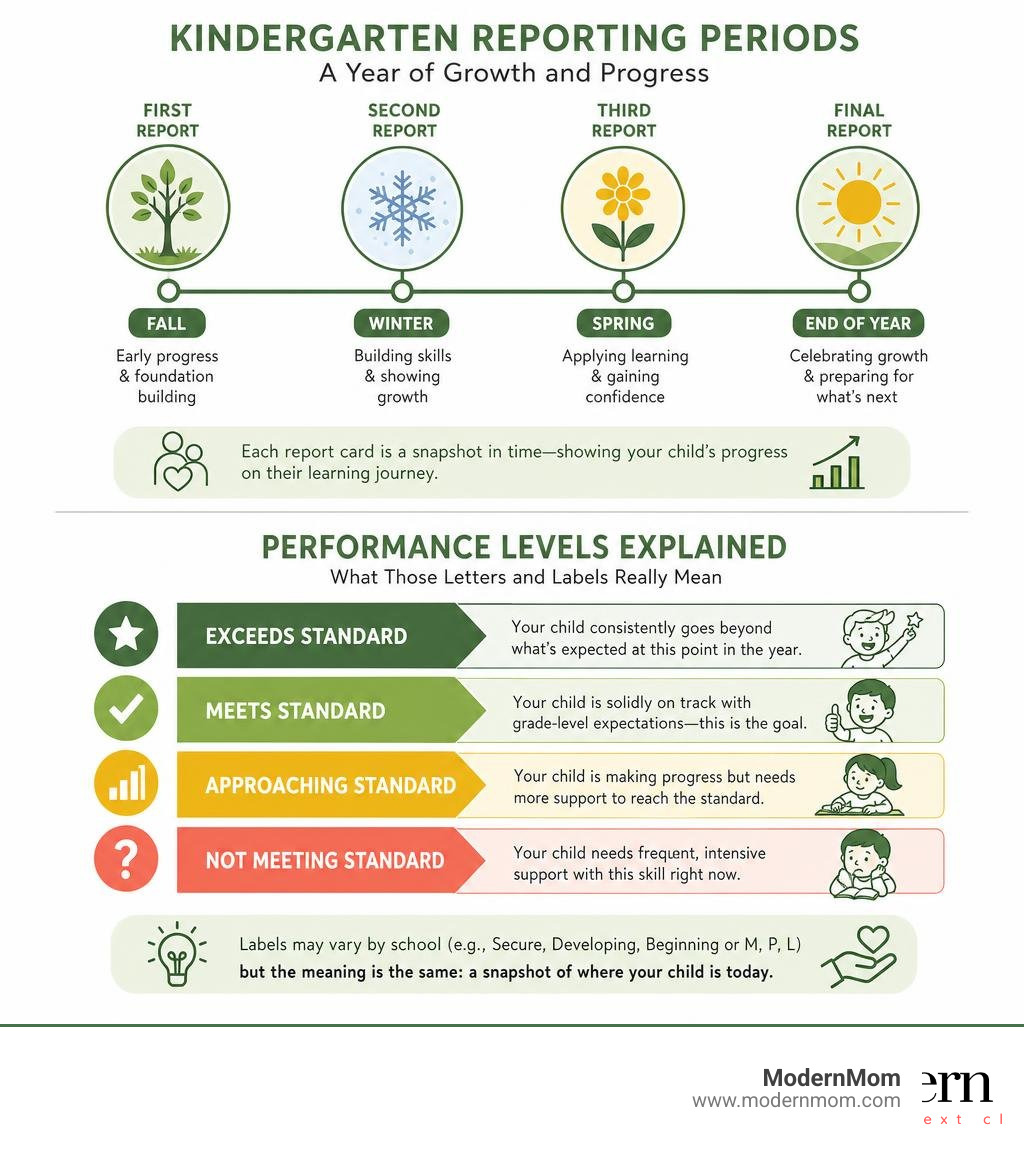
Here’s a quick breakdown of the most common performance levels you’ll see:
| Level | What It Means |
|---|---|
| Exceeds Standard | Your child consistently goes beyond what’s expected at this point in the year |
| Meets Standard | Your child is solidly on track with grade-level expectations — this is the goal |
| Approaching Standard | Your child is making progress but needs more support to reach the standard |
| Not Meeting Standard | Your child needs frequent, intensive support with this skill right now |
You may also see variations like Secure (SC), Developing (DV), Beginning (BG), or codes like M (Meets), P (Progressing), and L (Limited) — these all follow the same idea. The label changes by district, but the meaning is the same: it’s a snapshot of where your child is today, not a prediction of where they’ll end up.
That little report card can feel like it’s written in another language — full of jargon, coded letters, and comments that leave you with more questions than answers. You’re not alone in that feeling, and it doesn’t mean something is wrong with your child or your understanding of it. These reports are packed with helpful insights once you know how to read them, and we’re here to help you decode it all.
Here at Modern Mom, we’ve helped countless parents navigate this milestone by breaking down complex school systems into clear, usable information. Whether this is your first report card or your third, this guide will walk you through everything you need to know with zero stress.
Helpful guides for understanding report cards and grades:
Introduction
Bringing home that first kindergarten report card is a major milestone for both you and your little one. It’s a beautiful, tangible sign of their transition into the big kid world of formal education.
It’s completely normal to feel a mix of pride and a little bit of anxiety when you open that envelope or log into the school portal. We often expect to see simple checkmarks or familiar letter grades, but today’s early childhood assessments focus deeply on developmental milestones.
Kindergarten report cards are issued at regular intervals throughout the year to keep you in the loop on your child’s growth. To help you keep track of these milestones, we’ve put together a quick guide to understanding the timeline of kindergarten reporting periods.
Standards-Based vs. Traditional Grading: Decoding Kindergarten Report Cards
Most primary schools have transitioned away from traditional letter-grade report cards (A, B, C) for early learners. Instead, they use Standards-Based Instruction and Reporting (SBIR). This system measures your child’s progress against specific, age-appropriate learning standards rather than comparing them to their peers.
One of the most important concepts to understand is “point-in-time” assessment. This means your child is evaluated on how well they perform a skill based on the expectations for that exact time in the school year. A skill that’s marked as “secure” in the fall might require more advanced mastery by the spring.
The frequency of these reports varies, but most districts issue them three or four times a year. In many schools, the very first update you’ll receive is a progress report card in November. These autumn updates often use a simple three-tier check system—noting whether a child is progressing very well, well, or with difficulty—to give you an early look at how they’re adjusting.
Understanding these early standards helps you set the stage for your child’s academic journey. For a look at how these expectations evolve as kids grow, check out our guide on Back to School for the Big Kids.
Understanding the Levels of Academic Performance
When decoding kindergarten report cards, you’ll encounter specific performance levels that describe academic progress. The most important level to understand is Level 3, or “Meets Standard.” This indicates solid performance of grade-level concepts and skills at that specific point in the school year. It means your child is exactly where they need to be!
To help you translate these codes, here’s a comparison of common standards-based performance levels and their meanings:
| Academic Performance Code | Equivalent Rating | Meaning for Your Child |
|---|---|---|
| Exceeds Standard (E / M+) | Secure / Consistently Demonstrating | Consistently performs above current grade-level expectations with independence. |
| Meets Standard (M / SC) | On Track / Secure | Solidly demonstrates understanding of grade-level concepts at this point in the year. |
| Approaching Standard (P / DV) | Progressing / Developing | Making steady progress but requires frequent prompting and support to meet the standard. |
| Not Meeting Standard (L / BG) | Limited Progress / Beginning | Demonstrates limited proficiency and needs intensive, structured intervention. |
These levels are scored independently each term. This means your child’s marks reflect their current daily work rather than a cumulative average of the whole year. For a deeper dive into how different school districts structure these academic codes, you can read more through this resource on Understanding the Kindergarten Report Card.
Key Academic Skills Assessed in Kindergarten

Kindergarten is a year of incredible growth across many different subjects. Teachers look at the whole child, evaluating both academic and physical development.
Here are the key areas typically assessed on a kindergarten report card:
- Reading Comprehension: Listening to stories, identifying characters and settings, and retelling major events.
- Early Writing: Holding a pencil correctly, writing their first name, and using phonetic spelling to write simple words.
- Counting and Number Sense: Recognizing numbers, counting to 100, and understanding one-to-one correspondence (matching one number to one physical object).
- Science Observation: Predicting, observing, and recording simple data about weather, seasons, and living organisms.
- Social Studies: Understanding their role in the family, classroom, and local community.
- Fine Motor Skills: Using scissors correctly, buttoning coats, and controlling a pencil or crayon.
- Gross Motor Skills: Skipping, hopping, catching a ball, and navigating the playground safely.
Math is a particularly exciting area of growth during this year. If you want to help your little mathematician thrive at home, look at our practical tips on How to Improve Your Child’s Math Skills.
Decoding Kindergarten Report Cards for Phonics and Sight Words
Early literacy is a major focal point in kindergarten classrooms. Phonics instruction teaches children to connect sounds to letters, which is the absolute foundation of reading.
Sight words are common words that students are encouraged to recognize quickly and automatically without sounding them out. Many of these high-frequency words don’t follow regular spelling patterns (like “the” or “was”). Kindergarten students are expected to master 52 high-frequency sight words by the end of the year to support reading fluency and comprehension.
When students recognize sight words automatically, they can read with greater fluency. This allows them to spend more time focusing on the meaning of the story rather than spending all their energy decoding individual words.
By the end of Senior Kindergarten, children should be able to print and recognize numbers and letters, with beginning recognition of some words. While the official goal for independent reading proficiency is expected by the end of Grade 1, the end-of-kindergarten instructional reading goal is typically a Level D.
You can protect your child’s hard-earned progress over school breaks by checking out our guide on Limiting Summer Slide by Strengthening Reading Habits at Home.
Interpreting Teacher Comments and Learning Behaviors
While marks tell you what your child is learning, the teacher’s written comments and learning behavior ratings tell you how they’re learning. These sections are often the most valuable parts of the entire report card.
Many schools assess learning behaviors using the C.A.R.E.S. framework:
- Cooperation: Working well with peers and sharing classroom materials.
- Assertion: Expressing needs, asking for help, and participating in discussions.
- Responsibility: Taking care of personal belongings and classroom spaces.
- Empathy: Showing kindness and understanding toward others.
- Self-control: Managing emotions, handling transitions, and following directions.
Effort ratings and social-emotional readiness are incredibly important in early elementary school. If a child can’t self-regulate or focus, it’s very difficult for them to absorb academic concepts.
When reading teacher comments, look for specific verbs and adjectives. Phrases like “is beginning to” or “requires support with” are developmental descriptors, not criticisms. To learn more about how teachers structure these early assessments, explore Report Card Comments for Kindergarten & Primary Grades (K–2) – Differentiated Teaching.
What to Do If You Have Questions or Concerns
If your child’s report card shows areas that need improvement, take a deep breath. Early childhood development isn’t a straight line—it happens in bursts and plateaus.
The best first step is to open a warm, collaborative line of communication with your child’s teacher. They see your child in a structured, social environment every day and can provide valuable context that numbers can’t show. Early intervention is highly effective, and addressing minor developmental delays now can prevent academic frustration later.
A report card is simply a tool to help us support our kids. To help keep your child’s spirits high as they learn, read our advice on how to Boost Your Child’s Confidence as Life-Long Learner.
Decoding Kindergarten Report Cards to Create an Action Plan
Once you’ve reviewed the report card and spoken with the teacher, you can create a simple, stress-free action plan at home:
- Integrate At-Home Learning: Turn daily activities into games. Count apple slices at snack time, point out sight words on cereal boxes, or play rhyming games in the car.
- Set Up a Structured Environment: Create a quiet, organized space for drawing, writing, and looking at books to build focus and independence.
- Build Consistent Routines: Reliable morning and bedtime routines help children feel secure, which directly improves their self-regulation at school.
- Keep Progress Monitoring Light: Keep learning fun and low-pressure. Celebrate the effort your child puts into trying new things rather than focusing only on the perfect result.
Frequently Asked Questions About Kindergarten Progress
What resources and guides can help me support my child’s progress at home?
Most U.S. school districts offer parent guides that outline the exact standards for each grade level. You can also ask your teacher for a copy of their sight word lists, reading benchmarks, or recommended practice activities. If your district posts report card resources online, look for the most current kindergarten parent guide, such as this U.S. district example on understanding Pre-K–2 report cards, so you can compare the codes on your child’s report card with the school’s own explanations.
Why does my child have a “Developing” grade if they’re doing well at home?
It’s very common for children to behave differently at home than they do in a busy classroom. At home, your child has your undivided attention and a familiar environment. At school, they must navigate social dynamics, distractions, and transition times. A “Developing” mark simply means they’re still building the stamina to perform that skill consistently in a classroom setting.
How do I prepare for a parent-teacher conference about the report card?
Go in with a collaborative mindset. Write down a short list of questions beforehand, focusing on both academic progress and social-emotional growth. You can bring along a few samples of work your child has done at home if you have specific questions about their writing or drawing skills. Ask the teacher for one or two simple activities you can do at home to support their current classroom goals.
Conclusion
At ModernMom, we know that raising a confident, happy learner is a team effort. Decoding kindergarten report cards doesn’t have to be stressful when you view it as a collaborative roadmap for growth rather than a final judgment. By focusing on effort, celebrating progress, and keeping a close partnership with your child’s teacher, you’re giving your little one the ultimate foundation for a lifetime of learning.
For more parenting resources, tips, and school readiness advice, check out the ModernMom Education & College Planning section.
The post What Do Those Kindergarten Report Card Letters Actually Mean appeared first on ModernMom.