
The Summer Slump Is Real — Here’s How to Fight It
Fighting the summer slump is something almost every busy mom faces — whether it’s your own focus slipping at work, your kids losing the math skills they worked so hard for, or just that heavy, restless feeling that settles in when routines fall apart.
Here’s a quick snapshot of what you’re up against — and what actually helps:
What is the summer slump?
A drop in productivity, motivation, and skill retention that hits both adults and children during the summer months.
Key signs:
- You’re distracted, low-energy, or struggling to focus at work
- Your kids seem bored, irritable, or are forgetting what they learned
- Your household routines have quietly fallen apart
What actually helps:
- Keep a light, consistent daily rhythm — don’t try to replicate the school year
- Align work tasks to your natural energy peaks (your chronotype)
- Give kids 20 minutes of reading and a few short math sessions per week
- Plan one small adventure or activity each day to break the monotony
- Rest is part of the strategy — burnout makes everything worse
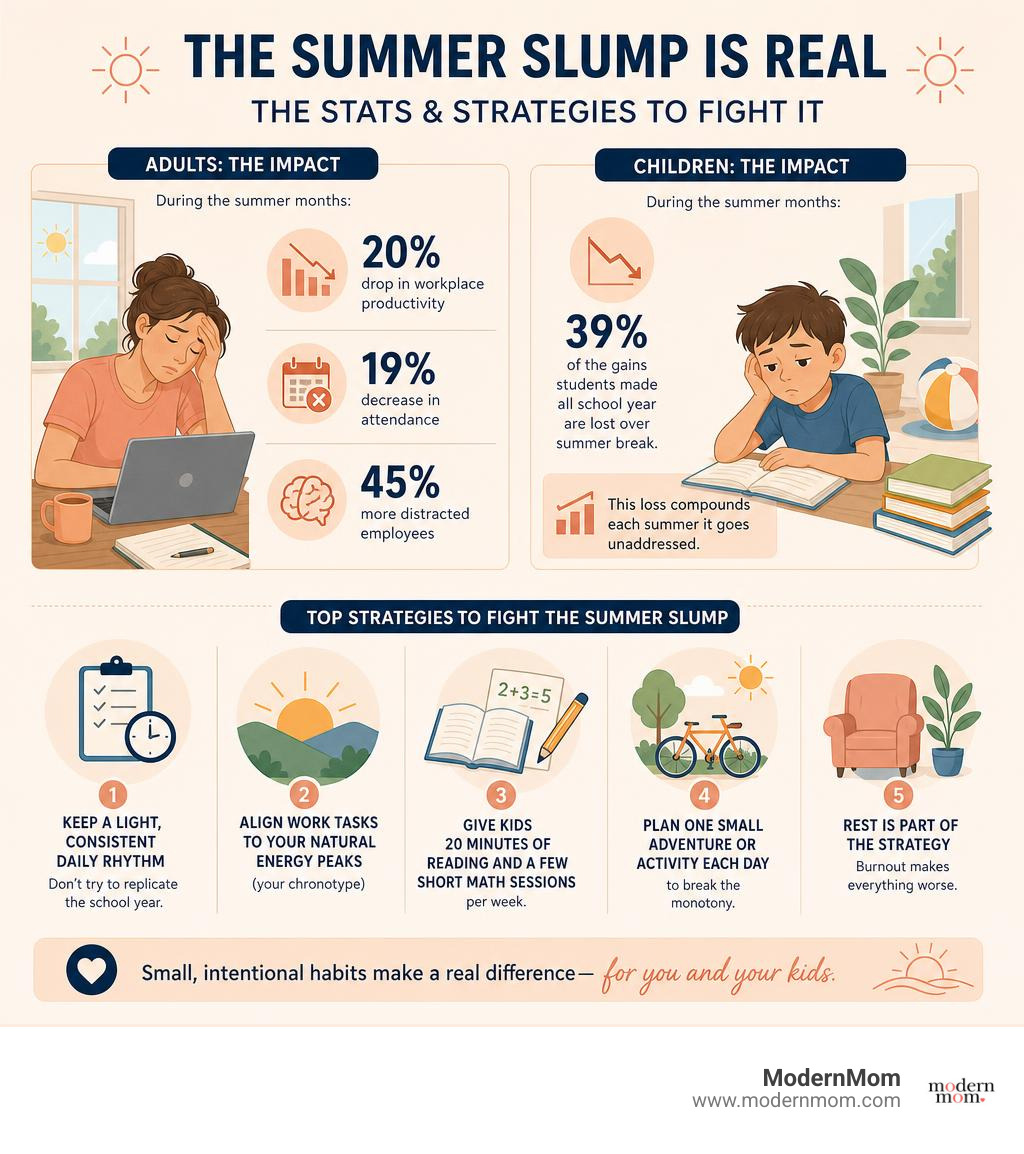
The stats behind the slump are eye-opening. Workplace productivity drops by roughly 20% in summer, and employees are nearly 45% more distracted. For kids, the picture is just as striking — students lose an average of 39% of the gains they made all school year, and that loss compounds every summer it goes unaddressed.
The good news? You don’t need a rigid schedule or expensive programs to turn things around. Small, intentional habits make a real difference — for you and your kids.
What is the Summer Slump and Why Does It Happen?
We’ve all felt that shift when June arrives. The weather warms up, the sun stays out late, and suddenly, sitting in front of a computer screen feels like pulling teeth.
This isn’t just in your head. Workplace productivity drops by approximately 20% during these sun-drenched months. Attendance decreases by around 19%, and employees report feeling roughly 45% more distracted.
For our kids, this shift is even more dramatic. Often called the “summer slide,” children lose significant academic ground over the break. On average, students lose 39% of the learning gains they made across the entire school year.
Furthermore, 52% of students lose ground in all five consecutive summers of their elementary years. This regression isn’t just academic; it affects pediatric mental health too. When school routines vanish, kids lose access to structured socialization and cognitive stimulation, which can lead to irritability, sleep issues, and social withdrawal.

Circadian Rhythms and Entrainment: The Science of Seasonal Sluggishness
Why do we feel so unmotivated when the weather gets warm? The answer lies in chronobiology and a process called “entrainment.”
Entrainment is how our internal biological clocks sync with environmental cues like sunlight and temperature. During summer, longer daylight hours and increased heat alter our melatonin production.
This shift in our circadian rhythms signals to our bodies that it’s time to rest and play, not grind through spreadsheets. We are biologically wired to slow down when the sun is high, making the traditional 9-to-5 workday feel like an uphill battle.
The Impact of Weekly and Annual Productivity Cycles
Productivity naturally flows in cycles. On a weekly scale, Mondays are typically our most productive days, while Friday afternoons are notoriously sluggish.
On an annual scale, summer represents the lowest point of professional output. Instead of fighting this natural ebb and flow, organizations and families do better when they learn to manage energy rather than force constant, high-intensity output. By planning for these cycles, we can work with our biology instead of against it.
Fighting the Summer Slump at Work: Strategies for Busy Moms and Professionals
As working moms, we are carrying a double load in the summer. We are trying to keep our professional lives afloat while managing kids who are suddenly home all day.
Managing this starts with setting realistic professional boundaries and adjusting how we work. Taking short, intentional outdoor breaks can actually reset your focus. Rather than trying to force eight hours of uninterrupted desk time, we can get more done by working in highly focused, shorter blocks.

Aligning Work with Your Chronotype and Flexible Schedules
One of the easiest ways to beat the summer slump is to align your tasks with your personal chronotype. Are you an early bird or a night owl?
If you thrive in the quiet morning hours, schedule your deep, analytical work before the rest of the house wakes up. Save meetings, emails, and lighter tasks for the afternoon when your energy naturally dips. If your workplace allows flexible hours, taking advantage of a modified summer schedule can give you back your sanity.
Using Personality Assessments and Coaching Tools to Maintain Motivation
Understanding how you tick is a powerful productivity tool. Tools like the Enneagram, DISC, or the 16 Types can help you identify your natural summer tendencies.
For instance, if you are high in extroversion, you might find your motivation spikes when you schedule collaborative projects or professional networking lunches. If you are high in openness to experience, you might beat summer boredom by taking on a creative, self-guided professional development course.
Using automated coaching tools that send personalized daily nudges can also help keep you on track without adding another item to your to-do list.
Preventing the Summer Slide: Keeping Kids Engaged Without the Stress
When it comes to our kids, we don’t have to choose between a fun summer and academic readiness. In fact, forcing kids to do hours of schoolwork at the kitchen table often backfires, leading to burnout and tears.
Instead, we can focus on “comfort-zone practice” and mastery learning. Think of it like a master carpenter: they spend 85% of their time using skills they’ve already mastered and only 15% stretching their technical boundaries.
Summer is the perfect time to let kids read books that feel “easy” or play math games that reinforce basic concepts. This builds fluency, speed, and confidence, setting them up for a strong start in the fall.
Here are a few quick, screen-free learning activities to try:
- Bake a double batch of cookies to practice fractions and measurements.
- Have a living room poetry reading or write silly comic books.
- Set up a pretend grocery store with real coins to practice making change.
- Create a backyard nature journal to sketch leaves and track local birds.
Fighting the Summer Slump with Low-Pressure Daily Reading and Math Habits
Consistency always beats intensity. You don’t need a three-hour study block; just 20 minutes of daily reading and math practice two to three times a week is enough to protect their progress.
To make this work, let your kids choose what they read, even if it’s graphic novels or magazines. For a practical roadmap on setting up these simple routines, check out How to Prevent Summer Slide: A Real Parent’s Action Plan.
Educators also emphasize that parent and teacher scaffolding — like discussing a book’s plot over lunch — makes a massive difference. You can read more about building these foundations in this guide on Building Student Literacy Over the Summer.
Turning Boredom into Growth: Project-Based Learning and Unstructured Play
It is okay to let your kids get bored. In fact, boredom is often the birthplace of creativity and independence.
Instead of immediately turning on a screen, give your kids simple project guardrails. Encourage them to design a neighborhood scavenger hunt, build a cardboard escape room, or plan a backyard carnival. For a step-by-step approach to setting up these low-stress projects, explore The Simple Strategy That Turns Summer Boredom into Independent Projects Without Overwhelming Your Family.
Balancing Rest and Routine: How Families Can Avoid Burnout
Maintaining momentum is important, but rest is also a vital part of our strategy. If we overschedule our summers with camps and strict academic programs, we risk starting the school year exhausted.
Fighting the Summer Slump by Creating a Gentle Daily Rhythm
A rigid schedule rarely survives the summer, but a gentle daily rhythm can keep everyone sane. Try dividing your day into predictable blocks rather than strict hourly slots.
A great rhythm to try is: morning outdoor play to burn off energy, mid-day reading to cool down, afternoon free time for independent play, and real, open-ended conversations around the dinner table.
For more ideas on how to weave learning into your daily life without worksheets, take a look at How to Prevent Summer Slide Without Worksheets (Fun Ideas That Actually Work). You can also check out our list of 4 Fun Educational Activities to Do with Your Kids This Summer to keep things fresh.
Planning Simple Adventures
We don’t need expensive vacations to make summer feel magical. Sometimes, the best memories come from simple, “90s-style” activities like running through the sprinklers, going on a neighborhood bike ride, or planning a late-night stargazing party in a blanket fort.
Measuring Impact and Demonstrating ROI on Summer Development
Whether you are looking at your own career growth or your child’s academic progress, it’s helpful to track what is actually working. For professionals, the return on investment (ROI) of summer development shows up in maintaining a steady workflow without burning out before September. For kids, the ROI is a smooth transition back to school and high confidence.
| Approach | Structured Academic Programs | Gentle Daily Rhythms |
|---|---|---|
| Time Commitment | 2–4 hours per day | 20–30 minutes per day |
| Risk of Burnout | High for both kids and parents | Very low; prioritizes recovery |
| Skill Retention | High short-term retention | High long-term retention and fluency |
| Cost | Often expensive | Free or very low-cost |
| Primary Focus | New curriculum and test prep | Comfort-zone mastery and curiosity |
Frequently Asked Questions About the Summer Slump
How much learning do kids actually lose over the summer?
On average, kids lose up to 34% of their school-year math gains and 28% of their reading gains over summer vacation. This cumulative loss can set them back several months by the time school starts in the fall. To understand how to break this cycle, read Summer Slide Learning Loss: 5 Powerful Ways to Prevent It.
How can I keep my remote work productivity high when kids are home?
The key is setting clear expectations and creating independent stations for your kids. Try time-blocking your day so you work during their quiet times, and set up self-serve snack stations so they don’t interrupt your meetings. For simple prep ideas, check out our favorite Ideas for Snack Time.
What are some quick, low-cost ways to keep kids active and learning?
Your local library is your best friend in the summer! Almost all libraries host free summer reading challenges with fun prizes and weekly community events. You can also take 20-minute neighborhood nature walks, assign simple household chores, or play board games that naturally build math and logic skills.
Conclusion
Fighting the summer slump doesn’t mean you have to run a strict boot camp at your kitchen table or work yourself to exhaustion. By understanding our biological rhythms, keeping daily learning habits light and consistent, and prioritizing rest, we can enjoy a beautiful, restorative summer while keeping our minds active.
Be kind to yourself this season, celebrate the small wins, and embrace the slow, sunny days. For more tips on supporting your family’s educational journey, Explore ModernMom’s College Planning Guide.
The post Overcome the Summer Productivity Slump appeared first on ModernMom.