
Back for Good? Here’s How to Reconnect After a Relationship Break
Breakups hit hard. One minute you’re building a life with someone, and the next you’re wondering if it’s really over—or if there’s still something worth saving. That push and pull is more common than you might think.
Studies show that around half of young adults report breaking up and later reconciling with an ex-partner. If you’re here, you’re not alone, and you’re definitely not foolish for considering a second chance.
But getting back together isn’t just about missing each other. It takes honest self-reflection, real accountability, and a shared commitment to doing things differently this time. A break can actually be a healthy reset—but only if both people use that time well.
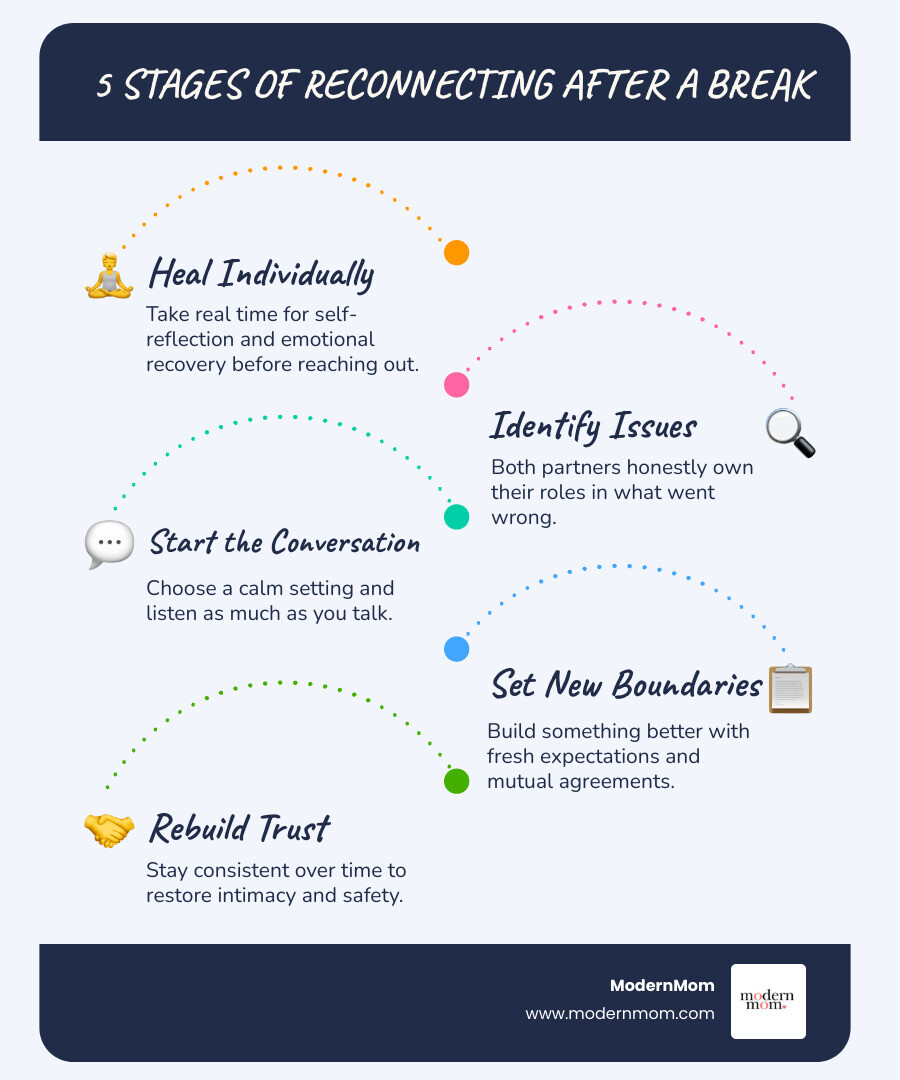
Here’s a quick roadmap for how to reconnect after a relationship break:
- Give yourself real time to heal — don’t rush back before you’ve reflected.
- Understand what went wrong — both partners need to own their part.
- Start the conversation — choose a calm, neutral setting and listen as much as you talk.
- Set new boundaries and expectations — don’t pick up where you left off; build something better.
- Rebuild trust slowly — consistency over time matters more than grand gestures.
- Get support if you need it — a therapist or counselor can make a real difference.
Is It Time to Try Again? Understanding the Break vs. the Breakup

Before we can figure out how to reconnect, we have to be clear about what kind of “break” we’re actually in. In modern dating, there’s a phenomenon called “relationship churning”—that on-again, off-again cycle that many of us experience.
There is a massive difference between a temporary pause and a permanent goodbye. A break is often a strategic “time out” to lower the emotional heat and gain perspective. A breakup, on the other hand, is usually intended to be final.
Research has found that 44% of adults in romantic relationships were able to reconnect with an ex-partner even after things seemed to have ended.
| Feature | Relationship Break | Permanent Breakup |
|---|---|---|
| Intent | To reflect and improve the bond | To end the partnership entirely |
| Communication | Often limited or scheduled check-ins | Generally cut off or “no contact” |
| End Goal | Re-evaluation and potential reunion | Moving on to separate lives |
| Duration | Agreed-upon timeframe (e.g., 3 weeks) | Indefinite |
Deciding if Reconnecting is the Right Choice
So, is it worth another shot? Love is a powerful motivator, but experts point out that love alone isn’t enough to sustain a partnership. The real question is whether both of you can agree on what it looks like to function in a healthy way.
ModernMom often explores the connection between moms And love, and it’s clear that for a relationship to thrive—especially when kids are involved—it needs mutual commitment. If you’re only going back because you’re lonely or afraid of being single, you’re likely to fall right back into the same old patterns.
Reconnecting is the right choice when you both see the break as a catalyst for growth, not just a way to escape the pain of missing each other.
How to Reconnect After a Relationship Break: The Essential First Steps

Reconnection doesn’t start with a text to your ex; it starts with you. This time apart is a gift of space that allows you to “deconstruct” what went wrong. Use this time to focus on individual healing.
If you’re feeling overwhelmed, finding victory over fear is a great place to start your internal work. It’s also crucial to develop coping skills that don’t rely on your partner.
When we’re too dependent on someone else for our happiness, the relationship becomes heavy. By building your own “calm core” through journaling, exercise, or hobbies, you show up to the reconnection phase as a whole person, not just half of a struggling couple.
Setting the Right Timeline for Your Reconnection
How long should a break last? There’s no magic number, but experts suggest anywhere from a few weeks to a few months. A few days usually isn’t enough to change deep-seated habits, while several months might lead to drifting too far apart.
The key is to set ground rules from the start. According to How to Reconnect After a Break: 14 Helpful Tips, setting a clear timeframe prevents the “limbo” that causes so much anxiety.
Decide early on: Will we text? Are we seeing other people? When exactly will we meet to talk? Having these limits in place creates a sense of safety for both partners.
Healing the Heart: Addressing Past Issues and Patterns
When you finally sit down to talk, the goal isn’t to pick up where you left off. The old relationship is gone—and that’s actually a good thing! You are now building a “Relationship 2.0.”
This requires radical accountability. Instead of pointing fingers, focus on your own part in the breakdown. Using “I” statements is a game-changer here. Instead of saying, “You always ignored me,” try, “I felt lonely when we stopped having our evening talks.”
Sometimes, the best example is closer to home: two people who use time apart to reflect, take responsibility, and grow. When both partners do that work, reconnecting can feel less like repeating the past and more like choosing each other with clearer eyes.
Practical Communication: How to Reconnect After a Relationship Break
Communication is the bridge that carries you back to each other. Here are a few expert-backed strategies to use during your first few meetings:
- Active Listening: Don’t just wait for your turn to speak. Summarize what your partner said to ensure you actually understood it.
- Open-Ended Questions: Instead of “Are you still mad?” ask, “What was the hardest part of this month for you?”
- Update Your “Love Maps”: This is a Gottman Institute term for knowing the details of your partner’s inner world. Ask about their new stresses, hopes, and even their current favorite song.
- Respond to “Bids”: A “bid” is any attempt at connection—a touch, a joke, or a comment. Turning toward these bids builds the emotional bank account you’ll need for the future.
Rebuilding Trust and Intimacy for a Stronger Future
Trust isn’t rebuilt with a single apology; it’s rebuilt through a million tiny “micro-moments” of reliability. Research from the Gottman Institute found a striking statistic: couples who stayed together “turned toward” each other’s bids for connection 86% of the time, while those who divorced only did so 33% of the time.
Rebuilding intimacy also means prioritizing quality time. Start small. You don’t need a two-week vacation to reconnect; sometimes a 20-minute phone-free walk or a “gratitude minute” before bed does more for your bond.
These same principles are often seen in healthy parent-child relationships—consistency and emotional presence are the foundations of any strong love.
When to Walk Away: Knowing When Not to Reconnect
As much as we want things to work, sometimes the healthiest choice is to keep walking. If the break revealed that you are much happier and more peaceful alone, listen to that.
Signs it might be time to move on:
- The “Why” hasn’t changed: If the same toxic patterns (like lying or emotional neglect) are still present, a break won’t fix them.
- One-sided effort: If you’re doing all the reflecting while they’re just waiting for things to “go back to normal.”
- Abuse or extreme toxicity: A break cannot fix a fundamental lack of safety.
- Fundamental incompatibility: You realized during the break that your life goals (kids, career, location) are moving in opposite directions.
Frequently Asked Questions
How long should a relationship break last?
While it varies, most experts recommend 3 to 6 weeks. This is long enough to break the immediate cycle of reactivity but short enough to maintain the emotional connection. The most important factor is having an agreed-upon end date so neither person feels abandoned.
Can a relationship really go back to normal after a break?
Actually, you don’t want it to go back to “normal.” Normal is what led to the break in the first place! The goal of how to reconnect after a relationship break is to create a “new normal” that includes better communication, clearer boundaries, and more intentionality.
What are the most common mistakes when reconnecting?
The biggest mistake is “trickle-truthing” (only revealing bits of the truth) or rushing back into physical intimacy before the emotional wounds have healed. Another common pitfall is expecting your partner to have changed completely without doing any of the work yourself.
Conclusion
Reconnecting after a break is a delicate dance, but it can lead to the most resilient version of your relationship yet. It’s about more than just “trying again”—it’s about learning, growing, and choosing each other with eyes wide open.
ModernMom believes that every woman deserves a relationship that feels like a safe harbor. Whether you’re just starting the conversation or you’re deep in the process of How to Make Marriage Work After Separation, remember to be patient with yourself and your partner.
Healing isn’t a straight line, but with honesty and effort, your “back for good” can be the start of your best chapter yet.
The post Back for Good? How to Reconnect After a Breakup appeared first on ModernMom.