
Why Budgeting for Large Families Is a Different Game Entirely
Budgeting for large families is one of the most rewarding — and challenging — financial tasks a parent can take on. With more mouths to feed, more shoes to replace, and more “Mom, can I?” moments than you can count, the stakes are simply higher than for the average household.
Here’s a quick snapshot of what works:
| Priority | Action |
|---|---|
| Track every dollar | Use a budgeting app or worksheet to see exactly where money goes |
| Feed the family for less | Bulk buy, plan meals monthly, and embrace leftovers nights |
| Save first | Set aside 10–20% of each paycheck before spending anything else |
| Plan for the unexpected | Build sinking funds for back-to-school, holidays, and medical costs |
| Involve the kids | Weekly family budget check-ins build accountability and money skills |
| Cut the easy wins | Second-hand clothes, DIY haircuts, and reusable products add up fast |
Nearly 1 in 5 U.S. households have three or more children under 18 — and these families face higher living costs while being less likely to have an emergency fund in place. A family of 7 or more can spend double the national average on groceries alone if spending isn’t actively managed. That’s not a small problem. It’s a big one that deserves a real, practical plan.
The good news? The same core budgeting principles that work for smaller families still apply here. They just need a little more creativity, consistency, and — let’s be honest — patience.
This guide pulls together real strategies from parents who are actually doing it: feeding 10+ people on a managed budget, saving for seven sets of braces, and still finding ways to make room for joy.
Renee Kemper is a business builder and digital strategist with experience navigating the financial complexity that comes with running a household — insight she brings directly to her work helping Modern Mom readers tackle budgeting for large families with confidence. Whether you’re starting from scratch or fine-tuning a system that’s almost working, you’re in the right place.
Learn more about budgeting for large families:
The Unique Financial Landscape of Large Families

When we talk about budgeting for large families, we aren’t just talking about “more of everything.” We’re talking about a completely different financial ecosystem. According to Pew Research, about 20% of U.S. households have three or more children. These families often face a “perfect storm” of high fixed costs and less wiggle room for emergencies.
One of the biggest hurdles is housing. Many rental markets have a bias against large households, or the cost of a 4+ bedroom home is exponentially higher than a standard 2-bedroom. Transportation is another heavy hitter; you aren’t just buying a car; you’re often buying a high-capacity van or SUV that drinks more fuel and costs more to insure.
The Economic Policy Institute’s Family Budget Calculator shows that a modest but adequate lifestyle for a large family requires a significantly higher income than poverty-line measures suggest. For example, a family of 10 might spend $600 a week on groceries even after cutting out treats and buying generic brands.
This is why having a plan is non-negotiable. Without a structured approach, it’s easy to fall into a cycle of “overdraft whack-a-mole.” To get ahead, we need to bridge the emergency fund gap. Most large families struggle to keep a liquid cushion, making them vulnerable to “the car broke down” or “three kids need shoes” moments. For more on staying prepared, check out The Complete Family Emergency Kit Checklist.
For a deeper dive into the mechanics of managing these high-volume expenses, Mastering the Art of Family Budgeting: The Ultimate Guide for Large Families offers excellent perspectives on scaling your finances.
Step-by-Step: Budgeting for Large Families from Scratch

Creating a budget for a household of 6, 8, or 10 people can feel like trying to untangle a giant ball of yarn. The key is to break it down into manageable bites.
- Take an Income Snapshot: Don’t just look at your salary. Look at your “YTD” (year-to-date) on your pay stubs to understand your true annual earning power. Include tax refunds, side hustles, or any government benefits like WIC.
- Identify Fixed vs. Variable Costs: Fixed expenses (mortgage, insurance, car payments) are the easy part. Variable costs (groceries, utilities, “Mom, I need $20 for a field trip”) are where the leaks happen.
- Use Cash Flow Projections: Don’t just look at your bank balance today. Look at what will be there after the mortgage and the water bill come out. This prevents the dreaded mid-month overdraft.
Essential Budget Categories for Big Households:
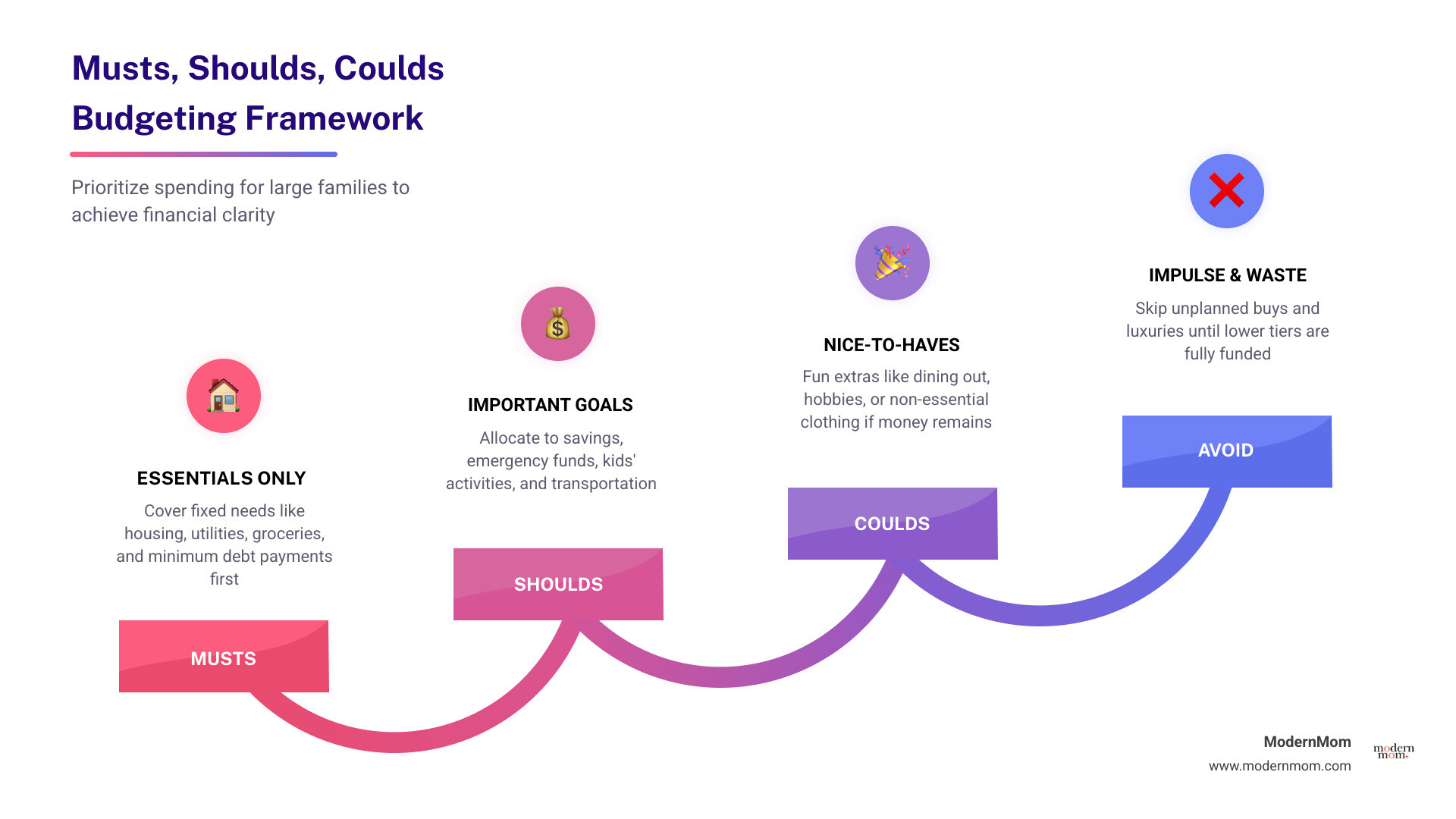
- The “Musts”: Housing, utilities, basic groceries, transportation, insurance.
- The “Shoulds”: Emergency fund contributions, debt payoff, clothing (because kids never stop growing), and medical/dental co-pays.
- The “Coulds”: Extracurriculars, family outings, “kindness” funds (for gifts or spontaneity), and streaming services.
Choosing the Best Method for Budgeting for Large Families
There isn’t a one-size-fits-all method, but some work better for the chaos of a big house:
- Zero-Based Budgeting: Every single dollar gets a job. If you have $5,000 coming in, you assign all $5,000 to categories until there is $0 left. This ensures that “extra” money doesn’t just vanish into thin air.
- The Envelope System: This is great for variable spending. When the “Groceries” cash is gone, you stop buying food until next month. Many modern moms use “digital envelopes” through apps like YNAB (You Need A Budget) or Quicken Simplifi.
- Hybrid Systems: Use automated syncing for your bills but keep a paper calendar on the fridge for meal planning and upcoming school fees. This keeps the “invisible labor” of money management visible to everyone.
Involving the Whole Crew in Budgeting for Large Families
We can’t do this alone. In a large family, everyone needs to be on the team. This is where “Loud Budgeting” comes in. Instead of saying “we’re broke,” we say, “we’re choosing to spend our money on a summer trip instead of takeout this week.”
- Weekly Family Meetings: Spend 15 minutes on Sunday reviewing the week’s expenses. Did we go over on groceries? Does anyone have a birthday party coming up?
- Money Dates: For parents, a monthly “no-shame” money date is vital. Ask: What worked? What felt hard? What’s next?
- Age-Appropriate Tasks: Let the teens help with price comparisons or coupon clipping. It builds their financial literacy and takes a task off your plate. Balancing these roles is part of the journey—learn more in 4 Tips To Balance Family And Career Or At Least Try/.
Slashing the Grocery Bill: Feeding a Crowd for Less
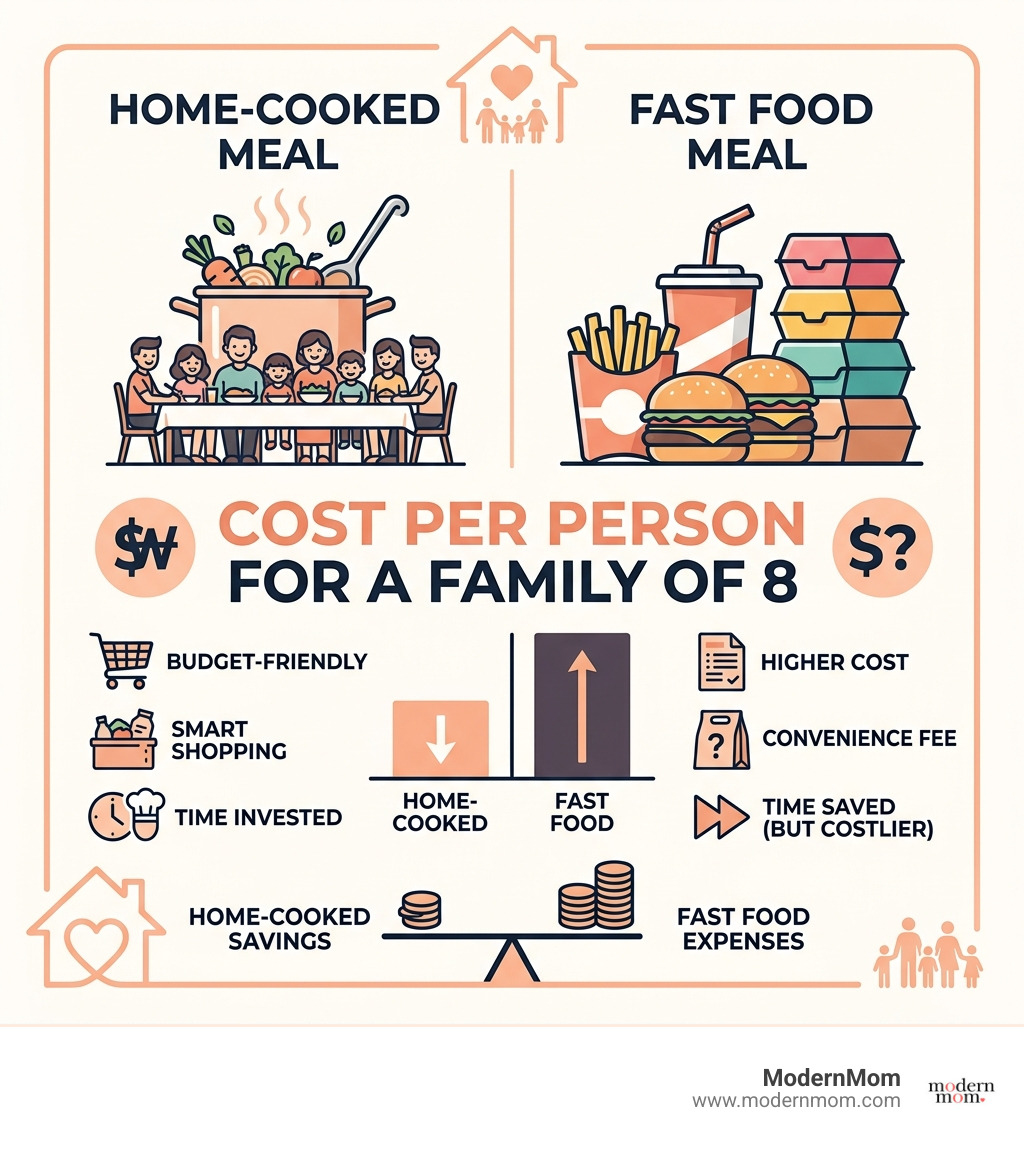
The grocery bill is usually the largest variable expense in budgeting for large families. Some parents of 10 report spending $1,200 to $1,400 a month, which breaks down to about $4 per person, per day. How do they do it?
- Bulk Buying & Wholesale Memberships: Stores like Costco or Sam’s Club are your best friends. Buy shelf-stable items like rice, pasta, and toilet paper in the largest quantities available.
- The Meat Markdown Strategy: Shop early in the morning when stores mark down meat that is nearing its “best by” date. You can often find hams, chickens, or ground beef for 50% off or more. Stick them in the freezer immediately!
- Generic Over Name Brand: For staples like flour, sugar, and canned beans, the generic brand is almost always identical to the name brand but costs 30% less.
- Frozen Over Fresh: Frozen vegetables are picked at peak ripeness and are much cheaper than fresh produce out of season. Plus, they won’t rot in your crisper drawer if you don’t use them by Tuesday.
Strategic Shopping and Meal Planning for Budgeting for Large Families
- Pantry Inventory: Never go to the store without knowing what you already have. “Shop your pantry” first and build your meal plan around those ingredients.
- Leftovers Night: Designate one or two nights a week as “Buffet Night.” It reduces food waste and gives the cook a night off.
- Batch Cooking: If you’re making one lasagna, make three. It takes almost the same amount of time, and you’ll have two “fast food” nights ready in the freezer for a fraction of the cost.
- Store Apps and Digital Coupons: Before you checkout, scan the store’s app. Many moms save $20–$50 per trip just by clicking digital coupons while they walk the aisles.
Beyond the Kitchen: Cutting Costs on Utilities, Clothing, and More
When you have a large family, small savings multiply. If you save $10 on one child’s shoes, that’s $10. If you do it for eight children, that’s $80.
- DIY Haircuts: Learning to use clippers for the boys and doing simple trims for the girls can save a family of six upwards of $60 to $100 a month.
- The Hand-Me-Down System: Use a “dot system” to organize clothes. One dot on the tag for the oldest, two for the second, and so on. This makes it easy to see who a garment belongs to and who it goes to next.
- Minimalist Wardrobes: Kids don’t need 20 outfits. Aim for a set number (e.g., 5 play outfits, 2 church outfits, 2 PJs). It reduces laundry and shopping stress.
- Utility Efficiency: Install a smart thermostat and low-flow showerheads. In a house where the shower might run for two hours straight across eight people, those low-flow fixtures pay for themselves in a single month.
- Reusable Products: Switch from paper napkins to cloth and from disposable water bottles to high-quality reusable ones. It’s better for the planet and your wallet.
Building a Secure Future: Savings, Debt, and Seasonal Planning
It’s easy to feel like you’ll never save money when you’re budgeting for large families, but consistency is more important than the amount.
- Sinking Funds: These are your secret weapon. Take annual expenses—like $600 for back-to-school or $1,200 for Christmas—and divide them by 12. Set aside that amount every month. When August or December rolls around, the money is already there.
- Automated Investing: Even $25 a paycheck into a 529 college savings plan or an IRA adds up over 18 years. Treat these transfers like a “bill” that must be paid.
- The Debt Snowball: If you have debt, list it smallest to largest. Pay off the smallest one first to get a “win,” then roll that payment into the next one.
- Holiday Gift Budgets: Many large families use the “Want, Need, Wear, Read” rule (four gifts per child) or set a strict per-child limit (like $250) to keep Christmas from becoming a financial hangover.
Frequently Asked Questions about Budgeting for Large Families
How do parents of 10+ kids make it work?
It comes down to “Grace Math” and extreme resourcefulness. They rely heavily on community wisdom—sharing tips with other large-family moms. They often buy meat by the half-cow, accept hand-me-downs with gratitude, and focus on hospitality (home-cooked meals) rather than expensive outings. They also tend to be masters of “Loud Budgeting,” being very transparent with their kids about financial choices.
How often should we adjust our family budget?
At a minimum, you should do a quick check-in every week and a deep dive every month. Large families have “seasons”—growth spurts might mean a high clothing budget one month, while a school term might increase your fuel and activity fees. Flexibility is key; a rigid budget will break, but a flexible one will bend with your life.
What are the most common budgeting mistakes big families make?
The biggest mistake is ignoring sinking funds. When you have many children, “surprises” like a broken tooth or a lost coat are actually predictable. Another mistake is neglecting self-care in the budget. If the parents are burnt out, the whole system collapses. Finally, a lack of automation leads to missed bills and late fees, which are just “stupid tax” that large families can’t afford to pay.
Conclusion
Budgeting for large families isn’t about deprivation; it’s about intention. It’s about making sure that your hard-earned money is going toward the things that actually matter to your crew—whether that’s a stable home, healthy food, or a much-needed family vacation.
At ModernMom, we know that managing a large household is a full-time job in itself. By implementing these hacks, you’re not just saving pennies; you’re buying yourself peace of mind and teaching your children invaluable life skills. You don’t have to be perfect; you just have to be intentional.
Ready to take the next step in your financial journey? More info about money services can help you find the tools and community support you need to thrive. You’ve got this, Mom!
The post Large Family Budgeting Hacks for Busy Parents appeared first on ModernMom.