
When Tidying Up Leaves You More Exhausted Than Before
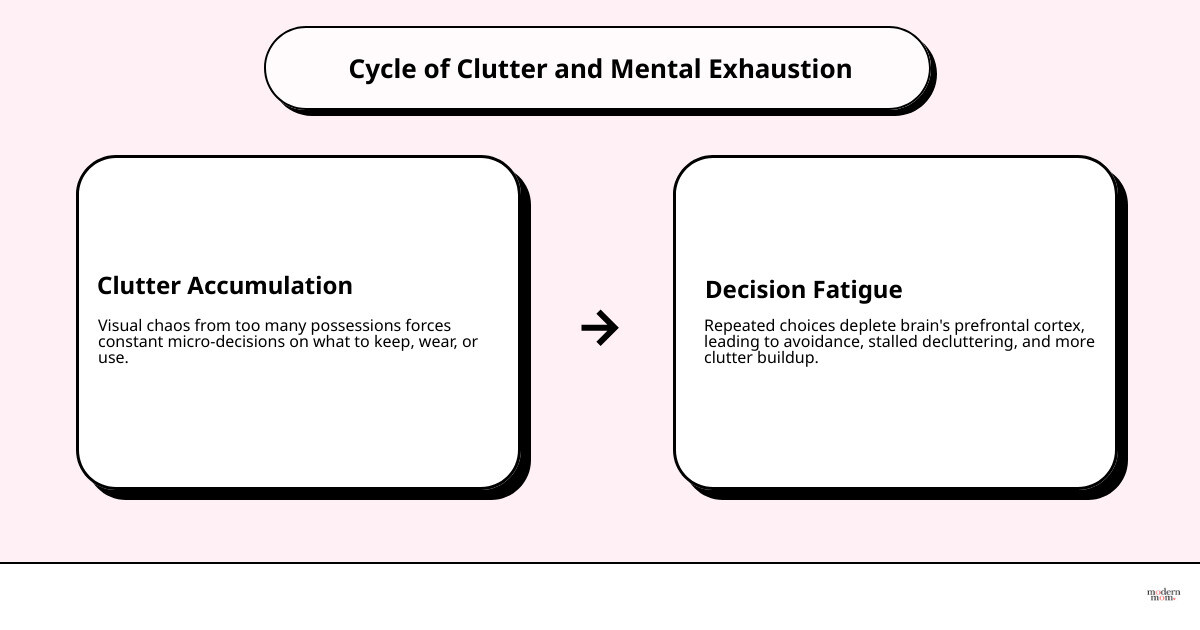
Decluttering decision fatigue is the mental exhaustion that hits when you’ve made too many keep-or-toss choices in one sitting — and it’s the real reason most decluttering sessions stall before anything actually gets done.
Here’s a quick breakdown of what it is and how to beat it:
- What it is: Your brain’s decision-making capacity wears out after repeated choices, just like a muscle after too many reps
- Why decluttering triggers it: Every single item requires a judgment call — keep, donate, toss, or store — and those micro-decisions add up fast
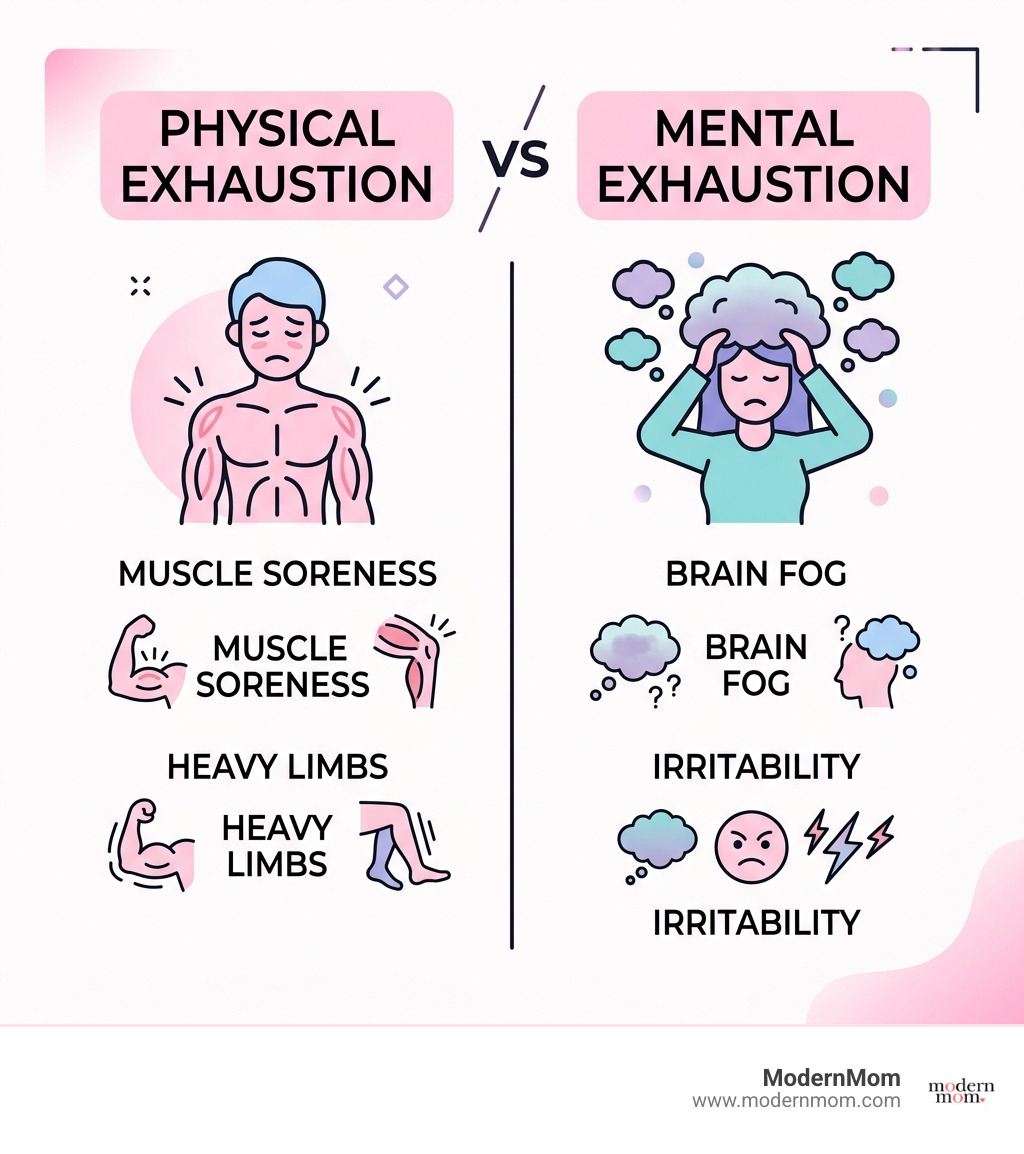
- Common signs: Brain fog, irritability, “I’ll deal with it later” piles, and the urge to quit after 10 minutes
- How to fix it: Short timed sessions (15 minutes), numerical limits per category, pre-set decision rules, and saving sentimental items for last
Sound familiar? You start with the best intentions — maybe it’s a Saturday morning, coffee in hand, closet doors open wide. Twenty minutes later, you’re sitting on the floor surrounded by stuff, paralyzed, putting everything back where it was. That’s not laziness. That’s your brain hitting a wall.
Research backs this up. A well-known study on judicial decisions found that judges were significantly more likely to grant parole early in the day than later — not because the cases changed, but because their decision-making capacity depleted over time. Your closet is doing the same thing to you.
The good news? There are simple, practical strategies that work with your brain instead of against it — and you don’t need a full weekend or a professional organizer to use them.
Decluttering hacks basics:
Why Decluttering Decision Fatigue Hits So Hard
Have you ever wondered why you can manage a high-stakes meeting at work but fall apart trying to decide which of your 15 spatulas to keep? It’s because decluttering isn’t just physical labor; it’s a high-intensity workout for your prefrontal cortex. This part of the brain handles complex tasks like planning and judgment. When we declutter, we ask this “CEO” of our brain to make hundreds of micro-decisions in a row.
Eventually, the CEO goes on strike. This is often referred to as an “amygdala hijack.” When the thinking part of your brain gets too tired, the emotional part—the amygdala—takes over. It starts treating the stress of choosing between two pairs of jeans as a physical threat. This triggers a fight, flight, or freeze response. Most of us “freeze” (staring blankly at the pile) or “flee” (leaving the room to scroll on our phones).
According to The Overwhelm is Real: Understanding and Overcoming Decision Fatigue, this mental burnout is a normal neurological response. It’s not a lack of willpower; it’s a biological limit. Think of your decision-making energy like a phone battery. Every “yes,” “no,” or “maybe” drains a percentage of that charge.
Choice overload is a very real phenomenon. In a famous 2011 study involving jam, researchers found that consumers were much more likely to make a purchase when offered only 6 types of jam compared to 24. Too many options lead to “decision avoidance.” When we look at a cluttered shelf, our brain sees 24 types of jam and simply shuts down.
The Science of Choice Overload
We often hear the “fact” that the average person makes 35,000 decisions every day. While that number is widely cited in productivity circles, researchers note it’s more of a popular myth than a measured statistic. However, even if the number is lower, the weight of those decisions matters.
The Pareto Principle, or the 80/20 rule, is a great way to look at our belongings. Studies often suggest that women wear about 20% of their wardrobe 80% of the time. This means 80% of your closet is essentially “noise” that creates a constant cognitive load. Every time you open that door, your brain has to filter through the 80% you don’t use to find the 20% you do. That filtering process alone is a drain on your energy before your day has even begun.
Signs You’ve Hit the Wall
How do you know if you’re actually tired or just experiencing decluttering decision fatigue? The symptoms are subtle but distinct. You might start with high energy, but an hour in, you find yourself second-guessing decisions you made ten minutes ago.
Common signs include:
- Brain Fog: Feeling like you can’t think clearly or process what you’re looking at.
- Irritability: Snapping at your kids or partner because they asked a simple question while you were “in the zone.”
- Analysis Paralysis: Holding an old receipt for five minutes, unable to decide if it’s “important.”
- Procrastination: Suddenly feeling the urge to go wash the dishes or check email instead of finishing the drawer you started.
As noted in Decluttering Fatigue: Why Half-Finished Piles, Stalled Drawers, and Mental Exhaustion Keep Showing Up, these half-finished piles are often the result of “decision density.” If you try to tackle a junk drawer filled with tiny, unrelated items, the number of decisions per square inch is much higher than if you were decluttering large furniture.
5 Strategies to Conquer the Mental Drain
To beat the drain, we have to stop relying on raw motivation and start using systems. Systems act as “pre-decisions,” doing the heavy lifting so your brain doesn’t have to.
The 15-Minute Miracle for Decluttering Decision Fatigue
The most effective way to protect your mental energy is to use the 15-minute rule. Long, marathon decluttering sessions are almost guaranteed to lead to poor choices. One professional organizer shared a story of a client who, after six hours of decluttering, nearly threw away a box of irreplaceable family heirlooms simply because she was too tired to care anymore.
By setting a timer for just 15 minutes, you create a “sprint” environment. You know there is an end in sight, which prevents the brain from entering that “overwhelmed” state. These micro-sessions build “decision-making muscle” through small, consistent wins. When the timer goes off, you stop—even if you feel like you could do more. This preserves your energy for tomorrow.
Using Numerical Limits to Simplify Choices
Numerical limits are the ultimate “decision filter.” Instead of asking “Do I want to keep this?” for every single item, you set a rule beforehand. This is the core of strategies mentioned in this article about Decision Fatigue and Decluttering.
Some effective rules include:
- The 10-Item Rule: Pick a category (like coffee mugs or white t-shirts) and decide you will only keep 10. You aren’t deciding what to toss; you’re selecting your “top 10” favorites. The rest automatically go.
- Project 333: This famous minimalist challenge involves choosing only 33 items of clothing to wear for three months. It eliminates the “what should I wear” struggle every morning.
- The One-In, One-Out Rule: For every new item that enters your home, one must leave. This keeps your “inventory” at a manageable level without requiring a massive decluttering day.
- The 30-Book Rule: Limit your bookshelf to 30 books (or whatever fits comfortably in a single row). No double-stacking!
Advanced Tactics to Minimize Mental Load
Once you’ve mastered the basics, you can use advanced psychological tricks to make the process even smoother. One of our favorites is “Inside-Out Decluttering,” a method highlighted by Method Seattle in Decluttering Your Decision Fatigue.
Instead of pulling everything out of a closet and sorting through the mess (which creates massive visual noise and immediate fatigue), you do the opposite. You reach in and pull out only the things you know you love and use. Everything left in the closet is then treated as a single decision: “Do I really need to go through this, or can it all be donated?”
Pre-defined Filters: The Secret to Decluttering Decision Fatigue
A decision filter is a lens you apply to everything you touch. You decide the criteria before you start. For example, if you are decluttering your kids’ old school papers, your filter might be: “I will only keep items with original artwork or a personal note from a teacher.”
This turns a complex judgment call into a simple “Yes/No” check. Other great filters include:
- The “Buy it Again” Test: If I saw this in a store today, would I pay full price for it?
- The “Meaningful Inscription” Rule: For cards and letters, keep only those with a handwritten message that moves you.
- The “One Year” Rule: Have I used this in the last 12 months?
The Box of Clarity and Category Countdown
If you’re stuck on “maybe” items, use the Box of Clarity (also known as the Quarantine Method). Put all those “I might need this someday” items into a box, tape it shut, and write a date three months from now on the side. If you don’t open that box by that date, you can safely donate it without looking inside. This removes the immediate fear of making a “wrong” decision.
The Category Countdown (popularized by the KonMari method) also helps. By gathering every single item of one category—say, all the pens in the entire house—you can see the true volume of what you own. It’s much easier to decide to keep only five pens when you’re looking at a pile of fifty.
Practical Tips for Sustainable Progress
Managing your environment is just as important as managing your mind. Visual noise—the “clutter” our eyes see even when we aren’t actively decluttering—acts like 50 open tabs on a computer browser. It’s constantly draining your battery in the background.
Protecting Your Energy Reserves
To keep your decision-making battery full, try these tips:
- Declutter in the Morning: Your prefrontal cortex is freshest after sleep. Tackle the hardest categories first thing.
- Reduce External Decisions: On days you plan to declutter, simplify the rest of your life. Wear a “uniform” (like leggings and a favorite tee), eat the same lunch you had yesterday, and don’t try to solve big life problems.
- The CEO Uniform: Many successful CEOs wear the same outfit every day to save their mental energy for business. We can do the same during a “decluttering season.”
- Sleep Hygiene: Decision fatigue is significantly worse when you’re sleep-deprived. If you had a rough night with the kids, skip the decluttering today.
Managing Sentimental Items and Shared Spaces
Sentimental items are the “boss level” of decluttering. They are high-emotion and high-decision-cost. Always save these for last. You need to build up your “decision muscles” on easy things like expired spices and old socks before you tackle your grandmother’s china.
For items you can’t bear to toss but don’t have room to display, try a Sentimental Showcase. Choose your absolute favorite 5-10 items and create a beautiful display. For the rest, consider a “Digital Album.” Take a high-quality photo of the item, and then let the physical object go. The memory is in the photo, not the dust-collecting box in the attic.
In shared spaces, use the “Notice and Do” rule. Encourage family members to handle a “pile” as soon as they notice it. This prevents the “invisible labor” from falling entirely on you.
Frequently Asked Questions about Decluttering Decision Fatigue
Where is the best place to start when I’m overwhelmed?
When decluttering decision fatigue is already setting in, go for the “easy wins.”
- Bathroom Cabinets: Decisions here are mostly objective. Is it expired? Toss it. Do I use this specific hairspray? No? Toss it.
- Junk Drawers: These are high-impact. Clearing one drawer gives you an immediate boost of “I can do this!”
- Kitchen Counters: Clearing flat surfaces provides instant visual relief, which lowers your overall stress levels.
How do I handle sentimental items without spiraling?
Limit yourself to a specific container, like one “memory box” per child. If the box is full, something has to come out before something new goes in. This forces you to prioritize the best memories rather than all the memories. Also, recognize your emotional capacity. If you start crying or feeling a deep sense of dread, stop. Your brain is telling you it’s had enough for today.
What if my family is the source of the clutter?
This is a common struggle for moms! Start by modeling the behavior. When they see you enjoying a clearer, calmer space, they may be more inclined to join in. Designate “personal zones” where family members are responsible for their own stuff. If items are left in “common zones,” use a “holding basket.” At the end of the week, anything still in the basket gets put away by the owner—or it might “disappear” to a donation center.
Conclusion
At ModernMom, we know that your home should be your sanctuary, not another source of stress. Decluttering decision fatigue is a hurdle, but it’s one you can jump over with the right tools. By shifting from “marathon cleaning” to “strategic sprints,” you protect your mental energy and make room for what truly matters: time with your family and peace of mind.
Decluttering is a journey, not a destination. It’s okay to take it one drawer, one 15-minute timer, and one “top 10” list at a time. You are building sustainable habits that will serve you for years to come.
Want more quick wins for a tidier home? Check out our guide on 5 things to tidy up while your morning coffee is getting ready to start your day with a sense of accomplishment!
The post Decluttering Without Draining: How to Avoid Decision Fatigue appeared first on ModernMom.