
Can You Really Have Straight A’s and a Social Life?
Balancing straight A grades while keeping friendships, hobbies, and a good night’s sleep intact is one of the biggest challenges students — and their parents — face today.
Here’s the quick answer:
- Yes, it’s possible — but only when grades are pursued smartly, not obsessively
- Time management matters more than total hours studied
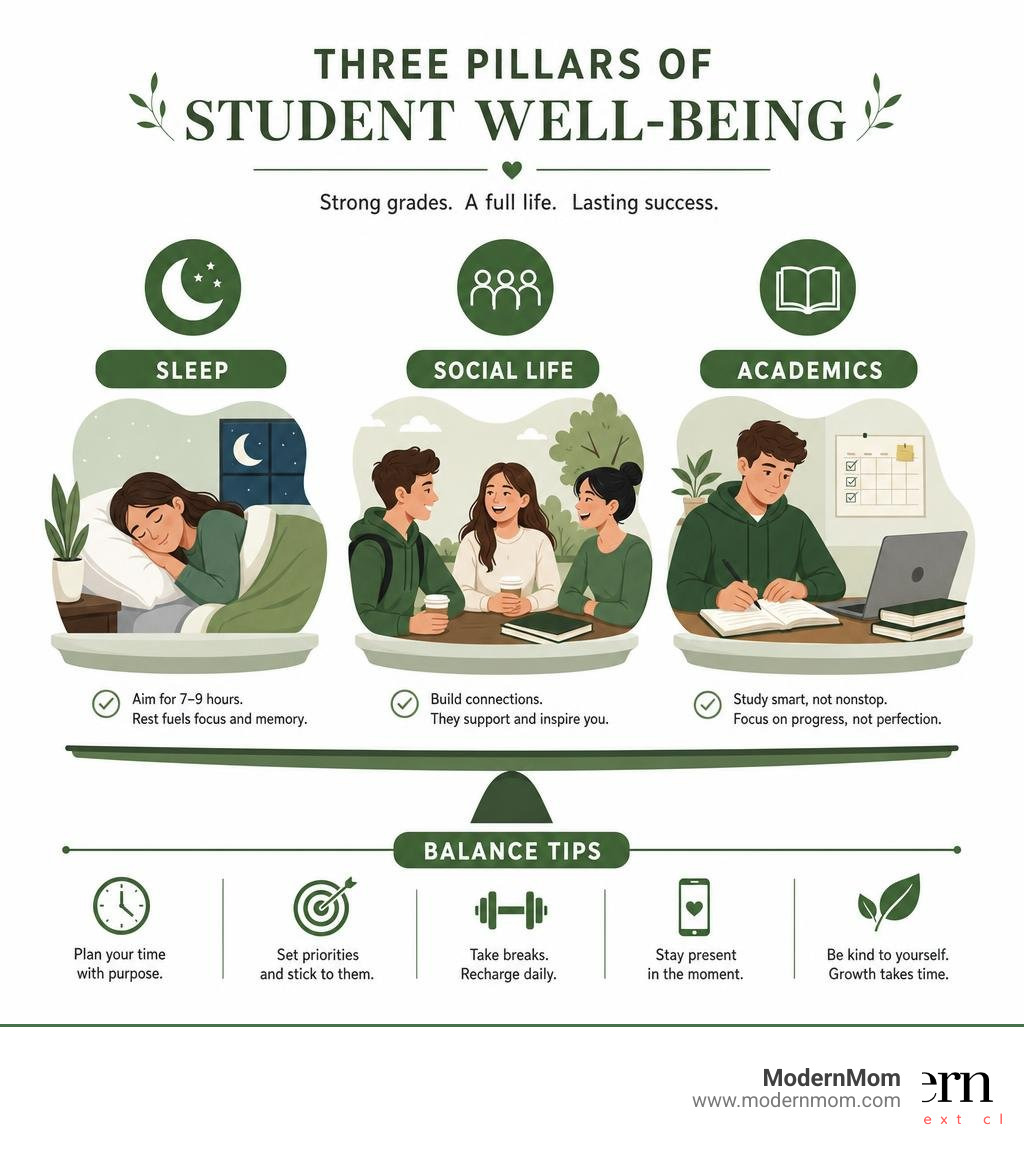
- Sleep and social connection aren’t sacrifices — they’re part of what makes high performance sustainable
- Perfectionism is the enemy of both good grades and a good life
- The goal is balance, not a flawless transcript at the cost of everything else
The pressure is real. Students today are juggling demanding coursework, extracurriculars, part-time jobs, and social lives — all while feeling like every grade could make or break their future. And research backs this up: students who chase straight A’s report 40% less time for creative pursuits and passions, and are significantly more likely to experience burnout and anxiety.
But here’s the thing — it doesn’t have to be that way.
This guide is for every mom watching her kid study until midnight and wondering if there’s a better path. There is.
More articles on getting better grades:
The Hidden Costs of Academic Perfectionism

As moms, we naturally want our kids to do their best. We cheer at report card time and celebrate those hard-earned letters. But when the pursuit of perfection turns into an all-consuming obsession, we need to take a step back and look at the hidden costs.
Striving for flawless grades often breeds perfectionism, anxiety, and depression. When our kids tie their entire worth to a number on a screen, any minor setback feels like a catastrophe. In fact, students who earn straight A’s in high school are three times more likely to experience burnout and anxiety in college compared to those with a mix of grades.
In her podcast episode The Problem with Straight A’s, life coach Jody Moore highlights how this mindset fosters all-or-nothing thinking. When kids feel they must get an A in everything, they stop taking healthy intellectual risks. They choose the easy route just to protect their GPA, which can quietly work against their long-term growth and fulfillment.
Furthermore, as discussed in this Opinion: Is Earning Straight-A’s Always Good? article, the intense pressure to maintain a perfect record can leave students emotionally, mentally, and physically drained. It’s a heavy burden to carry, and it often comes at the expense of their youth.
The Opportunity Costs of a Perfect 4.0 GPA
When a teenager spends every waking hour memorizing flashcards, what are they giving up? The opportunity costs are massive. True creativity, deep personal passion, and self-motivation often get pushed aside to make room for school compliance.
To understand what we are sacrificing, we first have to ask: What GPA Is Straight A? Historically, it’s a perfect 4.0, representing an A in every single class. But chasing this arbitrary number can actually destroy a child’s natural love of learning.
Interestingly, studies on alternative education methods like unschooling and self-directed learning show that students who avoid traditional grading systems entirely have 30% higher college graduation rates. They also display much stronger self-motivation skills. Why? Because they learned to pursue knowledge out of genuine curiosity, rather than a hunger for external rewards.
Understanding the Psychological Toll of GPA Addiction
When a student becomes addicted to the validation of a 4.0, their self-esteem becomes incredibly fragile. They begin to view themselves not as human beings, but as academic machines.
The psychological risks are very real. Research indicates that straight-A students are 2.5 times more likely to develop perfectionism-related mental health issues, such as depression or bipolar disorder, later in life. As outlined in this deep-dive on the Dangers of being a Straight A student, traditional schooling can condition kids to prioritize short-term rewards over meaningful, self-directed goals.
This anxiety-driven perfectionism creates adults who are terrified of failure. If they don’t have a clear rubric or a teacher telling them exactly how to get an “A” in life, they freeze. We don’t want to raise kids who are excellent at following instructions but completely lost when it comes to navigating the real world.
The Art of Balancing Straight A Grades Without Burning Out

So, how do we help our kids achieve academic success without sacrificing their mental and physical health? The secret lies in balancing straight A grades through smart systems, not sheer force of will.
We want to teach our kids to work smarter, not longer. By developing good study habits, our teens can master their academic workload while still keeping their social lives alive.
According to experts at CollegeVine in their guide on How to Get Straight A’s in High School, the key is selecting a balanced schedule. Taking five AP classes alongside heavy extracurriculars is a recipe for disaster. It is far better to mix challenging courses with areas of personal strength, giving the brain room to breathe.
Practical Time Management for Balancing Straight A Grades
Time management isn’t about filling every second of the day with work; it’s about using the time you have efficiently. One of the best tools we can teach our kids is the Pomodoro technique: studying with intense focus for 25 minutes, followed by a 5-minute break to stretch, grab a snack, or check their phone.
Using a physical or digital planner is also non-negotiable. When students map out their week, they can spot “time pockets”—like a 30-minute study hall or a car ride—to knock out quick homework assignments. This keeps their evenings free for family dinners and friends.
Here is a quick look at how changing study styles can save hours of stress:
| Study Strategy | How It Works | Impact on Free Time |
|---|---|---|
| Cramming | Pulling an all-nighter right before the exam | High stress, ruins sleep, poor long-term retention |
| Spaced Repetition | Reviewing notes for 15 minutes a day over a week | Low stress, preserves sleep, frees up weekends |
By understanding their personal procrastination triggers—which are usually rooted in a fear of failing or feeling overwhelmed—students can break big projects into bite-sized steps and get started early.
Smart Study Habits Over Endless Cramming
To protect their free time, students need to move away from passive reading and embrace active learning. Sitting with a highlighter and reading a textbook three times is incredibly inefficient.
Instead, encourage your teen to use the Cornell note-taking method (writing questions on the left and summaries on the back) or try peer teaching. If they can explain a concept to you in simple terms, they truly understand it.
This active approach is also the secret to test prep. For example, learning how to study for the SATs isn’t about memorizing every math rule; it’s about taking timed practice tests, analyzing mistakes, and adjusting. Forming small, focused study groups can also keep students accountable while making the process feel a lot less lonely.
Redefining Success Beyond the Report Card
As parents, we need to ask ourselves: what is the ultimate goal of education? Is it to produce a valedictorian, or is it to raise a happy, capable adult who can navigate the complexities of life?
Interestingly, only 20% of valedictorians and National Merit Scholars go on to achieve top-tier success in their careers compared to those with more balanced academic records. The real world doesn’t care about a perfect GPA; it cares about what you can do and how you treat people.
Sometimes, the best thing a student can do after high school isn’t rushing straight into an Ivy League pressure cooker. Something we need to discuss: should kids take a gap year before college? Taking a year to work, travel, or volunteer can build a level of maturity, independence, and self-motivation that no classroom can ever teach.
Why Soft Skills Matter More Than Perfect Marks
In today’s workforce, “soft skills” are the ultimate currency. Employers are looking for leadership, clear communication, problem-solving, and adaptability. These are qualities that cannot be measured by a multiple-choice test.
When we engage in helicopter parenting—stepping in to solve every conflict, dispute a grade, or manage our child’s schedule—we rob them of the chance to develop failure recovery skills. B students often make incredible leaders because they have learned how to collaborate, delegate, and bounce back from a disappointing result. They know they aren’t the smartest person in the room, so they learn how to work beautifully with others.
How Parents Can Support Teens in Balancing Straight A Grades
We have a massive role to play in lowering the temperature at home. We can start by setting healthy homework boundaries and establishing that our love and pride are completely independent of their report card.
Try changing the conversation. Instead of asking “What did you get on the math test?”, try asking:
- “What was the most interesting thing you learned today?”
- “How did you help a friend today?”
- “What is something you struggled with, and how did you handle it?”
Prioritize family time, protect family dinners, and show them that downtime is not wasted time—it is essential recovery time.
Real-Life Strategies for a Well-Rounded Student Life
A truly successful student life is a well-rounded one. Our kids should have memories of high school and college that involve laughter, school football games, and late-night talks with friends—not just the glow of a computer screen.
For older students, balancing a job can actually teach incredible life skills. If they are looking to earn their own money, checking out our Step-by-Step Guide to Finding College Jobs can help them find flexible roles that respect their academic schedule.
Making Room for Extracurricular Passions and Social Connections
Creative pursuits, sports, and friendships are not distractions from schoolwork; they are the fuel that keeps students motivated. When kids have an outlet they love, they return to their studies with clearer, more focused minds.
As your teen navigates the college prep years, keep things in perspective. Use resources like Ace Your Senior Year: The Ultimate College Application Playbook to help them present their authentic, well-rounded selves to admissions officers. Colleges want to see unique passions and genuine community involvement, not a robotic student with a 4.0 and zero personality.
Prioritizing Sleep and Mental Well-Being
Let’s make a family rule: sleep is sacred. Chronic sleep deprivation is a mental health crisis disguised as academic dedication.
Teens need 8 to 10 hours of sleep per night for their brains to consolidate what they learned during the day. Encourage a solid bedtime routine that includes turning off screens at least thirty minutes before bed. When a child is well-rested, their memory, focus, and mood improve dramatically, making schoolwork take half the time.
Frequently Asked Questions about Academic Balance
Is it possible to get straight A’s and still get 8 hours of sleep?
Absolutely. The students who achieve this are those who study actively, use smart time-management tools like the Pomodoro technique, and avoid the trap of perfectionism. They treat sleep as a non-negotiable part of their academic strategy.
How do colleges view a student with a few B’s in advanced classes?
Colleges consistently report that they would rather see a student challenge themselves with rigorous AP or Honors classes and earn a B than take “easy” classes just to maintain a perfect 4.0. They value academic curiosity and resilience over safety.
What are the signs that my child is suffering from GPA addiction?
Watch out for physical signs of chronic stress, like frequent headaches, stomach issues, or changes in sleep patterns. If your child weeps over a 95%, refuses to participate in family activities because they “must study,” or isolates themselves from friends, it’s time to step in and help them find balance.
Conclusion
At ModernMom, we believe that raising successful kids means raising whole, happy, and resilient human beings. Academic success is a wonderful goal, but it should never come at the cost of a child’s mental health, self-esteem, or joy.
Let’s teach our kids the power of self-compassion. Let’s show them that mistakes are just data, and that a “B” is simply a signpost on the road of learning, not a definition of their worth. You’ve got this, Mama, and so do they.
For more supportive tips and tools to guide your family through these high-pressure years, explore our Modern Mom College Planning Resources today.
The post Can You Have Straight A’s and a Social Life? Yes, Here’s How appeared first on ModernMom.