
From Chaos to Calm in Minutes
Decluttering hacks can transform your home and your headspace—without taking all day. If you’re a busy mom drowning in stuff, you’re not alone. Clutter has a sneaky way of piling up, making even simple tasks feel overwhelming. But the good news? You don’t need a weekend-long purge to see results.
Quick Decluttering Hacks That Work:
- The 4-Box Method – Sort items into Keep, Donate, Relocate, or Trash
- The One-Minute Rule – If it takes less than 60 seconds, do it now
- The Hanger Trick – Reverse hangers to identify unworn clothes
- The 5-Things Method – Pick up five misplaced items and put them away
- Drop Baskets – Use bins to corral clutter and sort later
- Clear One Surface – Start with a single counter or table for instant calm
- The 20/20 Rule – Let go of items you can replace in 20 minutes for under $20
Studies show that clutter isn’t just messy—it’s mentally draining. When you’re surrounded by unfinished tasks and visual reminders, it saps your energy and focus. But decluttering doesn’t have to mean becoming a minimalist or spending hours reorganizing. It’s about creating systems that work for your family and your life.
At Modern Mom, we know you’re juggling a million things. That’s why these hacks are designed to fit into your real, busy life—whether you have 5 minutes or an hour. Experts agree that small, consistent efforts build momentum and lead to lasting change. The key is starting small and celebrating every win, no matter how tiny.
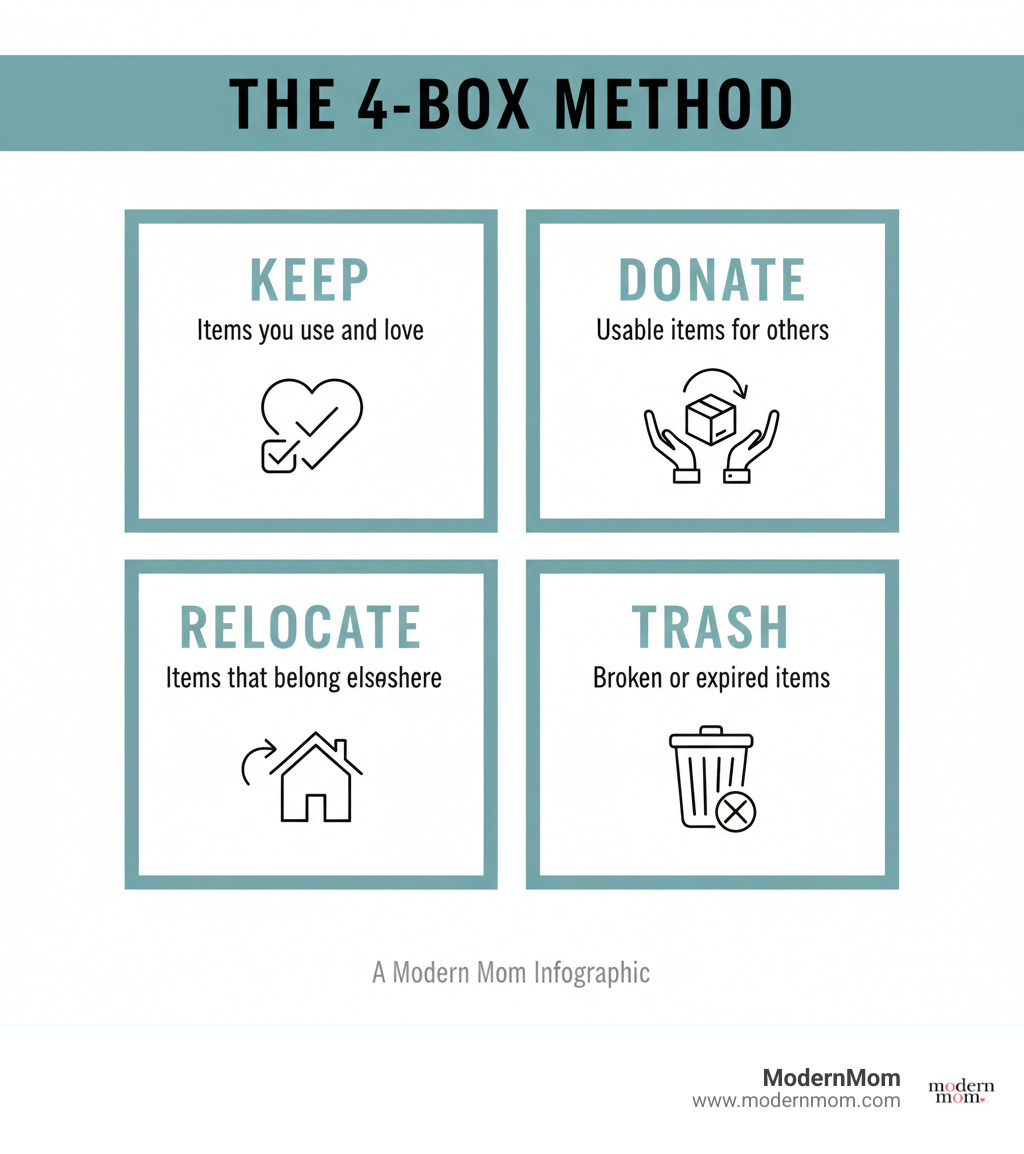
Ready to reclaim your space? The sections ahead will walk you through mindset shifts, room-by-room strategies, and family-friendly tips to make decluttering simple, sustainable, and even a little fun.
Quick Decluttering Hacks:
The Mindset Shift: Decluttering Starts in Your Head
Here’s the truth: the hardest part of decluttering isn’t sorting through your stuff—it’s getting your head in the right place first. Before you grab a single donation box, let’s talk about the mental shifts that make everything else easier. Because when you change how you think about your belongings, the actual letting-go part becomes so much simpler.

Change Your Perspective on “Just in Case” Items
You know those things you’re holding onto “just in case”? The bread maker from your wedding registry. The jeans that might fit again someday. The craft supplies for a project you swear you’ll start. We all have them.
It’s completely normal to feel this way. Studies show that the fear of loss is a powerful motivator—our brains are wired to feel the pain of giving something up more strongly than the joy of having a clear space. But here’s the thing: planning ahead can help you let go with confidence.
Try the 20/20 Rule: If you can replace something in 20 minutes for under $20, it’s safe to let it go. This simple guideline takes the emotion out of the equation. Ask yourself the 5-Year Question too: “In five years, will I be glad this is still taking up space in my home?” It’s surprisingly clarifying.
Every item you own costs you something—not just money, but time spent cleaning it, searching for it, or stressing about it. There’s also opportunity cost: what else could you do with that space and mental energy? If you ever needed that “just in case” item again, you could borrow it from a friend, rent one, or simply use an alternative. Focusing on solutions makes letting go feel less scary.
Reframe Clutter as “Inventory”
Let’s get one thing straight: clutter isn’t a moral failing. It doesn’t mean you’re lazy, messy, or bad at adulting. It just means you have more inventory than you can comfortably manage.
Think about it this way: the average household owns over 300,000 items. That’s not a typo. With that much stuff, it’s no wonder our mental bandwidth gets stretched thin. When you reframe clutter as “inventory”—just like a store tracking its stock—it becomes a practical problem with a practical solution. You simply need to reduce what’s on your shelves.
This mindset shift takes away the shame and replaces it with clarity. You’re not a “messy person”—you’re someone managing a very large inventory in a limited space. And that? That’s totally fixable. Letting go of things you don’t use frees up both physical space and mental energy for what matters most.
The Secret Hack: Do More of What Matters
Here’s a decluttering hack nobody talks about: the best way to care less about your stuff is to care more about your life. When you’re busy doing things that light you up—spending time with your family, pursuing hobbies, enjoying experiences—your attachment to material things naturally loosens.
Focus on experiences, not just possessions. A night playing board games with your kids. A coffee date with a friend. Finally starting that book you’ve been meaning to read. Creating space for family time, hobbies, and rest brings more joy than any “just in case” item ever could.
Sometimes clutter accumulates when we’re feeling stuck, unfulfilled, or disconnected. Shopping and acquiring become a way to fill an emotional gap. But when you fill that gap with meaningful experiences instead, the urge to hold onto (or buy) more stuff fades. You’re not just removing clutter—you’re making room for the life you actually want to live.
That shift in focus? It’s what makes decluttering hacks stick for the long haul.
Quick Wins: 15-Minute Decluttering Hacks for Busy Moms
Let’s be honest—finding hours to declutter just isn’t happening. Between school drop-offs, work deadlines, and everything in between, you need decluttering hacks that fit into the tiny pockets of time you actually have. The beauty of these quick wins? They take 15 minutes or less, deliver instant results, and build the momentum you need to keep going. Sometimes the hardest part is simply starting, so these micro-actions are designed to get you moving without the overwhelm.
Start with the Obvious: Trash and “Home-less” Items
The fastest way to see progress? Start with the no-brainers. These decluttering hacks require almost zero decision-making, which means you won’t get stuck in analysis paralysis. Plus, the visual change happens quickly, giving you that satisfying instant gratification that makes you want to keep going.
Try the 5-Things Method first. Walk into any room and pick up just five items that don’t belong there. Put them back where they go. That’s it. This narrow focus prevents you from feeling overwhelmed and shows you how quickly small actions create real change.
Next, grab a trash bag and do a quick “trash walk” through your main living areas. Toss obvious garbage, expired pantry items, old magazines, broken toys—anything that’s clearly past its prime. You’ll be amazed at how much lighter your space feels after just one lap around the house.
Keep a donation bin by the door to make letting go effortless. Place a designated box or bag near an exit and add items as you find them—outgrown clothes, duplicate kitchen gadgets, toys your kids have lost interest in. When it’s full, put it straight in your car so it actually makes it to the donation center. Pro tip: Use black trash bags for items you’re on the fence about to prevent second-guessing.
For items that belong in another room but you don’t have time to deal with right now, use drop baskets. Place one in a central spot and toss in misplaced items as you find them. When the basket fills up, take a few minutes to redistribute everything to its proper home. This prevents clutter from migrating and taking over your space.
Finally, accept the One-Minute Rule: If something takes less than 60 seconds, do it immediately. Hanging up your coat, putting away a dish, wiping up a spill—these tiny tasks prevent small messes from becoming big piles. It’s a simple habit that keeps everyday clutter from gaining a foothold.
The Hanger Trick for a Clutter-Free Closet
Your closet is probably hiding clothes you haven’t worn in months (or years). The Hanger Trick is a genius, low-effort way to identify those forgotten garments without forcing yourself to make tough decisions all at once.
Here’s how it works: Reverse all your hangers at the start of a new season—just turn them backward on the rod. Each time you wear something, return it to the closet with the hanger facing the correct way. After 30 days, or at the end of the season, look at what’s still reversed. Those backward hangers belong to items you genuinely haven’t worn. They’re prime candidates for donation or selling.
It’s a visual, undeniable record of what you actually use versus what’s just taking up space. No guilt, no guessing—just clear data to help you make decisions.
Tackle One Flat Surface
Flat surfaces are clutter magnets. Your kitchen counter, coffee table, dining table, and nightstand somehow attract every random item that enters your home. Instead of trying to tackle an entire room (hello, decision fatigue), focus on clearing just one flat surface.
Pick your target—maybe it’s the kitchen counter that’s buried under mail, keys, and random odds and ends. Clear everything off it. Wipe it down. Then only put back items that truly belong there and get used daily. Everything else finds a proper home or gets tossed.
This creates a clean, calm “home base” that feels amazing every time you see it. That small win proves you can make a real difference, and it builds momentum for tackling the next area. Decision fatigue is real, especially when you’re staring at a mountain of stuff. By narrowing your focus to one manageable zone, you give yourself permission to succeed without the mental exhaustion.
Game-Changing Decluttering Hacks for Every Room
Once you’ve mastered the quick wins, it’s time to introduce some game-changing decluttering hacks that can transform larger areas of your home and tackle more stubborn clutter, including those emotional attachments. These strategies are designed to be effective and sustainable, even for busy families and those with unique organizational needs.
Family-Friendly Decluttering Tips That Actually Work
Neurotypical decluttering advice often fails for individuals with ADHD or busy families because it overlooks the need for flexibility, visual cues, and simplified decision-making. Our homes are active hubs, and our Decluttering Hacks need to reflect that.
- Use “Doom Baskets” for quick cleanups: This brilliant hack involves having a designated large basket (or a few!) in common areas. When guests are coming over, or you just need a quick tidy, simply “doom” all the stray items into the basket. The mess is contained, and you can sort it later when you have more time and mental energy. It’s organized chaos, but it works!
- The Touch It Once rule: This applies particularly well to paper clutter and mail. When you pick up a piece of mail, touch it once: open it, pay the bill, file it, or toss it immediately. Don’t let it sit down to be dealt with later. This prevents piles from forming and keeps surfaces clear. For children, it means putting a toy away before taking out another.
- Visual cues like clear bins and labels help everyone know where things go: Especially crucial for kids and anyone who struggles with object permanence, clear, labeled bins make it easy to see what’s inside and where things belong. Use pictures for younger children to empower them to put toys away independently.
- Make decluttering a game for kids: Turn tidying into a fun challenge. Set a timer, play upbeat music, or create a “who can pick up the most” contest. Involving children teaches them valuable life lessons about prioritization, generosity (when donating), and organization. Implement a “one-in, one-out” rule for new toys to prevent future overwhelm.
The Snowball and 1% Better Methods
Big projects can feel overwhelming, but these decluttering hacks break them down into manageable, motivating steps. They tap into the psychological principle of building momentum.
- The Snowball Method for decluttering: This method is simple but powerful. Start by choosing just one item to declutter. Identify specific reasons why you don’t want it (e.g., wrong color, uncomfortable fabric). Then, find other items with similar characteristics and declutter those too. This starts small but gains speed, allowing you to clear many things with minimal effort. It’s about finding patterns in your clutter and rolling with them.
- The 1% Better theory: Instead of aiming for a perfectly decluttered home overnight, aim for being just 1% better each day. This means consistently making small, almost imperceptible improvements. Declutter one drawer today. Tomorrow, organize one shelf. Small, consistent progress adds up to big results over time, making decluttering a sustainable habit rather than an exhausting sprint. The most effective habits are those that are easy to start and repeat.
Address the Emotional Clutter
Decluttering can be emotionally draining. It’s not just about getting rid of things; it’s about confronting memories, decisions, and sometimes even guilt or nostalgia. But remember, the memories are in you, not in the things. These decluttering hacks help address the emotional aspect of clutter:
- Sentimental items can be tough. Ask yourself: “Will I care about this in five years?”: This is the 5-Year Question in action. For items that hold emotional weight, consider their future relevance. Often, the object isn’t as important as the memory it evokes. If the answer is “no,” it might be time to let go.
- Take photos of special items before letting them go: For cherished items that are no longer practical to keep (like children’s artwork, old trophies, or inherited trinkets), take a high-quality photo. Create a digital “memory album” that preserves the sentiment without the physical clutter.
- Keep just one representative item from a collection: You don’t need to keep an entire set of antique teacups to honor your grandmother. Choose the most meaningful one or two pieces that truly represent the memory, and let the rest find new homes.
- The Grey Zone Donation strategy: For items you’re truly undecided about (the “maybes”), place them in a box, seal it, and label it with a date (e.g., 3-6 months from now). Store the box out of sight. If you haven’t opened the box or needed anything from it by the designated date, donate it without looking inside. This bypasses decision fatigue and emotional attachment by deferring the final decision.
Frequently Asked Questions about Decluttering
We’ve heard from countless Modern Moms navigating their own decluttering journeys, and certain questions come up again and again. You’re not alone in these challenges—and we’ve got practical answers to help you move forward.
How do I get my family on board with decluttering?
Here’s the truth: you can’t force anyone to accept decluttering, but you can inspire them. Start with your own space and lead by example. When your family notices you’re calmer, less stressed, and can actually find your keys in the morning, they’ll start to see the benefits firsthand.
Focus on shared benefits rather than criticism. Frame conversations around what matters to them: “Wouldn’t it be nice to have more room for your Lego creations?” or “Imagine how much easier game night would be if we could actually reach the table.” This approach feels collaborative rather than judgmental.
For kids, turn tidying into a fun challenge. Set a timer and see who can put away the most toys before the buzzer. Play their favorite music during cleanup time. Use clear bins with picture labels so even young children know exactly where things belong. Small successes build confidence and make decluttering feel less like a chore and more like a game everyone can win.
Consistency matters more than perfection. When everyone has designated “homes” for their belongings and understands the system, maintaining order becomes second nature.
What’s the fastest way to declutter a room?
When you need results now—maybe guests are coming or you just need to breathe—here’s your game plan. Set a 15-minute timer. This creates urgency and prevents you from getting lost in nostalgia or overthinking decisions.
Grab three things: a donation box, a trash bag, and a basket for items that belong elsewhere. For those 15 minutes, focus only on visible clutter—surfaces and floors. Don’t get sidetracked by drawers or closets. That’s a different project for a different day.
Pick up obvious trash first—old magazines, broken toys, expired coupons. Then tackle items that clearly belong in other rooms. Finally, identify things you no longer need or want and toss them straight into the donation box. The key is making quick decisions without second-guessing yourself. You’ll be amazed at how much lighter a room feels when you can actually see your countertops again.
This method works because it provides immediate visual impact without overwhelming you. It’s about creating momentum and proving to yourself that progress is possible, even in small bursts.
How do I stop clutter from coming back?
Maintaining your newly decluttered space requires building simple habits that become automatic over time. The good news? Small, consistent actions prevent the overwhelming buildup that got you here in the first place.
Try the “one in, one out” rule for new items. Bought a new sweater? Donate an old one. Your child received a new toy? Together, choose one to pass along to another family. This simple practice prevents accumulation and makes you more intentional about what enters your home. It also teaches kids valuable lessons about generosity and making thoughtful choices.
Schedule a 10-minute tidy-up each evening before bed. This micro-habit prevents clutter from building up overnight and ensures you wake up to a calmer space. Put away shoes, relocate items to their proper homes, and clear kitchen counters. When tidying becomes part of your daily rhythm, it never feels overwhelming.
Use a command center for mail and papers to keep surfaces clear. Designate one central spot for incoming mail, bills, and school notices. Apply the “touch it once” rule here: open it, deal with it, file it, or toss it immediately. Create simple categories like “to action,” “to file,” and “to recycle.” Paper clutter multiplies faster than almost anything else, so catching it at the entry point makes a huge difference.
Finally, be mindful about what you bring home. Before purchasing something new, ask yourself if you truly need it and where it will live. Every item requires your time, energy, and space. When you’re selective about what enters your home, maintaining order becomes infinitely easier.
Conclusion: Enjoy Your Newly Reclaimed Space
You did it! Whether you cleared one surface or tackled an entire room, every single step counts. Reclaiming your space from clutter isn’t just about having a tidier home—it’s about creating a peaceful, functional environment where your family can truly thrive. With these decluttering hacks and a fresh perspective on what you own, you’re well on your way to moving from overwhelmed to in control.
Here’s the beautiful truth: decluttering is a journey, not a destination. Some days, your home will look magazine-ready. Other days, the “doom basket” will overflow, and that’s perfectly okay. What matters is that you’ve built new habits and changed how you think about the stuff in your home. Accept the small wins—that cleared kitchen counter, that organized closet, that one drawer where you can actually find what you need. These victories add up to something bigger: a calmer, more welcoming space that supports your family instead of stressing you out.
A supportive, clutter-free home means less mental noise and more bandwidth for what truly matters—family time, self-care, hobbies, and simply being present. When you’re not constantly scanning your environment for the next task or tripping over toys, you have more energy for the people and experiences that bring joy. That’s the real magic of decluttering.
You don’t have to do this perfectly or all at once. Start with one 15-minute session. Try the 5-Things Method tomorrow morning. Implement the One-Minute Rule this week. Small, consistent actions create lasting change, and before you know it, maintaining your space will feel natural instead of exhausting.
With a few new habits and Modern Mom guidance, you can create a calm, welcoming space you love coming home to. You’ve got this, mama—one cleared surface at a time.
The post Hack Your Home: Quick & Easy Decluttering Secrets appeared first on ModernMom.