
Your Guide to a Stress-Free Senior Year
A senior year checklist is your roadmap for managing college applications, financial aid, graduation planning, and emotional support during your teen’s final year of high school. Here’s what you need to tackle:
Essential Senior Year Tasks:
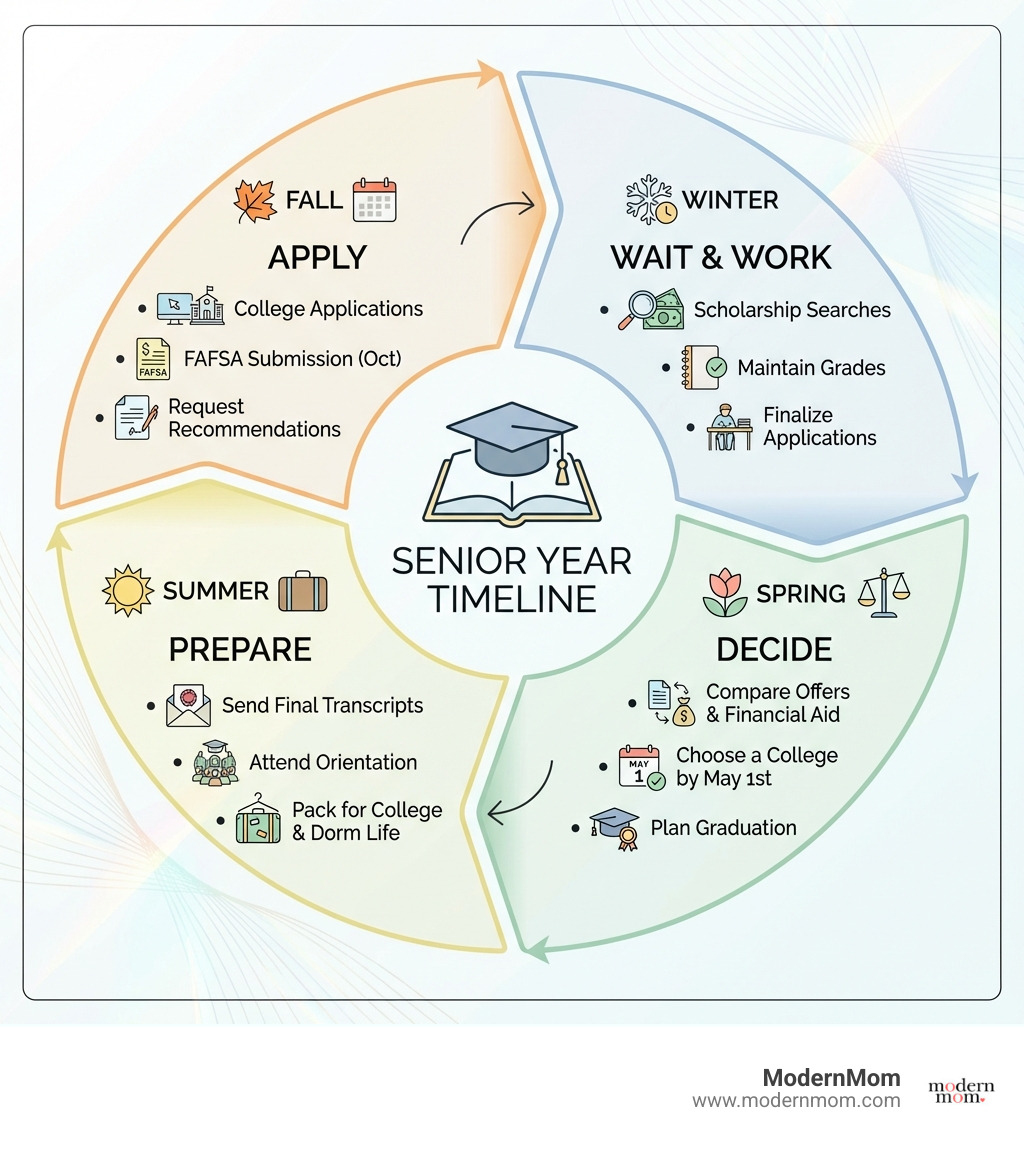
- Fall (Aug-Nov): Submit college applications, complete FAFSA (opens in October), take SAT/ACT if needed, request letters of recommendation
- Winter (Dec-Feb): Finalize applications, apply for scholarships, maintain strong grades to avoid offer rescission
- Spring (Mar-May): Review acceptance letters and financial aid packages, commit to a college by May 1st, plan graduation
- Summer (Jun-Aug): Send final transcripts, attend orientation, register for classes, prepare for dorm life
Your child’s senior year of high school is both thrilling and overwhelming. Between college applications, financial aid forms, standardized tests, and all those “lasts” — the last homecoming, the last first day of school, the last game — it’s easy to feel like you’re drowning in deadlines while trying to savor every moment.
Here’s the truth: senior year doesn’t have to be chaos. With a solid plan broken down into manageable chunks, you can help your teen steer this transition without losing your mind (or your budget).
The costs alone can be staggering. Research shows that prom can exceed $800, senior photos range from $200 to $500, and college application fees add up fast at $30-$40 per school. And that’s before you factor in graduation announcements, yearbooks, and the emotional weight of watching your baby prepare to leave the nest.
This year is about more than just getting into college. It’s about teaching your teen time management, financial responsibility, and resilience. It’s about celebrating their achievements while preparing them for independence. And yes, it’s also about managing your own emotions as you face this major life transition.
The good news? You don’t have to figure it all out alone. We’ve talked to admissions experts, financial aid counselors, and moms who’ve been exactly where you are right now. At Modern Mom, we understand that a Senior year checklist isn’t just about tasks — it’s about creating a framework that supports your whole family through this milestone year. This guide breaks down everything you need to know, season by season, so you can focus on what matters most: supporting your teen and making memories you’ll both treasure.
More info for your senior year checklist:
Your Complete Senior Year Checklist: A Seasonal Guide
Senior year can feel like a marathon, not a sprint. Breaking it down by season makes everything more manageable for you and your teen. Here’s a step-by-step guide for fall, winter, spring, and the summer after graduation. Having a detailed senior year checklist can significantly help students stay organized and reduce stress throughout the application and decision process, ensuring they don’t miss crucial deadlines.
Fall (August – November): The Application Hustle

The fall semester is often the most intense period of senior year. It’s when the bulk of college applications are submitted and financial aid forms start to open. This is the time for focused effort and meticulous organization.
-
College Applications:
- First, help your teen finalize a list of 5-8 colleges. This includes a mix of “safety,” “target,” and “reach” schools. Many students start this process the summer before senior year, utilizing resources like the Common App to streamline applications.
- Understand the different application types: Early Action (EA), Early Decision (ED), and Regular Decision (RD). EA is non-binding and allows students to apply early for an early response. ED is binding, meaning your teen commits to attending if accepted. RD is the standard application timeline.
- Note all deadlines in a shared family calendar. This is crucial for staying on track and preventing last-minute rushes.
- Ensure your teen is also building their resume by continuing with extracurricular activities, volunteer work, or job shadowing. These experiences demonstrate commitment and interests beyond academics, playing a vital role in the college preparation process.
-
Standardized Tests:
- If your teen needs to take or retake the SAT or ACT, register for these tests early. Many colleges allow students to self-report scores, but official scores will eventually be required.
- For those aiming to improve their scores, dedicated test prep can make a difference. We have some great tips on how to increase SAT and ACT Scores. The ACT and SAT costs are around $50 per test, so plan accordingly.
-
Financial Aid:
- This is a critical step! The Free Application for Federal Student Aid opens in October. It’s essential to complete it as early as possible, as some federal and state aid is awarded on a first-come, first-served basis.
- Gather the necessary documents, such as tax returns, bank statements, and investment records. Some private colleges may also require the College Scholarship Service (CSS) Profile. This is a key financial aid step for many families.
-
Recommendations & Essays:
- Your teen should ask teachers, counselors, or employers for letters of recommendation. Encourage them to provide at least a two-week notice and a “brag sheet” outlining their achievements and goals.
- Brainstorm and write compelling college essays. These essays are a chance for your teen to showcase their personality and experiences beyond their grades and test scores. Have parents, teachers, or counselors review them for feedback.
| Application Type | Typical Deadline | Notification Date | Commitment Level |
|---|---|---|---|
| Early Decision (ED) | October/November | December | Binding – must attend if accepted |
| Early Action (EA) | October/November | December/January | Non-binding – can apply to other schools |
| Regular Decision | January/February | March/April | Non-binding – can apply to other schools |
Winter (December – February): Maintain Momentum

With the holiday season often falling in this period, it can be tempting to relax. However, winter is a crucial time to maintain focus, finalize applications, and hunt for scholarships. This is also when the dreaded “senioritis” can start to creep in.
-
Finalize Applications:
- Submit all Regular Decision applications, typically due in January. Double-check that all materials, including transcripts and test scores, have been received by colleges. A quick call or email to the admissions office can confirm everything is in order.
- If your teen applied Early Action or Early Decision, notifications often arrive in December or January. This can be an exciting or nerve-wracking time!
-
Hunt for Scholarships:
- Winter break offers a perfect opportunity to search and apply for local and national scholarships. Encourage your teen to dedicate time each week to this. School counselors are a great resource for local opportunities, and various online platforms can help with national searches.
- Scholarships are a vital way to reduce the financial implications and potential hidden costs associated with senior year and college preparation.
-
Beat Senioritis:
- This is where things can get tricky. Many students feel a dip in motivation once college applications are submitted or acceptance letters start rolling in. This is known as “senioritis.”
- It’s vital to remind your teen that colleges look at final grades. A significant drop in academic performance or unexplained absences can lead to an offer of admission being rescinded. Experts, like John Morganelli, former Director of Admissions at Cornell University, confirm that “An offer of admission—early or otherwise—is provisional until the institution receives and verifies the student’s final transcript.”
- Encourage your teen to view their final semester as preparation for the academic rigor of college. Maintaining good grades now builds strong study habits for later. For more on this, check out More on what senioritis is and how to combat it.
Spring (March – May): The Final Senior Year Checklist Push
Spring brings a mix of anticipation, celebration, and big decisions. Admission decisions arrive, financial aid packages are compared, and the ultimate choice of where to go is made. It’s also time to gear up for graduation.
-
Decisions & Dollars:
- Admission decisions and financial aid award letters typically arrive in March and April. This is a critical time to sit down as a family and compare costs and aid offers.
- Create a spreadsheet to analyze the true cost of attendance for each school, considering grants, scholarships, and loans. Discuss the financial implications and potential for considerable student debt. This conversation is essential for preparing your teen for the financial realities of college life.
-
Make the Choice:
- If possible, make a final visit to the campuses your teen is seriously considering. Seeing the campus again, talking to current students, and attending accepted student events can solidify their decision.
- Most colleges require students to commit by May 1st, National Decision Day. This is the big moment! Notify the chosen college of your teen’s acceptance and decline offers from other institutions.
-
Waitlist & Other Options:
- If your teen is waitlisted at a top-choice school, encourage them to send a letter of continued interest, update the admissions office with any new achievements, and maintain strong grades.
- If no acceptance letters have come through, don’t panic. The National Association for College Admission Counseling releases a college openings update in early May, providing a list of colleges still accepting applications. There are always options!
-
Graduation Planning:
- Order the cap, gown, and announcements according to your school’s deadlines. These can often be separate purchases from senior dues.
- Plan the graduation party. Some seniors prefer a low-key celebration, while others want a bigger bash. Get your teen involved in the planning. For party ideas, see Ways to Plan a Teenage Party.
- Discuss the various senior year costs beyond tuition. Prom can exceed $800, senior photos range from $200-$500, yearbooks around $100, and class rings $200 or more. These expenses can quickly add up, easily surpassing $1,000 combined, so budgeting ahead is key.
Summer (June – August): Prepare for Launch
The summer after graduation is a whirlwind of celebrations, goodbyes, and preparations for the next big adventure. This period is crucial for setting your teen up for success in college and independent living.
-
Finalize Paperwork:
- Ensure the high school sends the final transcript to the college. This is a non-negotiable step, as provisional offers are confirmed once final grades are verified.
- Complete all housing forms, health records, and orientation registrations. Missing these deadlines can cause unnecessary stress before move-in day.
-
Orientation & Registration:
- Attending summer orientation is a must! It’s an invaluable opportunity for your teen to register for classes, meet future classmates, learn about campus resources, and get a feel for college life. This helps prepare them for the transition to college life beyond academics.
-
Life Skills 101:
- This is the perfect time for practical discussions. Talk about budgeting, managing a bank account, doing laundry, basic cooking, and personal safety. These are essential skills for independent living that often get overlooked in the college application frenzy.
- For more guidance, exploring resources like Key Topics for Parents to Address with Teens This Summer can spark important conversations.
-
Pack & Prepare:
- Shop for dorm essentials. Coordinate with their new roommate to avoid duplicate items like mini-fridges or microwaves.
- Enjoy the last few weeks of summer together as a family. These moments are precious and help prepare everyone emotionally for the transition.
Beyond the Checklist: Your Role as a Mom
This year is a huge transition for your teen, but it’s a big one for you, too. Your support is the secret ingredient to their success and your sanity. Senior year is not just about tasks; it’s about nurturing, guiding, and celebrating this significant milestone.
-
Be the Safe Space: Your teen will be stressed, overwhelmed, and possibly moody. Be a calm listener and a source of encouragement, not added pressure. Studies show that parental emotional support can significantly reduce student stress during this period. They need a safe space to vent and process their own emotions, even if they seem distant.
-
Manage the “Lasts”: It’s okay to feel emotional about the “last first day,” the “last home game,” or the “last school dance.” These are monumental moments. Find a friend or partner to share these feelings with so you can process them and stay strong for your child. Focus on celebrating these “lasts” as stepping stones, rather than mourning them.
-
Talk About Money: Be open and honest about the costs of senior year and college. Use this as a teaching moment for budgeting, saving, and financial planning. Discussing the financial implications early can alleviate future stress. Resources like Maximizing Your Money: Smart Moves for Your Tax Refund can be a great starting point for family finance talks, helping your teen understand the value of every dollar.
-
Celebrate Everything: From submitting the first application to the final graduation walk, celebrate the small wins along the way. These celebrations, big or small, keep morale high and remind everyone that this is a journey to be cherished, not just endured. Acknowledging their efforts and achievements reinforces their motivation and builds confidence.
Frequently Asked Questions about Senior Year
How do we handle ‘senioritis’ after an acceptance letter arrives?
It’s a common challenge, but we need to tackle it head-on. Remind your teen that college offers are provisional. Colleges can and do rescind offers for major grade drops, unexplained absences, or disciplinary issues. Frame the final semester not as an ending, but as “training for college,” where they build essential time management and study habits. Experts suggest that continued academic engagement is an unspoken condition of enrollment. Keeping them focused on exciting summer plans and dorm decor ideas can also help maintain motivation and remind them of the prize at the finish line.
What if my teen doesn’t get into their dream school?
It’s a tough moment, and it’s okay for them to be disappointed. Allow them space to feel that emotion. Then, help them shift their focus and get excited about the schools that did accept them. Remind them that college is what you make of it; they can thrive and find their community at any institution. Many successful people didn’t attend their “dream” school. For some, this might even be a good time to ask, “Should I Earn a College Degree?” and explore all post-high school options, including trade schools, gap years, or immediate employment.
What are the biggest hidden costs of senior year?
Senior year is definitely pricier than many parents anticipate. Beyond the obvious college application fees ($30-$40 per application), be prepared for:
- Senior portraits: These can range from $200 to $500, often with mandatory studio contracts and expensive print packages.
- Prom: The average cost can exceed $800, covering attire, tickets, transportation, and after-prom activities.
- Yearbook: Around $100, plus potentially $25-$200 for a personal ad.
- Class rings: These can easily cost $200 or more.
- Graduation cap and gown: Typically around $50, but often a separate purchase from senior dues.
- Other expenses: Don’t forget graduation announcements, parties, senior trips, and fees for things like painted parking spots or special senior events. Budgeting for these expenses early can prevent financial stress and allow your teen to fully enjoy these milestone moments.
Conclusion: You’ve Got This, Mom!
Navigating senior year is a journey filled with paperwork, deadlines, and a whole lot of emotions. By using a Senior year checklist and tackling it one season at a time, you can reduce the stress and truly enjoy this milestone year with your child. We’re not just preparing them for college; we’re launching them into adulthood, equipping them with the organizational skills, financial literacy, and emotional resilience they’ll need for future success. You’re doing an amazing job. For more tips on navigating every stage of your child’s education, explore the resources here at ModernMom.
Find more education tips and resources here
The post Ace Your Senior Year: The Ultimate College Application Playbook appeared first on ModernMom.