
Your Art College Portfolio: A Quick-Start Guide for Stressed-Out Students (and Their Moms)
An art college portfolio is a curated collection of your best creative work — and it’s the single most important part of your art school application. Here’s what you need to know at a glance:
- What it is: 8–15 pieces of original artwork that showcase your skills, creativity, and personal voice
- Why it matters: It’s how admissions teams evaluate your potential — often carrying more weight than grades or test scores
- What schools look for: Technical skill, originality, variety, conceptual thinking, and authentic storytelling
- How to submit: Most schools use platforms like SlideRoom or Common App’s Art Supplement
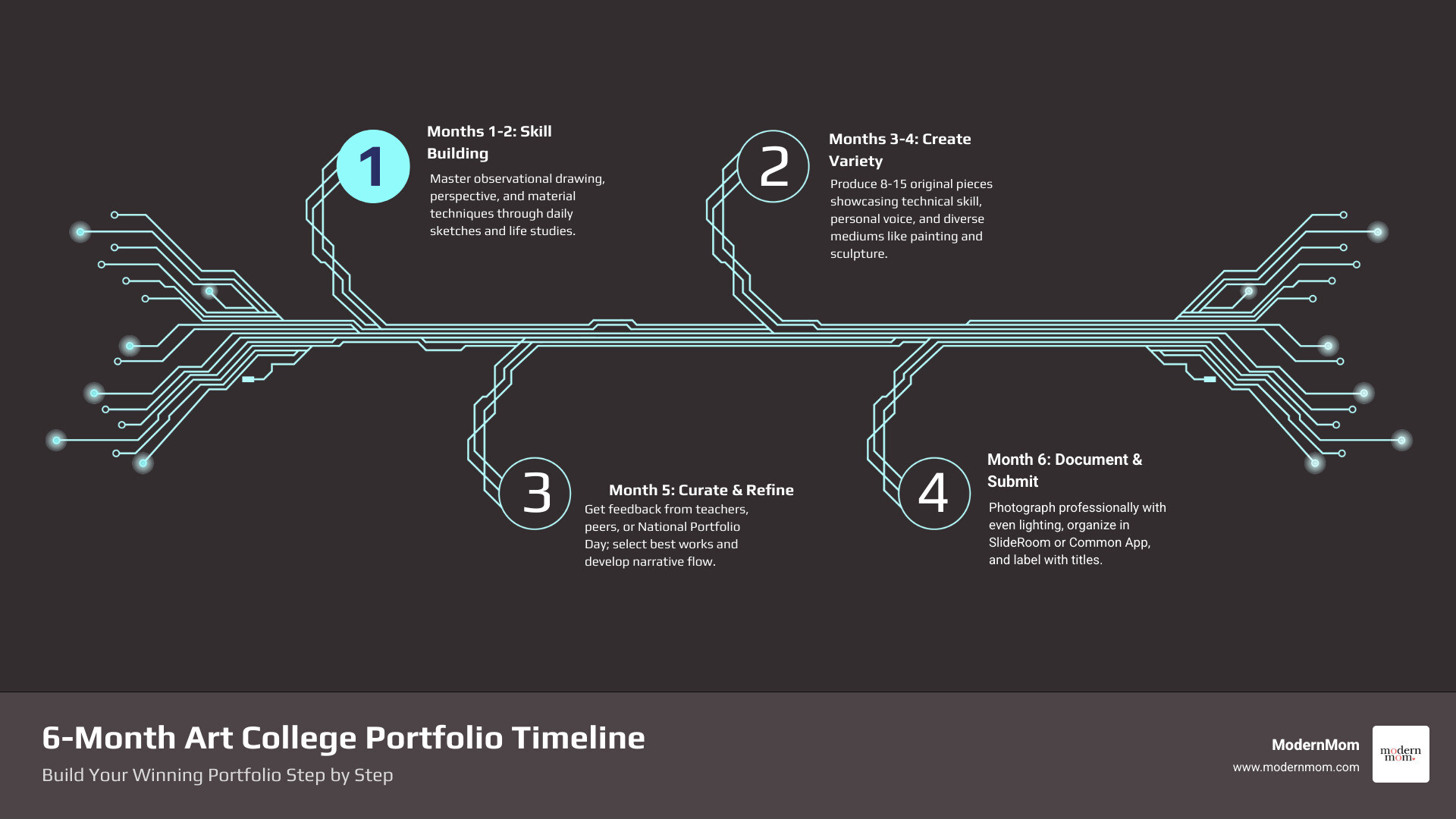
- When to start: Ideally 6–12 months before your application deadline
If your teen has been staring at a blank sketchbook wondering where to even begin, you’re not alone. Building an art college portfolio can feel overwhelming — but with the right roadmap, it’s absolutely doable.
This guide walks you through everything: what to include, how many pieces to prepare, how to avoid common mistakes, and how to put it all together with confidence.
Getting Ready For College:
Building a Winning Art College Portfolio: What Admissions Officers Look For
When we think of college admissions, we often think of “gatekeepers” trying to keep people out. But in the art world, admissions officers are more like talent scouts or helpers. Their goal is to see if your student has the potential to thrive in a rigorous studio environment. They aren’t looking for perfection; they’re looking for a “spark” — that mix of intellectual curiosity, self-discipline, and a unique creative voice.
A strong art college portfolio isn’t just about getting an acceptance letter; it’s a major factor in securing financial aid. For instance, students at the Prima Materia Art Institute have seen incredible results, with a 100% success rate into dream schools and an average scholarship of $80,000 per graduate. Some students have even secured Presidential Scholarships worth over $108,000!
Every school has its own flavor. For example, Moore College of Art & Design Portfolio Requirements | Moore College emphasize demonstrating your strengths and ideas through your 8-12 best works. Meanwhile, schools like MICA look for “visual sensitivity” and “artistic commitment.” Essentially, they want to see that your teen isn’t just “good at drawing,” but that they have something to say.
Demonstrating Technical Skill in Your Art College Portfolio
Technical skill is the foundation upon which all great art is built. Think of it as the “grammar” of the visual world. Admissions officers want to see that your student understands the basics of craft, even if they plan to go into a digital field like animation or game design.
One of the most important ways to show this is through observational drawing. This means drawing from real life — not from a photograph, a comic book, or another artist’s work. Experts from Ringling College and RIT emphasize that drawing from life shows how a student translates the 3D world onto a 2D surface.
To master this section, suggest your teen focus on:
- Life Studies: Drawings of people (hands and feet are notoriously difficult and impressive when done well!), objects, or interior spaces.
- Perspective: Demonstrating an understanding of 1-point, 2-point, or even 3-point perspective.
- Material Mastery: Showing proficiency in traditional media like charcoal, graphite, ink, or oil paint.
As noted in Portfolio Preparation | MICA , schools want to see foundational craft that proves the student has the “muscles” to handle advanced college-level projects.
Getting Feedback on Your Art College Portfolio
We know it’s tempting to keep the work hidden until it’s “perfect,” but getting professional feedback early is the secret weapon of successful applicants. Your teen’s art teacher is a great start, but outside perspectives are invaluable.
National Portfolio Day is a massive resource where representatives from dozens of art colleges gather (virtually or in person) to review work. It’s not an audition; it’s a teaching moment. Admissions counselors will tell your student exactly what’s working and what gaps they need to fill.
According to How To Make A Killer Art Portfolio For College , these reviews are often much friendlier than students expect. The staff are typically “super nice” and want to help students succeed. If you can’t make it to a National Portfolio Day, many schools, like Ringling or PCA&D, offer virtual 1-on-1 reviews that you can schedule right from their websites.
Curating Your Best Work: Quantity, Variety, and Storytelling
Curation is just a fancy word for “picking the right stuff.” Think of the art college portfolio like a “greatest hits” album. You don’t want every song you’ve ever written; you want the ones that show your range and your absolute best performance.
How Many Pieces Do You Really Need?
The “magic number” varies by school, but it usually falls between 8 and 15. Here is a quick breakdown of what some top schools currently require:
| School | Number of Pieces Required |
|---|---|
| Columbus College of Art & Design (CCAD) | 8–15 pieces |
| MassArt | 12–15 pieces |
| MICA | 10–15 pieces |
| Moore College of Art & Design | 8–12 pieces |
| PCA&D | 8–10 pieces |
| RIT (BFA Programs) | 7–10 pieces |

Showing Variety and Exploration
While your teen might love one specific medium — say, digital painting — schools want to see that they aren’t a “one-trick pony.” We recommend including a mix of:
- 2D Work: Drawings, paintings, or printmaking.
- 3D Work: Ceramics, fashion pieces (like a dress made from trash bags!), or sculptures.
- Conceptual Pieces: Art that explores a specific idea or personal story. It doesn’t always have to be serious; it can be “nerdy,” funny, or dark.
- Process Work: Don’t hide the sketches! Including sketchbook pages shows how your teen thinks and solves problems.
The Power of Storytelling
Admissions teams love a narrative. This could be a series of comic panels, a set of character designs, or a painting that captures a specific emotional moment. Storytelling shows that the student can use their technical skills to communicate something meaningful to an audience.
Organizing and Documenting Your Masterpieces
You could have the most incredible painting in the world, but if the photo of it is blurry, dark, or taken on a messy bedroom floor, it won’t impress anyone. Professional documentation is half the battle.
Photographing Your Work
You don’t need a $2,000 camera, but you do need a plan.
- Lighting: Use even, natural light. Avoid using a flash, which creates “hot spots” on the work.
- Background: Use a neutral, clutter-free background (a white or grey wall/sheet works wonders).
- Clarity: Ensure the camera is parallel to the artwork to avoid distortion. Crop out anything that isn’t the art itself.
As explained in Submitting Your Portfolio , organization is key. You’ll need an “image inventory” that tracks the title, medium, dimensions, and year for every piece.
Submission Platforms
Most schools use SlideRoom, which often integrates with the Common App. This is where your teen will upload their high-resolution files. For digital work or videos, pay close attention to file sizes. RIT, for example, prefers PDFs to be under 10MB and videos to be under 3 minutes and 60MB.
Avoiding Common Pitfalls and FAQs
When it comes to the art college portfolio, what you don’t include is just as important as what you do. Here are the red flags admissions officers see most often:
- Fan Art: While drawing Batman or anime characters is great for practice, schools generally discourage it. They want to see your characters and your worlds.
- AI-Generated Work: This is a big one. Most schools, including RIT and Ringling, strictly forbid AI-generated art. MassArt allows it only with heavy disclosure of the tools used and the “why” behind it, but generally, it’s better to stick to human-made creations.
- Clichés: Still-lifes of fruit or flowers are fine for technical practice, but they can be boring. Encourage your teen to put a personal twist on them.
- Unfinished Work: Unless it’s a deliberate “process” piece in a sketchbook, ensure pieces look complete.
For more specifics on what to avoid, check out these Portfolio Requirements from the College of Art and Design at the Rochester Institute of Technology.
How many pieces should I include?
As we noted in our table, most schools want 10–15 pieces. Quality always beats quantity. If your teen has 8 amazing pieces and 4 “okay” ones, it’s often better to just submit the 8. You want to leave the reviewer thinking, “I want to see more,” not “Why did they include that?”
What if I don’t have access to expensive materials?
Don’t let a lack of fancy tech or high-end oil paints stop your teen. Admissions officers love resourcefulness! A stunning drawing made with a simple #2 pencil and a grocery bag can be more impressive than a mediocre digital painting made on a $1,000 tablet. Creativity with limited resources shows problem-solving skills — a trait every art school prizes.
Does my portfolio determine my major?
Not necessarily! While some schools have major-specific requirements (like Ringling’s Computer Animation or Game Art tracks), many schools admit students into a “Foundation Year.” This is a year where everyone learns the basics before officially picking a major. The skills your teen shows in their portfolio — like composition, color theory, and perspective — are transferable to almost any creative field.
Conclusion
Helping your teen navigate the art college portfolio process is a journey of its own. It’s a time of high stress, but also incredible growth. The portfolio is more than just a requirement; it’s a celebration of your student’s hard work, their unique perspective, and their dreams for the future.
At ModernMom, we are here to support you through every stage of the parenting journey — from the first finger paintings to the final college applications. You’ve got this, and so does your student!
For more help navigating higher education and creative careers, check out our other resources:
Don’t forget to take a deep breath. Whether they end up at a top-tier art institute or a local university, their creativity is a gift that will serve them for a lifetime. Happy creating!
The post Your Guide to a Stellar Art College Portfolio appeared first on ModernMom.