


Why Holistic Mental Health Matters for Every Mom
Holistic mental health is an approach to well-being that treats the whole person—mind, body, and spirit—rather than just addressing symptoms of mental illness. Here’s what you need to know:
Core Elements of Holistic Mental Health:
- Whole-Person Care – Addresses physical, emotional, social, and spiritual aspects together
- Root Cause Focus – Identifies underlying issues like nutrition, stress, or trauma instead of quick fixes
- Prevention & Empowerment – Builds resilience and healthy habits to maintain wellness long-term
- Personalized Approach – Recognizes that each person’s path to mental health is unique
Let’s be honest—sometimes just surviving the day feels like all you can manage. Between juggling work, caring for kids, managing the household, and trying to squeeze in self-care, thriving can feel like a distant dream. But what if mental wellness wasn’t just about not feeling bad, but about actively feeling good?
Think of your mental health like a garden. You can’t just pull the weeds (treat symptoms) and expect it to flourish. You need rich soil, sunlight, water, and care for every plant. That’s the essence of holistic mental health—nurturing all the interconnected parts of yourself so you can truly thrive, not just survive.
Globally, more than a billion people live with a mental health condition, and depression and anxiety cost the global economy an estimated $1 trillion per year in lost productivity. But research shows that simple holistic practices—like regular exercise, mindfulness, proper nutrition, and strong social connections—can significantly improve symptoms of depression, anxiety, and stress.
As someone who’s built brands, businesses, and strategies from the ground up, I’ve learned that sustainable success—whether in work or wellness—comes from addressing the whole picture, not just the surface. Understanding holistic mental health means recognizing that your emotional well-being is deeply connected to how you move, what you eat, who you connect with, and what gives your life meaning.
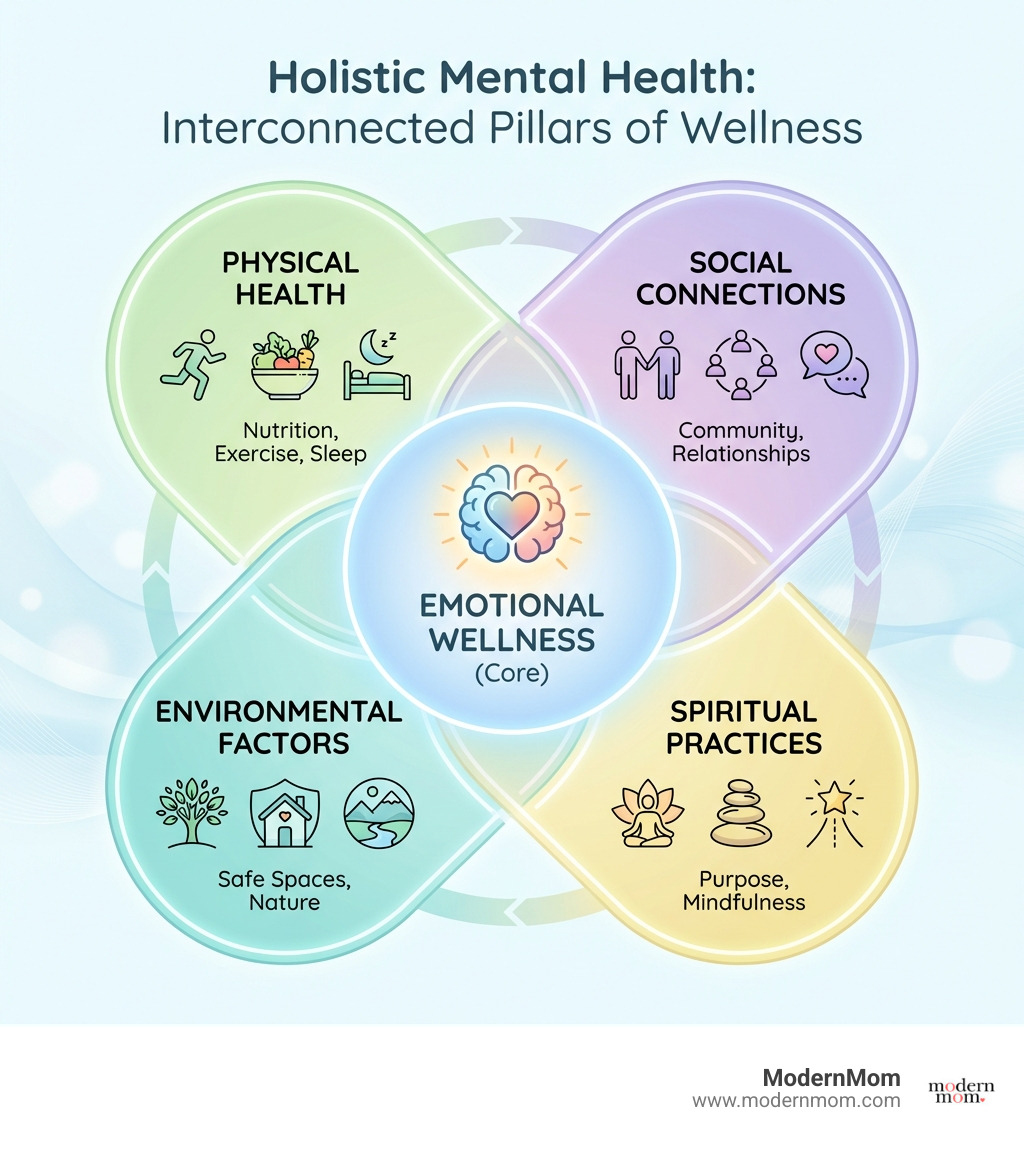
What is Holistic Mental Health?
When we talk about holistic mental health, we’re moving away from the old-school idea that health is simply the “absence of disease.” For decades, the medical model focused almost entirely on diagnosing a disorder and treating the symptoms—often with a “one-size-fits-all” pill or a specific clinical intervention. While medication has its place for stabilizing neurotransmitters, a holistic approach looks deeper.
It asks: Why is the “weed” growing in the first place? Is it a nutritional deficit? Is it a lack of social connection? Is it the chronic stress of modern “hustle culture”?
According to the Mayo Clinic’s overview of integrative medicine and health, a holistic approach isn’t about perfection. It’s about making conscious choices to nourish all aspects of yourself. It integrates conventional medicine with lifestyle changes and alternative therapies—like yoga, acupuncture, or nutrition—to create a foundation for lasting wellness.
For us moms, this is a game-changer. It means we don’t have to wait until we’re in a full-blown crisis to care for our minds. We can focus on prevention. By treating ourselves as a whole system, we empower ourselves to take the steering wheel of our own lives instead of just being passengers to our stress.

The Pillars of a Holistic Approach to Mental Well-being
To truly embrace holistic mental health, we need to look at the different “rooms” in our house of wellness. SAMHSA (the Substance Abuse and Mental Health Services Administration) identifies eight dimensions of wellness that affect our quality of life. If one room is cluttered or neglected, it eventually affects the rest of the house.
- Emotional Wellness: Understanding our feelings and coping effectively with stress.
- Physical Foundation: Nurturing our bodies through movement, nutrition, and sleep.
- Social Connection: Developing a sense of connection and a well-developed support system. (As moms, our “village” is vital!)
- Intellectual Growth: Recognizing our creative abilities and finding ways to expand our knowledge.
- Occupational Balance: Finding personal satisfaction and enrichment in our work (including the work of parenting!).
- Spiritual Harmony: Expanding our sense of purpose and meaning in life.
- Environmental Well-being: Occupying pleasant, stimulating environments that support well-being.
- Financial Stability: Satisfaction with current and future financial situations.
To help visualize how this differs from what we’re used to, check out this comparison:
Wellness Model vs. Traditional Medical Model
| Feature | Traditional Medical Model | Holistic Wellness Model |
|---|---|---|
| Primary Focus | Treating illness and symptoms | Promoting overall well-being and thriving |
| View of the Person | A set of symptoms or a diagnosis | A whole person (mind, body, spirit) |
| Approach | Reactive (wait for the problem) | Proactive (prevention and maintenance) |
| Responsibility | Provider-led (doctor “fixes” you) | Individual-led (you are empowered) |
| Goal | Symptom management | Resilience, balance, and fulfillment |
The Role of Nutrition and Gut Health in Holistic Mental Health
We’ve all heard the phrase “you are what you eat,” but did you know your gut is often called your “second brain”? There is a powerful gut-brain connection that means a healthy digestive system can positively impact your mental well-being.
When we eat highly processed sugars, we often experience energy crashes and mood swings. On the flip side, nutrient-rich foods for brain function—like leafy greens, fatty fish, and berries—can stabilize our mood and boost our energy.
Quick Tips for a “Happy Gut” Diet:
- Probiotics: Foods like yogurt or sauerkraut support the healthy bacteria that help produce serotonin (our “feel-good” hormone).
- Hydration: Even mild dehydration can lead to irritability and brain fog.
- Whole Foods: Focus on fruits, vegetables, and lean proteins to give your brain the fuel it needs to handle a toddler’s tantrum or a heavy workload.
Spiritual Practices and Holistic Mental Health
Spirituality doesn’t have to mean religion (though it certainly can!). In a holistic framework, spirituality is about finding meaning, purpose, and a sense of connection to something larger than ourselves.
According to APA research on the benefits of green spaces, simply spending time in nature can improve your mood and speed up recovery from stress. Whether it’s a morning prayer, a five-minute meditation, or a walk through a local park, these practices help us “find paradise within.”
Studies have shown that spirituality can even protect against depression in high-stress environments. For us, it’s about finding that quiet center in the middle of a noisy house. It’s the “breath of fresh air” our souls need to keep going.
Nurturing Your Mind, Body, and Spirit
So, how do we put all this into practice without adding another twenty items to our already-overflowing to-do lists? The key is integration.
Caring for the Body
Physical activity is one of the most powerful mood boosters we have. Harvard Health on how regular exercise boosts mood reports that just 30 minutes of moderate exercise most days can improve symptoms of depression and anxiety.
If you can’t get to the gym, try a “Minute Burst” challenge. Dance with your kids for three minutes, or do a quick set of squats while the coffee brews. It’s not about the “perfect” workout; it’s about moving your body to release those endorphins.
Don’t forget sleep hygiene. We know, we know—moms and sleep don’t always get along. But setting a regular schedule and avoiding screens before bed can help your brain actually recharge.
Nurturing the Mind
One of our favorite tools is the 4-7-8 breathing technique. Inhale for 4 seconds, hold for 7, and exhale for 8. It’s like a “reset button” for your nervous system.
We also advocate for journaling. Writing down your thoughts helps process emotions rather than letting them bottle up. Pair this with gratitude lists for happiness. Research shows that writing down just three things you’re grateful for each day can physically change your brain to be more optimistic.
Nourishing the Spirit
Creative expression—whether it’s painting, coloring with your kids, or listening to music—is a form of art therapy. It allows us to express things that words sometimes can’t.
Integrating Holistic Practices into a Busy Mom Life
We get it. You’re busy. The idea of adding “holistic wellness” to your day might feel like another chore. But holistic mental health is meant to support you, not stress you out.
The Power of “Mommy Time”
Goldie Hawn, the founder of MindUP, often talks about the importance of “Mommy Time.” Even if it’s just three minutes of deep breathing three times a day, those tiny breaks allow you to quiet your mind and gather yourself. As she says, “An unhappy parent creates an unhappy child.” Taking care of yourself is taking care of your family.
Setting Boundaries
Part of a holistic approach is protecting your energy. This means learning to say “no” to things that drain you. Check out our guide on mom burnout recovery for more on how to reclaim your time.
Practical Micro-Habits
- Social Connection: Text a friend just to say hi. Strong relationships are a pillar of wellness.
- Stress Relief: Try these stress relief activities for parents that take less than ten minutes.
- Mindful Moments: While doing the dishes, focus entirely on the sensation of the warm water and the smell of the soap. This is “mindfulness in action.”
If you’re feeling completely overwhelmed, taking a few minutes to relax and recharge isn’t a luxury—it’s a necessity for your mental health.
Overcoming Challenges on Your Wellness Journey
Transitioning to a holistic lifestyle isn’t always easy. You might face:
- Time Constraints: Start small. Five minutes of meditation is better than zero.
- Financial Barriers: You don’t need an expensive organic diet or a fancy yoga membership. Walking in nature is free. Gratitude journaling is free.
- Consistency: It’s okay to have “off” days. Holistic health is about the long game, not a 24-hour transformation.
- Stigma: Some people still view holistic practices as “woo-woo.” But the science is there! For example, scientific research on meditation for burnout shows that even meditations under 10 minutes can significantly decrease burnout and secondary trauma scores.
Be patient with yourself. You are molding the future through your children, but you can’t pour from an empty cup.
Frequently Asked Questions about Holistic Wellness
How does holistic care differ from traditional therapy?
Traditional therapy often focuses on “talk therapy” to process specific issues. Holistic care includes talk therapy but also looks at your sleep, your diet, your physical activity, and your sense of purpose. It’s a “whole-person” strategy rather than a “brain-only” strategy.
Can I use holistic practices alongside my current medication?
Absolutely! In fact, many experts recommend an “integrative” approach. Holistic practices like exercise, nutrition, and mindfulness can often enhance the effectiveness of medication and help manage side effects. Always talk to your healthcare provider before making major changes.
How do I start a holistic routine when I’m already overwhelmed?
Start with one thing. Just one. Maybe it’s drinking an extra glass of water today. Maybe it’s doing the 4-7-8 breath before you get out of the car at school pickup. Once that feels easy, add another small habit.
Conclusion
Embracing holistic mental health is about more than just avoiding “burnout”—it’s about stepping into a life where you can truly thrive. It’s about recognizing that you are a complex, beautiful system of mind, body, and spirit, and every part of you deserves to be nurtured.
By focusing on the “whole you,” you aren’t just improving your own life; you’re modeling resilience, self-care, and emotional intelligence for your children. You’re showing them that wellness is a journey, not a destination.
You aren’t alone in this. We are here to support you every step of the way. For more tips on staying active and eating well, explore more at ModernMom Health and Fitness.
You’ve got this, Mama. Take a deep breath, count your blessings, and remember that you are worth the effort.
The post Whole Person Wellness: Embracing a Holistic Approach to Mental Health appeared first on ModernMom.