


Why Setting Clear Goals Makes All the Difference in Therapy
If you’re starting therapy—or already in it—you might be wondering what examples of goals for therapy actually look like. Here’s the short answer:
Common therapy goals include:
- Managing anxiety — Practice grounding techniques when feeling overwhelmed
- Lifting depression — Engage in one pleasurable activity daily for two weeks
- Improving communication — Use “I” statements during difficult conversations
- Building self-esteem — Challenge negative self-talk using a thought journal
- Healing from trauma — Reduce avoidance behaviors by 50% in six weeks
- Establishing healthy habits — Follow a consistent sleep schedule for 30 days
- Strengthening relationships — Set one clear boundary per week with family members
Therapy can help you see tremendous growth as a person, but it’s critical that you clearly define what you want to work towards. Setting attainable short-term and long-term personal goals for therapy will help you imagine a better future for yourself.
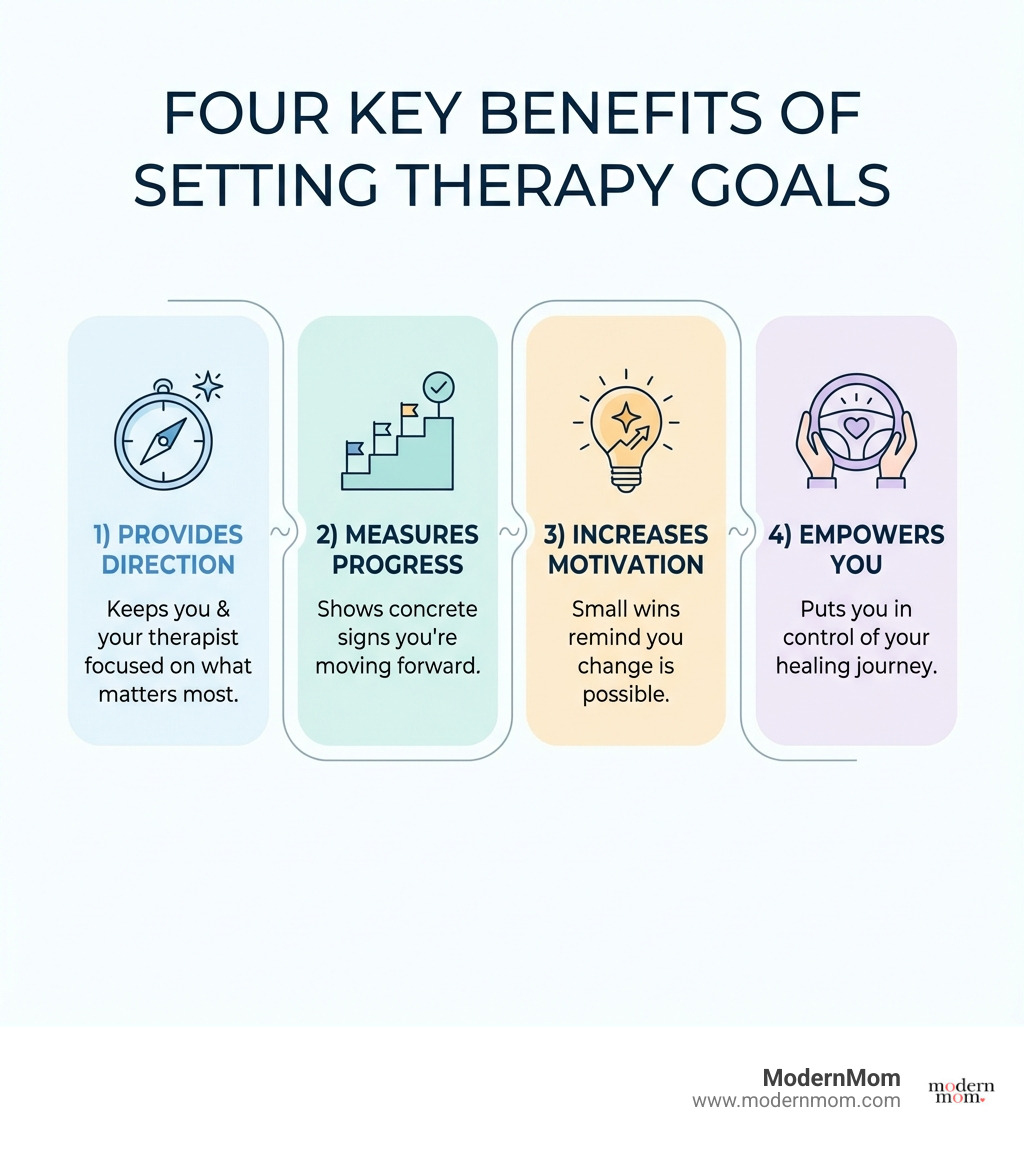
Goals give you direction. They help you and your therapist stay focused on what matters most to you—whether that’s feeling less overwhelmed, communicating better with your partner, or finally getting a good night’s sleep.
Goals also create motivation. When you can see progress—even small wins—it reminds you that change is possible. And that’s powerful, especially when you’re juggling work, kids, and everything else life throws at you.
Finally, goals make success measurable. Instead of wondering “Is this even working?”, you’ll have concrete signs that you’re moving forward.
As someone who’s spent years helping brands and businesses clarify their goals and grow through thoughtful strategy, I’ve seen how having clear examples of goals for therapy can transform outcomes. The same principles that drive success in business—clarity, focus, and measurable progress—apply beautifully to personal growth and healing.
First Things First: What Are Therapy Goals (And Why Do They Matter)?
So, what exactly are therapy goals? In the simplest terms, a therapy goal is an outcome you’d like to achieve through your therapeutic journey. It’s the “what” you want to change or improve in your life.
These goals are incredibly important because they provide a roadmap for both you and your therapist. They give your sessions direction and focus, ensuring you’re both working towards meaningful change. Clear goals also boost your motivation; seeing yourself make progress, even in small steps, can be a huge source of encouragement. Plus, they allow you to measure your success, giving you tangible proof that your hard work is paying off.
You might hear therapists talk about “goals” and “objectives,” and it’s helpful to understand the difference. Think of goals as the big picture, long-term outcomes you want. For instance, “Improve emotional regulation” is a goal. Objectives, on the other hand, are the specific, measurable, and actionable steps you’ll take to reach that larger goal. An objective for improving emotional regulation might be, “Client will identify and name emotions accurately in 8 out of 10 situations during therapy sessions within 4 weeks.”
Both short-term and long-term goals play crucial roles in therapy. Long-term goals are those significant life changes, like healing from past trauma or building lasting self-esteem. Short-term goals are the smaller, more immediate steps that build momentum towards those bigger aspirations. Achieving short-term objectives can feel like small victories, inspiring you to keep going and proving that lasting change is possible. These small wins reinforce positive beliefs and can drive our behavior towards even greater improvements. As we often say, Words Can Shape Our Beliefs and Drive Our Behavior.
The SMART Way to Set Goals That Actually Work
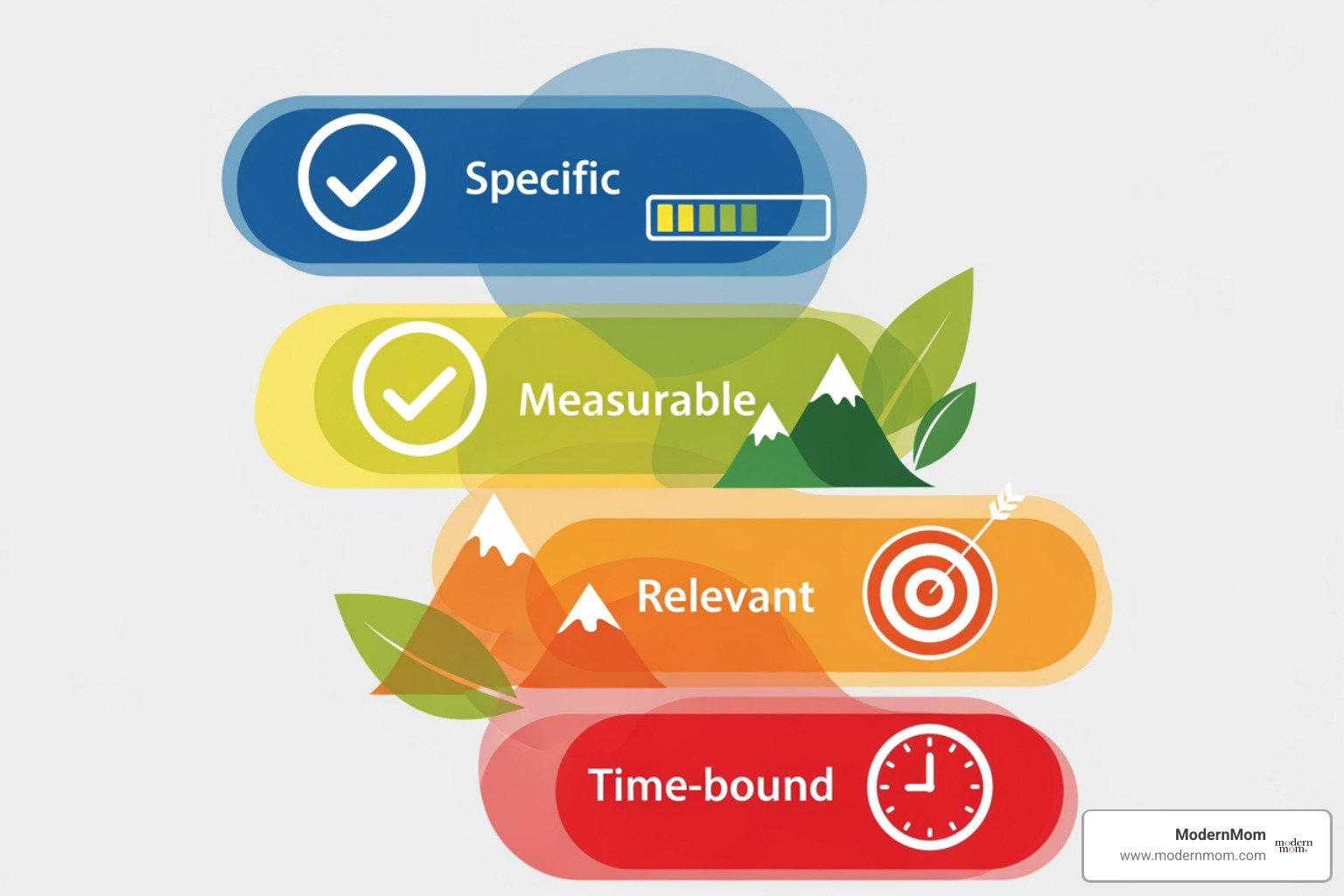
When it comes to setting effective therapy goals, the SMART framework is your best friend. It’s a structured approach that ensures your goals are clear, focused, and achievable. By applying this simple tool, you can transform vague aspirations into actionable plans that lead to real progress. You can even find a PR8: SMART Goal Sheet to help you get started.
Specific: Be Clear About What You Want
A specific goal clearly states what you want to achieve, why it’s important, and how you’ll accomplish it. Instead of saying, “I want to feel less stressed,” a specific goal would be, “I will practice a 10-minute mindfulness exercise three times a week to reduce feelings of overwhelm and improve my focus.” This kind of clarity helps both you and your therapist understand exactly what you’re working towards.
Measurable: Know What Success Looks Like
Measurable goals have clear criteria that let you track your progress. How will you know when you’ve achieved your goal? This could involve numbers, like “Reduce crying spells from 7 times per week to 2 times per week.” Or it could be tracking the frequency of using a new coping strategy, or even using a self-rating scale for your mood or anxiety levels. Journaling is a fantastic way to monitor these changes and see how far you’ve come.
Attainable: Set Yourself Up for Success
An attainable goal is realistic and challenging enough to promote growth without leading to frustration or burnout. It’s about setting yourself up for success, not disappointment. We know life as a mom can be demanding, so setting small, achievable steps is key. Studies show that realistic goals can be highly motivating, even for people living with depression or other mental health conditions. If a goal feels too big, we can always shrink it by 10-20% to make it more manageable.
Relevant: Make Sure Your Goals Matter to You
Relevant goals align with your personal values, aspirations, and needs. They should resonate deeply with what you want for your life. If a goal isn’t personally meaningful, it’s hard to stay motivated. For example, if you value peace and calm, a goal to “create a quiet space for myself for 15 minutes daily” will be far more motivating than one that feels imposed. It’s about finding what truly matters to you, not striving for The Impracticality of Perfection that doesn’t serve your authentic self.
Time-bound: Give Yourself a Gentle Deadline
A time-bound goal has a clear deadline, creating a sense of urgency and accountability. This doesn’t mean pressuring yourself, but rather establishing a timeframe to keep you focused. For example, “I will engage in at least two activities per week that bring me joy over the next six weeks.” Having milestones helps you break down the journey and celebrate progress along the way.
Common Examples of Goals for Therapy for Moms and Women
We understand that every woman’s journey is unique, but many of us share common struggles and aspirations. Here, we’ve gathered some common examples of goals for therapy that often resonate with moms and women, offering a starting point for your own therapeutic path.

Goals for Managing Anxiety and New Mom Stress
Anxiety can manifest in countless ways, from persistent worry to full-blown panic attacks. For new moms, stress can be particularly overwhelming. Therapy can equip you with powerful tools to manage these feelings and regain a sense of calm.
- Reduce panic symptoms: “I will use deep breathing techniques for 5 minutes during at least 80% of anxiety-provoking situations over the next 4 weeks.”
- Develop coping skills for worry: “I will practice ‘worry postponement’ for 15 minutes daily, dedicating a specific time to address concerns, for the next 6 weeks.”
- Decrease social anxiety: “I will initiate a conversation with one new person at a social gathering each month for the next three months.”
- Practice grounding techniques: “I will use the 5-4-3-2-1 grounding technique at least once daily when feeling overwhelmed, documenting its effectiveness in a journal for 8 weeks.”
- Manage intrusive thoughts: “I will challenge negative self-talk using cognitive restructuring techniques in 80% of instances where intrusive thoughts arise for the next 6 weeks.”
Goals for Lifting the Fog of Depression
Depression can make even simple tasks feel impossible, but therapy offers a path towards renewed energy and joy. Our aim is to help you find your way back to yourself, and these goals can be a great start for Four Tips to Control Your Moods and Reach Moodtopia.
- Increase engagement in pleasurable activities: “I will engage in at least 3 pleasurable activities weekly, such as reading or a hobby, for 8 weeks, and track my mood before and after.”
- Challenge negative self-talk: “I will identify and reframe negative self-statements into neutral or positive ones at least once daily for the next 6 weeks.”
- Improve mood: “I will report mood ratings of 6 or higher on a 1-10 scale for at least 5 days per week over the next 12 weeks.”
- Build a daily routine: “I will establish a consistent wake-up and bedtime routine (within 30 minutes) 5 days a week for the next month.”
- Increase social connection: “I will reach out to a supportive friend or family member for a brief conversation or activity twice a week for the next 6 weeks.”
Goals for Healing from Trauma or Difficult Experiences
Healing from trauma is a brave and often challenging journey, but it’s one where therapy can provide profound support. These goals focus on creating safety, processing memories, and building resilience.
- Process past events safely: “I will engage in trauma processing through an evidence-based modality (e.g., EMDR or Cognitive Processing Therapy) in weekly sessions over a 12-week period, documenting changes in symptoms.”
- Reduce trauma triggers: “I will identify 3 specific trauma triggers and practice a chosen coping strategy (e.g., grounding) during each encounter for 8 weeks, logging effectiveness.”
- Establish a sense of safety: “I will develop a written safety plan within the next 2 sessions and review/revise it as needed during weekly check-ins over a 6-week period.”
- Build resilience: “I will identify at least 5 personal strengths and 3 resilience factors within the next 2 sessions and document how they’ve helped me overcome challenges.”
- Reclaim your narrative: “I will write a narrative of my traumatic experience, focusing on my strength and survival, over 4 weeks, to be shared with my therapist.”
Goals for Building Healthier Relationships
Relationships are at the heart of our lives, and therapy can help us steer their complexities, from improving communication with our partners to steering family dynamics. These goals are about fostering connection and respect.
- Improve communication skills: “I will use ‘I’ statements during at least one conflict or disagreement per week with my partner for the next 6 weeks, reflecting on the experience in therapy.”
- Set and maintain boundaries: “I will identify 3 specific boundary-setting goals in personal relationships and practice implementing at least one boundary per week over the next 6 weeks.”
- Increase emotional intimacy: “My partner and I will engage in a 10-minute emotional check-in conversation each evening for the next 30 days, using a feelings guide.”
- Steer family dynamics: “My family members will collaboratively create a list of 5 household rules during the next two sessions and implement them weekly for 6 weeks, discussing progress in therapy.”
- Resolve specific conflicts: “My partner and I will practice active listening techniques during at least one conflict per week for the next 6 weeks, and reflect on the experience during each couples therapy session.” For those navigating new relationship phases, such as after divorce, these skills are essential. Learn more about Dating After Divorce: Three Ways to Tell Your Kids You Are Dating Again.
Personal Growth: Examples of goals for therapy focused on you
Sometimes, therapy is simply about becoming a better, more fulfilled version of ourselves. These goals are all about nurturing your inner world and celebrating your unique self.
- Practice self-compassion: “I will engage in a 5-minute self-compassion meditation daily for 4 weeks, noting feelings of kindness towards myself in a journal.”
- Reduce Mom Guilt: “I will challenge one instance of Mom Guilt Is Like Regular Guilt—Except on Steroids each day by reframing the thought or taking a small action for myself for the next 6 weeks.”
- Identify personal strengths: “I will list 3 personal strengths each week and reflect on how I’ve used them, for 8 weeks, to build self-awareness.”
- Boost self-esteem: “I will engage in one activity that genuinely makes me feel competent or proud twice a week for the next 6 weeks.”
- Find your purpose: “I will explore my core values by journaling about what truly matters to me for 15 minutes daily, 5 days a week, for the next month.”
Lifestyle Changes: Examples of goals for therapy for daily habits
Our daily routines and habits profoundly impact our mental well-being. Therapy can help us cultivate healthier patterns that support our overall health.
- Improve sleep hygiene: “I will follow a consistent sleep schedule (bedtime and wake-up time within 30 minutes) 6 nights a week for the next 30 days.” We know that sleep and mental health are heavily correlated, so prioritizing good sleep is crucial for overall well-being. https://www.ncbi.nlm.nih.gov/pmc/articles/PMC5449130/
- Build healthier habits: “I will replace one unhealthy habit (e.g., mindless scrolling) with a positive one (e.g., reading for 15 minutes) 5 days a week for the next month.” Research shows that habits are often unconscious behaviors triggered by environmental cues, so becoming aware of them is the first step to creating more positive routines. https://www.ncbi.nlm.nih.gov/pmc/articles/PMC3505409/
- Manage stress: “I will incorporate 20 minutes of moderate physical activity into my routine 3 times a week for the next 8 weeks to reduce stress.” Physical activity can be a powerful tool for Overcoming Challenges to Getting Lean and Fit.
- Improve nutrition: “I will prepare and eat balanced meals 5 days per week for the next 6 weeks, focusing on whole, unprocessed foods.”
- Limit screen time: “I will reduce my daily recreational screen time by 30 minutes for the next 4 weeks, substituting it with a calming activity.”
Your Roadmap to Success: Working With Your Therapist
Therapy is a collaborative journey, and your therapist is your partner and guide. Setting goals together ensures that your treatment is custom to your unique needs and desires.
How to Collaboratively Set Your Therapy Goals
Setting goals in therapy isn’t a solo mission; it’s a partnership between you and your therapist. They’re there to help you clarify what you truly want to achieve and break it down into manageable steps. It’s perfectly okay if you don’t know your goals when you first start. Many people begin therapy feeling overwhelmed or unsure, and figuring out what you want to work on can be your very first goal!
Being honest and authentic with your therapist about your hopes, fears, and even your uncertainties is key. They’ll use open-ended questions and motivational interviewing techniques to help you explore what truly matters to you. Surprisingly, research shows that nearly one in four people report their therapy sessions lacked proper goal-setting or progress follow-up. This highlights how crucial it is to actively engage in this process with your therapist to ensure your journey is focused and effective. https://pmc.ncbi.nlm.nih.gov/articles/PMC7754282/
Different therapeutic approaches also influence the types of goals set. For example:
- Cognitive Behavioral Therapy (CBT) often focuses on identifying and changing negative thought patterns and behaviors. Goals might involve challenging automatic negative thoughts or gradually exposing yourself to feared situations.
- Dialectical Behavior Therapy (DBT) emphasizes distress tolerance, emotion regulation, interpersonal effectiveness, and mindfulness. Goals might include practicing specific coping skills during moments of intense emotion or improving communication in relationships.
- Acceptance and Commitment Therapy (ACT) centers on psychological flexibility and living according to your values. Goals here might involve identifying your core values and taking committed action towards them, even in the presence of difficult thoughts or feelings.
Tracking and Adjusting Your Goals Along the Way
Think of therapy as a dynamic journey, not a static destination. Your goals aren’t set in stone; they’re living, breathing intentions that can evolve as you do. Regular check-ins with your therapist are essential for monitoring progress. This can be as simple as discussing how your week went or how a new skill you’re practicing is working out.
Celebrating small wins along the way is incredibly motivating. Did you use a new coping strategy successfully? That’s a win! Did you manage to set a boundary you’ve been avoiding? Another win! These moments reinforce your efforts and build confidence. It’s also perfectly okay to pivot. As you gain self-awareness and new insights, your priorities might shift, and your goals should shift with them. Your therapist will help you reassess and adjust your goals to ensure they remain relevant and empowering.
Common Pitfalls and How to Avoid Them
Even with the best intentions, setting therapy goals can have its challenges. Here are a few common pitfalls and how we can steer them:
- Vague Goals: “I just want to be happy” is a lovely sentiment, but it’s too broad to be actionable. We can overcome this by using the SMART framework to break it down into specific, measurable steps.
- Unrealistic Expectations: Expecting to eliminate all anxiety in a week is likely to lead to disappointment. Setting attainable goals that are challenging but realistic prevents burnout and encourages sustained effort.
- Lack of Client Involvement: Goals are most effective when they’re your goals, not just what your therapist thinks you should work on. Ensure you feel heard and that your goals align with your deepest desires.
- Therapist-Centric Goals: Sometimes, goals might inadvertently become what the therapist believes is best, rather than what you truly want. A good therapist will always ensure your goals are client-centered and driven by your values.
- Overcoming Resistance: It’s normal to feel resistance at times, whether it’s to the goals themselves or the work required. Discussing this openly with your therapist can help uncover underlying fears or ambivalence and find strategies to move forward.
Culturally Sensitive and Trauma-Informed Goals
It’s also vital that therapy goals are culturally sensitive and trauma-informed. This means your therapist will consider your unique cultural background, values, and experiences when helping you set goals. What might be an appropriate goal for one person could be culturally inappropriate or irrelevant for another.
For those who have experienced trauma, goals must prioritize safety, stabilization, and pacing. A trauma-informed approach ensures that goals are set at a pace that feels safe and manageable, without re-traumatizing or overwhelming you. It’s about empowering you to regain control and build resilience, always with respect for your individual healing process.
Frequently Asked Questions about Therapy Goals
We know you might have some lingering questions, and that’s perfectly normal! Here are answers to some of the most common inquiries we hear about therapy goals.
What if I don’t know what my goals are when I start therapy?
It is absolutely, 100% okay to show up for therapy without being able to perfectly articulate your goals. Many people begin therapy feeling a general sense of unease, sadness, or overwhelm, without a clear idea of what they want to change. Your therapist’s job in the initial sessions is often to help you explore your feelings, identify patterns, and gently guide you toward understanding what you want to work on. Think of it as a collaborative findy process. A good therapist will help you clarify your needs and transform vague feelings into concrete, achievable goals.
How long does it take to achieve my therapy goals?
There’s no one-size-fits-all answer to this, and honestly, it’s one of the most frequently asked questions! The timeline depends on several factors:
- Complexity of the goal: A short-term goal like “practice a new coping skill daily” might be achieved in a few weeks, while a long-term goal like “process complex trauma” can take months or even years.
- Your individual situation: Everyone’s journey is unique. Your personal history, current life circumstances, and how consistently you engage with the therapeutic process all play a role.
- The therapy approach: Different therapeutic modalities have varying timelines. Some solution-focused therapies might yield quicker results for specific issues, while deeper, insight-oriented therapies may take longer.
It’s important to focus on your progress and the journey, not just the destination. Celebrate every step forward, no matter how small.
What’s the difference between therapy and life coaching?
While both therapy and life coaching aim to help you improve your life, they have different focuses and scopes:
- Therapy (or psychotherapy) primarily focuses on mental health conditions, emotional healing, and resolving past issues that impact your present. Therapists are licensed mental health professionals trained to diagnose and treat conditions like depression, anxiety, PTSD, and relationship issues. They dig into your past to understand how it shapes your current experiences.
- Life Coaching is typically future-focused and helps individuals achieve specific personal or professional goals. Coaches are not licensed to diagnose or treat mental health conditions. They work with clients to identify strengths, overcome obstacles, and develop strategies to reach desired outcomes. Think of it as a partnership to open up your full potential in specific areas.
If you’re dealing with mental health challenges or unresolved past trauma, therapy is the appropriate path. If you’re generally well but want to achieve specific future-oriented goals, coaching might be a great fit. For teens struggling with decisions, How Peer Coaching Helps Teens Struggling With Decisions can be a valuable resource.
You’ve Got This: Taking the Next Step
We hope this guide has shed some light on the power of setting clear examples of goals for therapy. Goals aren’t about perfection; they’re about progress. They give you direction, boost your motivation, and help you measure the incredible strides you’re making towards a more fulfilling life.
Your therapeutic journey is a deeply personal one, but you don’t have to walk it alone. With a collaborative spirit, the SMART framework, and a supportive therapist by your side, you can transform your aspirations into tangible achievements.
You are strong, capable, and deserving of support. If you’re ready to take the next step and find the right support for you, we encourage you to explore resources and connect with professionals who can help you define your path forward. Learn more about finding the right support for you.
The post What Are Good Therapy Goals? Examples to Get You Started appeared first on ModernMom.