


Why Home Organization Hacks Actually Matter (Especially for Busy Moms)
Home organization hacks are simple, actionable strategies that help you declutter and maintain a tidy home without spending hours on cleanup. Here are the most effective ones:
- Create designated drop zones with baskets or trays in high-traffic areas like entryways
- Use the 20/20 Rule: If you can replace something for under $20 in under 20 minutes, let it go
- Set up catch-all baskets in problem areas to contain clutter before it spreads
- Store items where you use them to reduce the effort of putting things away
- Do a 5-minute daily reset to prevent clutter from building up
- Maximize vertical space with wall-mounted shelves and over-the-door organizers
- Keep a donation box in every closet for ongoing decluttering
Let’s be honest — clutter doesn’t appear overnight. It sneaks up on you slowly. Experts call it “clutter creep”: that gradual accumulation of stuff that happens when you set something down “just for a minute” or postpone putting an item away.
Before you know it, your breakfast nook is buried under mail and school memos. Your bathroom counter hosts an army of skincare products. And somehow, there’s always a reusable shopping bag by the front door that never made it back to the car.
Sound familiar? You’re not alone. The average American household has over 300,000 items in it. And as the clutter grows, so does your stress level.
Here’s the good news: You don’t need a complete home makeover or a weekend-long organizing marathon. Small, strategic changes — what experts call getting “1% better” — can make a massive difference. The key isn’t perfection. It’s setting up simple systems that work with your busy life, not against it.
This guide will show you home organization hacks that actually stick. No judgment, no overwhelm — just practical strategies that help you get your space (and your sanity) back.
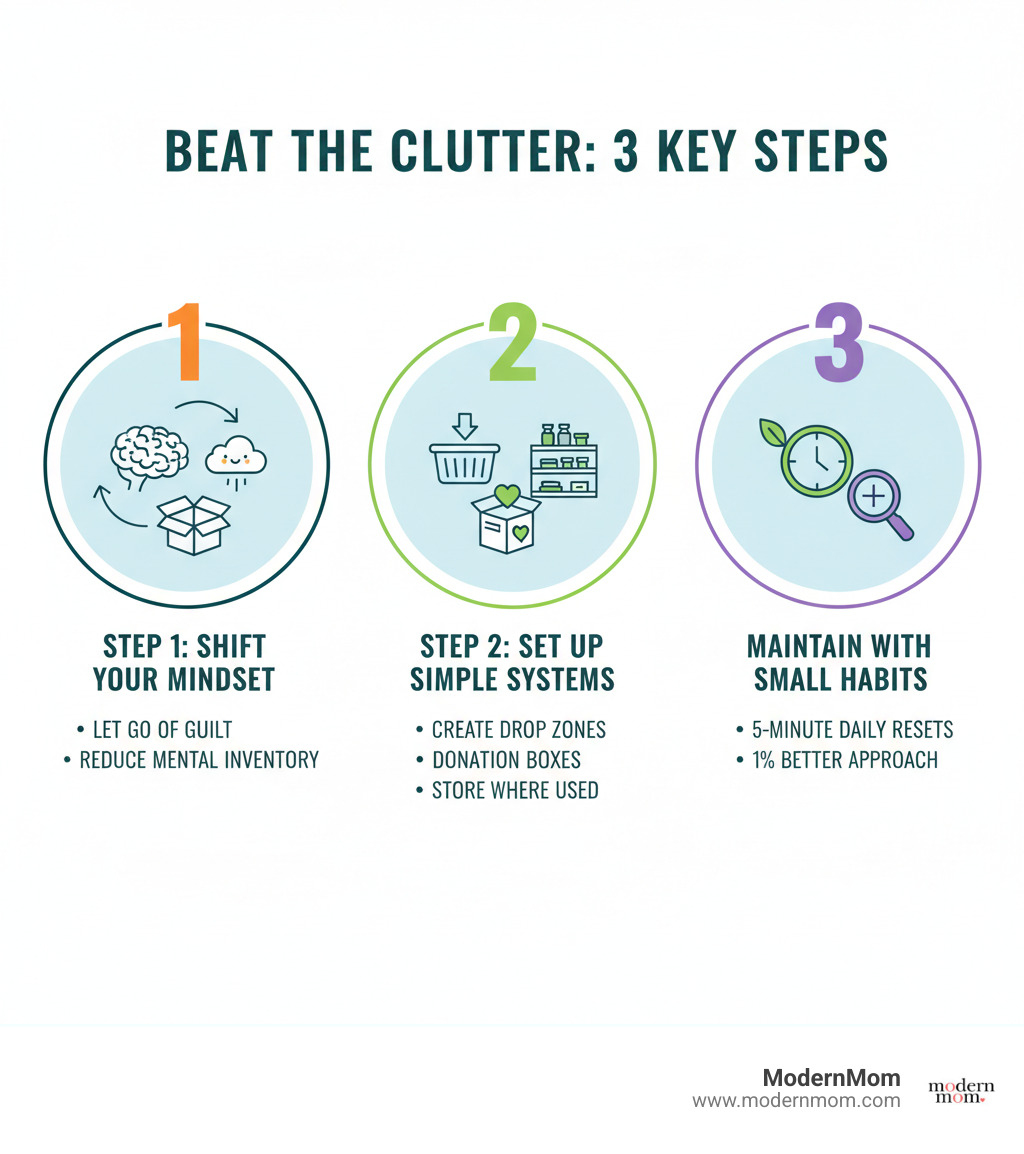
First, Shift Your Mindset (Not Your Furniture)
Here’s something that might surprise you: the biggest clutter problem in your home isn’t actually the stuff on your counters. It’s what’s happening in your head.
Clutter isn’t just physical — it’s a mental burden. Psychologists call it “cognitive load,” and it’s real. Every item you own takes up a tiny bit of mental space, whether you realize it or not. That stack of mail? Your brain is tracking it. Those toys scattered across the living room? Mental energy spent.
Even when we stop consciously seeing the mess (experts call this “junk blindness”), our subconscious mind is still carrying the weight. Studies show that visual clutter actually increases cortisol levels and makes it harder to focus. No wonder we feel stressed when we walk through the door.
But here’s the good news: you don’t need to reorganize your entire house to feel better. You just need to shift how you think about your stuff.
Many moms feel guilty about their clutter, or guilty about getting rid of things. We worry we’re wasteful if we donate something we spent money on. We hold onto items “just in case” we need them someday. We feel like having a messy home means we’re failing somehow.
Let’s stop that right now. Clutter isn’t a moral failing. It’s simply what happens when we have more items than we can realistically manage. When we reframe decluttering as an act of self-care — reducing mental load and creating breathing room for our future selves — everything changes.
The 20/20 Rule for Guilt-Free Decluttering
Want to know one of the most freeing home organization hacks you’ll ever learn? It’s called the 20/20 Rule, and it goes like this: if you can replace an item for under $20 in under 20 minutes, give yourself permission to let it go.
That’s it. Simple, right?
This rule helps us combat two sneaky mental traps. First, there’s the “just in case” mentality — keeping things we don’t use because we might need them someday. Second, there’s the sunk cost fallacy — hanging onto items we don’t need simply because we once spent money on them.
Think about those dried-up bottles of nail polish in your bathroom drawer. Or the tangle of old charging cords in your junk drawer that belong to phones you haven’t owned in years. Would you actually drive to the store to replace that random cord if you threw it out? Probably not — which means you don’t really need it.
The 20/20 Rule gives you concrete permission to release these items without guilt. If a genuine need arises (which is rare), you can easily replace it. In the meantime, you’ve freed up physical space and mental energy.
Think Like a Manager: The ‘Inventory’ Method
Here’s a perspective shift that changes everything: stop thinking of your home as “messy” and start thinking of it as overstocked inventory.
Imagine your house is a warehouse, and everything you own is inventory. When a warehouse has too much inventory, things get lost, damaged, and create chaos. It’s not a management failure — it’s simply too much volume for the system to handle.
The same applies to your home. You don’t have a clutter problem; you have an inventory management problem. When you own more items than you can reasonably track and maintain, things pile up. It’s not about being lazy or disorganized. It’s about having exceeded your capacity.
This simple reframe takes away the personal shame and turns decluttering into a practical project. Your goal isn’t just to tidy up — it’s to reduce your inventory to a manageable level so you can actually find, use, and appreciate what you own.
When you view your belongings this way, letting go becomes easier. You’re not throwing away perfectly good things; you’re optimizing your inventory for better management.
Tackle the ‘Grey Zone’ with the 5-Year Question
Let’s talk about those items that fall into the grey zone — things you’re not sure about. Not quite loved, not quite trash, just… there.
For these tricky items, try the Grey Zone Donation Box method. Gather all those maybes, put them in a box, tape it shut, and write today’s date on it. Set a reminder for one month from now. If you haven’t needed to open that box by then, donate it without looking inside. The fact that you didn’t miss anything proves you don’t need it.
For items you’re more attached to, ask yourself the 5-Year Question: “In five years, will I be glad this is still taking up space in my home?”
This question is especially powerful for sentimental items that have lost their practical purpose, or things you’re keeping for “someday.” Will you really be happy that old textbook is still on your shelf in 2030? Will you wish you’d kept those baby clothes your kids outgrew years ago?
The 5-Year Question helps you make decisions with your future self in mind. If the answer is no — if you won’t miss it or its purpose will be obsolete — it’s time to let it go. You’re not just clearing space today; you’re giving your future self the gift of a lighter mental load.
Genius Home Organization Hacks to Stop Clutter in Its Tracks
Now that we’ve gotten our minds right, let’s talk about setting up systems that actually work. The truth is, the best home organization hacks aren’t about creating a magazine-worthy home. They’re about building simple habits and structures that prevent clutter from taking over in the first place.
Think of it this way: perfection isn’t the goal. Making tidiness easy is.
Create Smart ‘Drop Zones’ and Catch-Alls
You know those spots where stuff just… accumulates? The entryway where backpacks and shoes pile up. The kitchen counter that somehow attracts every piece of mail. The stairs that become a staging area for items that need to go up or down “eventually.”
These high-traffic areas are clutter magnets, and fighting against them is exhausting. Instead, let’s work with them by creating designated drop zones and catch-all baskets.
In your entryway, a small tray or basket can corral keys, sunglasses, and that day’s mail before it spreads across every surface. A stair basket is a game-changer for collecting things that need to migrate between floors. In the family room, a large basket becomes toy central by the end of the day.
The beauty of these catch-all zones? They contain the chaos. Instead of clutter spreading throughout your entire home, it stays in one manageable spot. When you have a few spare minutes, you can quickly “batch declutter” by emptying these baskets and putting things back where they belong. It’s so much easier than hunting down stray items room by room.
One of Our Favorite Home Organization Hacks: Make Donating a No-Brainer
Here’s a simple truth: we’re way more likely to let go of things if the process is easy. That’s why keeping a donation box or bag in strategic spots around your home is one of the smartest home organization hacks you can implement.
Set up a dedicated “outbox” in your bedroom closet for clothes that no longer fit or feel right. The moment you try on those jeans and realize they’re not your style anymore, toss them in. No second-guessing, no piles on the floor.
Do the same in your kids’ closets and playrooms. Children outgrow clothes and toys at lightning speed, and having a donation box right there makes it easy to catch those items before they get buried in the back of a drawer. When the box is full, it goes straight to donation. No storing, no “I’ll deal with this later,” no guilt.
This constant, low-effort decluttering keeps things flowing out of your home naturally. It prevents the buildup that leads to those overwhelming “I need to declutter the entire house this weekend” moments that we all dread.
Store It Where You Use It
This might sound obvious, but it’s amazing how often we ignore this principle. When we store items far from where we actually use them, putting things away becomes a chore. And when something feels like a chore, we’re far more likely to just… not do it.
The solution? Store items exactly where you use them. Keep bathroom cleaning supplies under the bathroom sink, not in a utility closet down the hall. If your kids do crafts at the kitchen table, store the markers and construction paper in a nearby drawer or cabinet, not in their bedroom. That crockpot you use for weeknight dinners? It belongs in your kitchen pantry, not gathering dust in the basement.
This simple strategy dramatically reduces the friction of tidying up. When cleanup becomes a natural, easy extension of using something, it stops feeling like a separate task altogether. You’re not “doing chores”—you’re just finishing what you started. And that makes all the difference for busy families trying to keep clutter at bay.
Clever Storage Tricks That Maximize Your Space
Even after we’ve decluttered, we still need smart places to keep the things we love and use. The good news? We don’t need a bigger house — we just need to use the space we have more creatively. These home organization hacks help us maximize every inch of our homes, especially when we’re working with limited square footage.
Go Vertical! Use Your Walls (and Doors)
When floor space is at a premium, the solution is simple: look up! Vertical storage is one of the most underused home organization hacks out there. Floating shelves can hold everything from books and plants to kitchen essentials, all without eating up precious floor space. They’re perfect for creating storage in unexpected places — above doorways, in narrow hallways, or even in that awkward corner of the bathroom.
Over-the-door organizers are another game-changer. They’re fantastic for corralling shoes, pantry items, cleaning supplies, or bathroom products. We love that they keep things visible and accessible while using space that would otherwise go to waste.
A pegboard mounted on any blank wall becomes an incredibly flexible storage solution. Use it in the garage for tools, in the craft room for supplies, or even in the kitchen for utensils and small pots. The beauty of pegboards is that they adapt as our needs change — just move the hooks around.
Don’t overlook behind-door storage either. Slim shelving units or hanging organizers can tuck into those narrow gaps behind doors, providing discreet storage for books, pantry goods, or bathroom essentials. Even cleaning supplies can hang on simple hooks, freeing up cabinet space and making everything easier to grab.
Repurpose Everyday Items for Creative Home Organization Hacks
Here’s a truth we love: some of the best storage solutions don’t come from a store. Many everyday items we already have can be transformed into clever organizers with a little creativity.
Muffin tins make perfect drawer dividers for small items like jewelry, office supplies, bobby pins, or craft beads. They create instant compartments without spending a dime. Soda can tabs might seem quirky, but they’re brilliant for connecting clothing hangers together, instantly doubling our closet capacity. It’s a simple trick that makes a huge difference in tight closet spaces.
Wine crates can be stacked and secured to create rustic, budget-friendly bookshelves or storage units. They add character to a room while providing practical storage. Picture frames can become creative organizers too — remove the glass, add small hooks or a cork backing, and suddenly we have a stylish way to display jewelry or hang keys near the door.
These repurposing ideas prove that effective organization doesn’t require a big budget. Sometimes the best solutions are hiding in plain sight, just waiting for a new purpose.
The Magic of Matching Bins
Visual consistency might not seem important, but it makes a surprising difference in how organized and calm a space feels. When we use matching bins or baskets throughout our home, it reduces visual clutter and creates a cohesive, pulled-together look.
Whether we prefer woven baskets, clear acrylic containers, or sturdy plastic bins, choosing one style and sticking with it makes everything easier. Matching containers make labeling simpler and allow us to swap items between rooms as our needs change. We can move a basket from the playroom to the pantry or from the bedroom to the bathroom without disrupting the overall look of our home.
These versatile storage solutions work everywhere — pantries, closets, playrooms, bathrooms, and offices. Some of our favorites include Plastic Desktop Paper Storage Baskets for paperwork and mail, a Valet Tray for Men/Catch All Tray for entryway essentials, an Acrylic Vanity Tray for bathroom counters, a Canvas Tote Bag for quick pickups, and an XXXXLarge Blanket Basket for living room throws and toys.
The beauty of this approach is that it grows with us. As our family’s needs evolve, our matching bins adapt right along with them.
Make It Stick: The ‘1% Better’ Approach to a Tidy Home
The biggest secret to long-term organization isn’t a one-time purge; it’s consistent effort. The “1% better” approach means focusing on small, achievable improvements each day rather than aiming for overwhelming perfection. This builds habits that sustain an organized home over time.
Break It Down: The Power of Small Steps
Large organizing tasks can feel incredibly overwhelming, leading to procrastination and even more clutter creep. One of the best home organization hacks is to break down these big projects into tiny, manageable steps. Instead of tackling the whole garage, dedicate 15 minutes to one shelf.
Use a timer and put on some upbeat music or a podcast. This helps us maintain focus and makes the task feel less like a chore. We can even assign a different small task to each day of the week, like “Monday: 15 minutes on the kitchen counter” or “Tuesday: organize one drawer in the bedroom.” Small, frequent bursts of effort are far more effective than infrequent, exhaustive marathons.
The 5-Minute Daily Reset
This is perhaps the most crucial home organization hack for preventing clutter creep from returning. At the end of each day, or during a natural lull, take just five minutes to do a quick reset of our main living areas. This means putting stray items back in their designated homes, fluffing pillows, and clearing surfaces.
Small, frequent resets make a huge difference in avoiding clutter creep. It keeps hot spots from becoming overwhelming and ensures we wake up to a tidier, calmer space. Involve the whole family in this quick routine – even little ones can help put away toys or carry items to their rooms.
Don’t Forget Digital Clutter
In our physical decluttering efforts, it’s easy to overlook virtual clutter, but it can be just as stressful. Our phones and computers are often overflowing with duplicate photos, unused apps, and disorganized files. This is where digital home organization hacks come into play.
Make it a daily habit to delete duplicate photos from our phones. Choose the best shot and discard the rest immediately. This simple act prevents a massive backlog of digital junk, making it easier to find the photos we love and freeing up storage space. Regularly unsubscribe from unwanted emails and organize digital documents into clear folders. A little digital tidying goes a long way.
Frequently Asked Questions about Home Organization
How do I start organizing when I feel completely overwhelmed?
When the clutter feels suffocating and we don’t even know where to begin, the answer is simple: start small. Really small. Pick just one drawer, one shelf, or even a single section of the kitchen counter. That’s it.
Set a timer for 15 minutes and focus only on that tiny area. The goal isn’t to achieve perfection or transform the entire house – it’s simply to make progress. When the timer goes off, stop. Celebrate that small win, even if it feels minor. Tomorrow, tackle another small area. These bite-sized efforts add up faster than we think, and they help us build momentum without burning out.
What’s the fastest way to make a room look tidier?
When unexpected guests are on their way or we just need a quick visual refresh, there’s a simple trick: clear all the flat surfaces. Counters, coffee tables, and dining tables collect clutter like magnets, and clearing them instantly makes a space feel more organized.
Grab a catch-all basket and quickly gather any stray items – we can sort them later. Then, make the bed if it’s a bedroom, or fluff the pillows on the couch if it’s the living room. These simple actions take just minutes but dramatically reduce visual chaos. Our brains register clean, clear surfaces as “tidy,” even if the closets tell a different story.
How can I get my family on board with staying organized?
Getting everyone involved in maintaining an organized home starts with making it easy for them to participate. Create simple, intuitive systems that don’t require much thought – like clearly labeled bins, designated drop zones, and catch-all baskets in key areas. If putting things away is complicated or unclear, it simply won’t happen.
Involve family members in setting up these systems. Ask where they think things should go, rather than dictating rules. When people have input, they’re more likely to follow through. Lead by example with daily resets and keep the tone positive rather than nagging. Make tidying up a shared, low-pressure routine – maybe even set a timer for a quick 5-minute family pickup before dinner. Consistency and clear expectations work better than lectures every time.
Conclusion
You’ve made it through, and hopefully, these home organization hacks have shown you that creating a tidier, calmer home doesn’t require perfection or marathon cleaning sessions. It’s about building simple systems that actually fit into your real, messy, beautiful life.
The goal isn’t a magazine-worthy home that no one actually lives in. It’s about reducing the mental load, making daily life smoother, and giving yourself permission to let go of things that no longer serve you. Every small step—whether it’s a five-minute reset, a donation box in the closet, or finally releasing those “just in case” items—is moving you toward a more peaceful space.
The “1% better” approach means you don’t have to tackle everything at once. You’re not behind, and you’re definitely not failing. You’re simply a busy mom doing her best, and that’s more than enough.
So take a deep breath, pick one small hack from this guide, and give it a try. Celebrate your progress, no matter how tiny it seems. You’re creating a home that works for your family, and that’s something to be proud of.
For more practical tips on managing the stuff in your life and creating a calmer home environment, learn more about managing stuff and creating a calmer home. You’ve got this, mama.
The post The Lazy Girl’s Guide to Home Organization: Hacks That Actually Work appeared first on ModernMom.