


Why Mindful Journaling Matters for Busy Moms
Mindful journaling prompts are targeted questions or sentence starters designed to help you reflect on your thoughts, emotions, and experiences with presence and intention—without judgment. They guide you beyond surface-level thoughts into deeper self-awareness, helping you process everything from daily stress to bigger life questions.
Quick Guide to Getting Started:
- Choose your format: Paper journal or digital app—whatever feels right
- Set aside 5-10 minutes: Morning or evening, just be consistent
- Pick a prompt: Start with simple questions like “What am I grateful for today?” or “Where am I holding tension right now?”
- Write freely: Don’t edit yourself—let the words flow raw and unfiltered
- Review occasionally: Look back to notice patterns and growth
Why This Works for Moms:
Research shows that journaling can reduce anxiety and even speed up physical healing. For mothers juggling endless to-do lists, mental load, and everyone else’s needs, mindful journaling creates a judgment-free space to untangle thoughts, release overwhelm, and reconnect with yourself. It’s like therapy you can do in your pajamas at the breakfast table.
The beauty of mindful journaling is that it shifts your brain from circular, repetitive thinking to linear, constructive processing. Instead of the same worries spinning on repeat, you’re moving through them—one prompt, one breath, one page at a time.
As someone who’s built brands, businesses, and websites from scratch, I’ve learned that clarity comes from slowing down long enough to ask the right questions. Mindful journaling prompts have been that tool for me—and they can be for you, too.
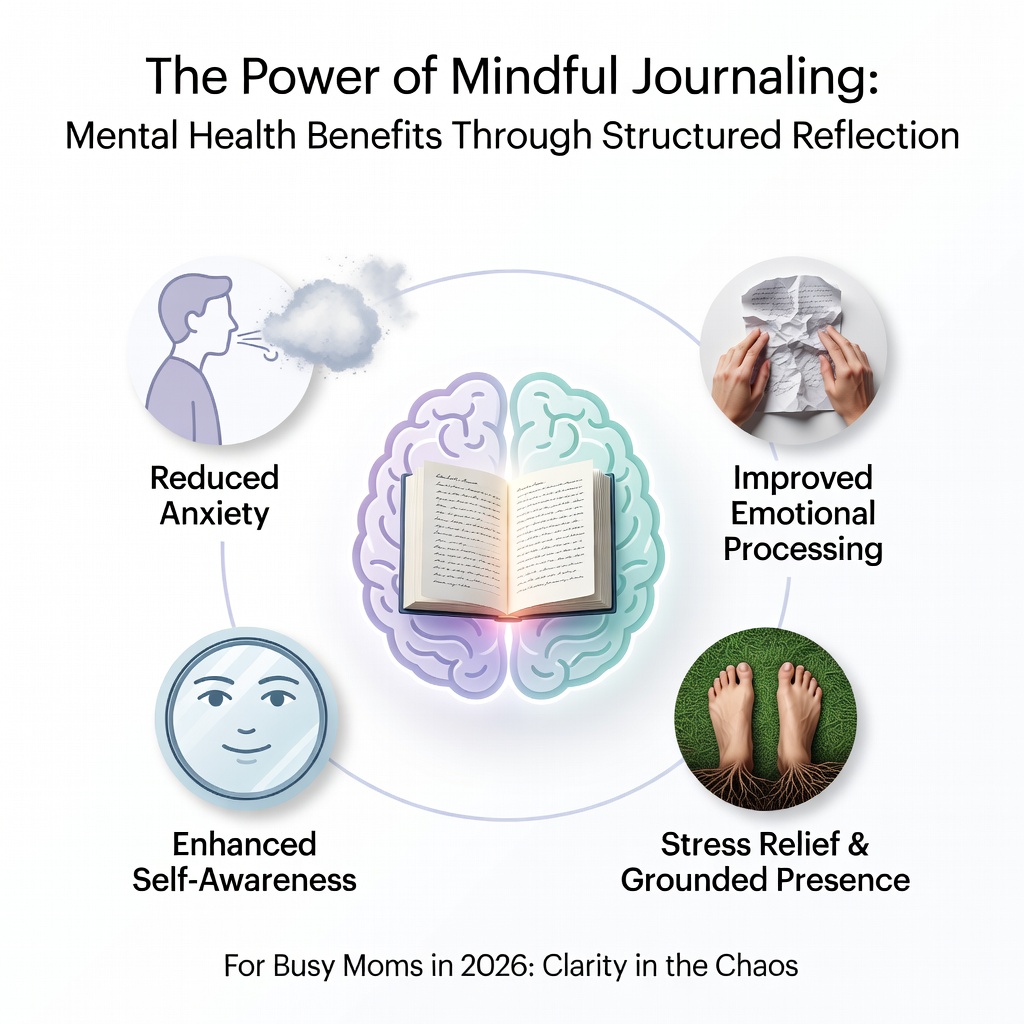
Mindful journaling prompts vocabulary:
The Science and Benefits of Mindful Journaling

When we sit down with a notebook, we aren’t just doodling or venting about a messy kitchen. We are engaging in a practice backed by significant scientific evidence. Studies have shown that journaling for anxiety reduction is incredibly effective, helping us navigate complex emotions and find a sense of calm.
Beyond the mind, the body also responds. Research suggests that expressive writing can actually speed up physical healing by reducing stress hormones that hinder the immune system. For a mom, whose body and mind are often pushed to the limit, this is a powerful tool for holistic recovery.
The science behind mindful journaling prompts
Why does using specific prompts work better than just staring at a blank page? It comes down to how our brains process information. Our thoughts often move in “circular” patterns—we worry about the same thing over and over without reaching a conclusion.
Writing shifts this into a “linear” mode. By using a Self-Esteem Journal For Adults, we force our brains to organize thoughts into sentences. This process helps reprogram the brain to focus on constructive solutions and positive shifts rather than staying stuck in a loop of negative self-talk.
How it differs from regular journaling
Regular journaling is often a “brain dump” of what happened during the day—a log of events. Mindful journaling, however, is about how you are experiencing those events. It’s the difference between writing “The kids were loud today” and “I felt a tightening in my chest when the noise level rose, and I noticed I was holding my breath.”
It requires presence, intention, and a strictly non-judgmental attitude. To deepen this practice, many experts recommend using 17 validated mindfulness tools to help stay grounded in the “now” rather than drifting into the “what if.”
Setting Up Your Practice for Success
You don’t need a mountain of supplies to start. In fact, overcomplicating the setup is one of the quickest ways to quit. The goal is to create a “gentle reset button” for your day.
Choosing your tools
The great debate: analog or digital? Some of us love the tactile feel of pen on paper. It slows us down and removes the temptation of notifications. Using a physical Gratitude Journal Worksheet can make the experience feel more like a sacred ritual.
However, if you’re a mom on the go, a self-care journaling app might be your best friend. It’s always in your pocket, and you can jot down thoughts during a school pickup line or a rare quiet moment in the car. The “best” tool is simply the one you will actually use.
Creating a sustainable routine
Consistency is the secret sauce. It takes time to embed a new pattern into your life—often around 100 days to make it truly second nature. Finding the right time of day is key to making this stick.
| Feature | Morning Journaling | Evening Journaling |
|---|---|---|
| Primary Goal | Setting intentions and prepping for challenges | Processing emotions and letting go of the day |
| Best For | Proactive mindset and focus | Stress relief and better sleep |
| Key Benefit | Reduces “morning anxiety” | Validates experiences and tracks growth |
Whether you choose a morning “brain prime” or an evening “soul soothe,” the key is to link it to new routines and habits you already have, like your morning coffee or your bedtime skincare routine. Remember to approach the page with non-judgmental writing; there are no “bad” entries.
30 Effective Mindful Journaling Prompts for Every Mood
Ready to dive in? Here are 30 mindful journaling prompts categorized to help you find exactly what you need right now.
Gratitude & Presence
- List 3 small, ordinary things that brought you a moment of peace today.
- What is a sound you can hear right now? Describe it in detail.
- Write about a “hidden” blessing in a recent challenge.
- What does your favorite “cozy” spot feel like in your body?
- Describe the taste of your first sip of water or coffee today.
- Use this Gratitude Journal Worksheet to list people who support you.
Self-Reflection & Growth
- What is one thing you did today that made you feel proud?
- If you could give your morning self one piece of advice, what would it be?
- Use the I’m Great Because… Worksheet to list three strengths you used today.
- What is a habit you are ready to release to make more space for joy?
- When do you feel most “yourself”?
- What does “mindful living” mean to you in this current season of life?
Body Awareness & Sensory Observation
- Scan your body from head to toe. Where are you holding tension?
- What color best describes your current mood? Why?
- How does your breath feel as it enters and leaves your nose?
- Describe the texture of the clothes you are wearing right now.
- What is one way you can nourish your physical body in the next hour?
- Sit in silence for two minutes. What was the first thought that bubbled up?
Letting Go & Emotional Release
- Write down one worry and “hand it over” to the paper.
- What is a “mistake” you made today that you are ready to forgive yourself for?
- Describe a situation where you need to set a firmer boundary.
- What is a thought that “serves the least amount of purpose” in your life?
- Write a letter to a fear you have, explaining why it no longer has power over you.
- What are you holding onto that is making your life feel “tense”?
Motherhood & Connection
- What is one beautiful thing you noticed about your child today?
- How can you be the “mom you need” today, rather than the “perfect” mom?
- Write about a moment of connection that felt truly authentic.
- What is a lesson your children have taught you about being present?
- How has your perspective on “strength” changed since becoming a parent?
- What would you say to your pre-mom self about the journey ahead?
How to use mindful journaling prompts for anxiety
When anxiety hits, our thoughts become a tangled mess. Grounding prompts act as an anchor. Instead of spiraling into the future, focus on sensory observation. Ask yourself: “What are five things I can see right now?”
We often feel that mom guilt is like regular guilt except on steroids. Journaling helps us externalize that guilt. When you write it down, you often realize the “rules” you’re breaking are ones you never agreed to in the first place. This emotional release is vital for staying grounded.
Prompts for self-compassion and motherhood
Motherhood is a series of mistakes and lessons learned. We often hold ourselves to impossible standards. Mindful prompts encourage us to look at our journey with the same kindness we offer our children.
Try learning to be the mom my son needs by focusing on your unique bond rather than a Pinterest-perfect image. Use your journal to practice radical forgiveness for the days when you weren’t your “best” self.
Common Mistakes and How to Stay Consistent
The biggest hurdle to journaling isn’t a lack of time—it’s perfectionism. We think if we miss a day, we’ve “failed,” or if our handwriting is messy, it doesn’t count.
Overcoming the blank page
On those “I suck” days, the blank page can feel like an indictment. When you’re feeling like it’s one of those I suck days, don’t try to write a masterpiece. Just start with free-writing. Set a timer for three minutes and write whatever pops into your head, even if it’s “I don’t know what to write.”
Often, the act of just moving the pen breaks the dam. This is a private space. You don’t have to be “inspiring.” You just have to be honest. Whether you’re writing about deep trauma or why I embraced the mom uniform, the goal is clarity, not a Pulitzer.
Combining journaling with other practices
Journaling doesn’t have to exist in a vacuum. It pairs beautifully with other self-care tools.
- Meditation: Journal for five minutes after a meditation session to capture the insights that arose.
- Therapy: Use your journal to track “triggers” or themes to discuss with your therapist.
- Nature: Take your notebook outside. Connecting with the earth can help you process the power of fear and find perspective.
The power of reflection lies in looking back. Every few weeks, read your old entries. You’ll likely see that the things that felt like “emergencies” a month ago have resolved themselves, giving you confidence for today’s hurdles.
Frequently Asked Questions about Mindful Journaling
Can I journal digitally or is paper better?
There is no “right” answer. Science suggests that writing by hand requires more focus and can be more “cathartic” for emotional processing. However, digital journaling is incredibly convenient and offers privacy features like password protection. Choose the one that removes the most friction for you.
How often should I use mindful journaling prompts?
While daily practice is ideal for habit-building, don’t let “every day” become a burden. Aim for 3-4 times a week to start. Even a five-minute session can provide a significant “mental reset.”
Can journaling replace professional therapy?
No. While journaling is a powerful tool for self-awareness and stress reduction, it is not a replacement for professional mental health care. It is, however, an excellent supplement to therapy, helping you do the “homework” of self-reflection between sessions.
Conclusion
At ModernMom, we know that your “daily grind” is often a marathon of giving to others. Mindful journaling prompts offer a way to give back to yourself. By taking just a few minutes to breathe and reflect, you aren’t just filling a notebook—you’re building a more resilient, present, and peaceful version of yourself.
Your emotional well-being is the foundation of your family’s health. When you are grounded, you can navigate the storms of motherhood with more grace and less reactive stress. If you’re looking for more ways to find your center, check out our four tips to control your moods and reach Moodtopia.
Start tonight. Pick one prompt, grab any scrap of paper, and just see what happens. You might be surprised by the wisdom you already carry inside.
The post Beyond the Daily Grind: Mindful Prompts for Deeper Reflection appeared first on ModernMom.