

Why Interactive Study Guides Are Changing Family Homework Time
Homework time shouldn’t feel like a nightly battle. When kids are tired, you’re busy, and everyone just wants to get through it, traditional study methods like rereading notes can feel frustrating and ineffective.
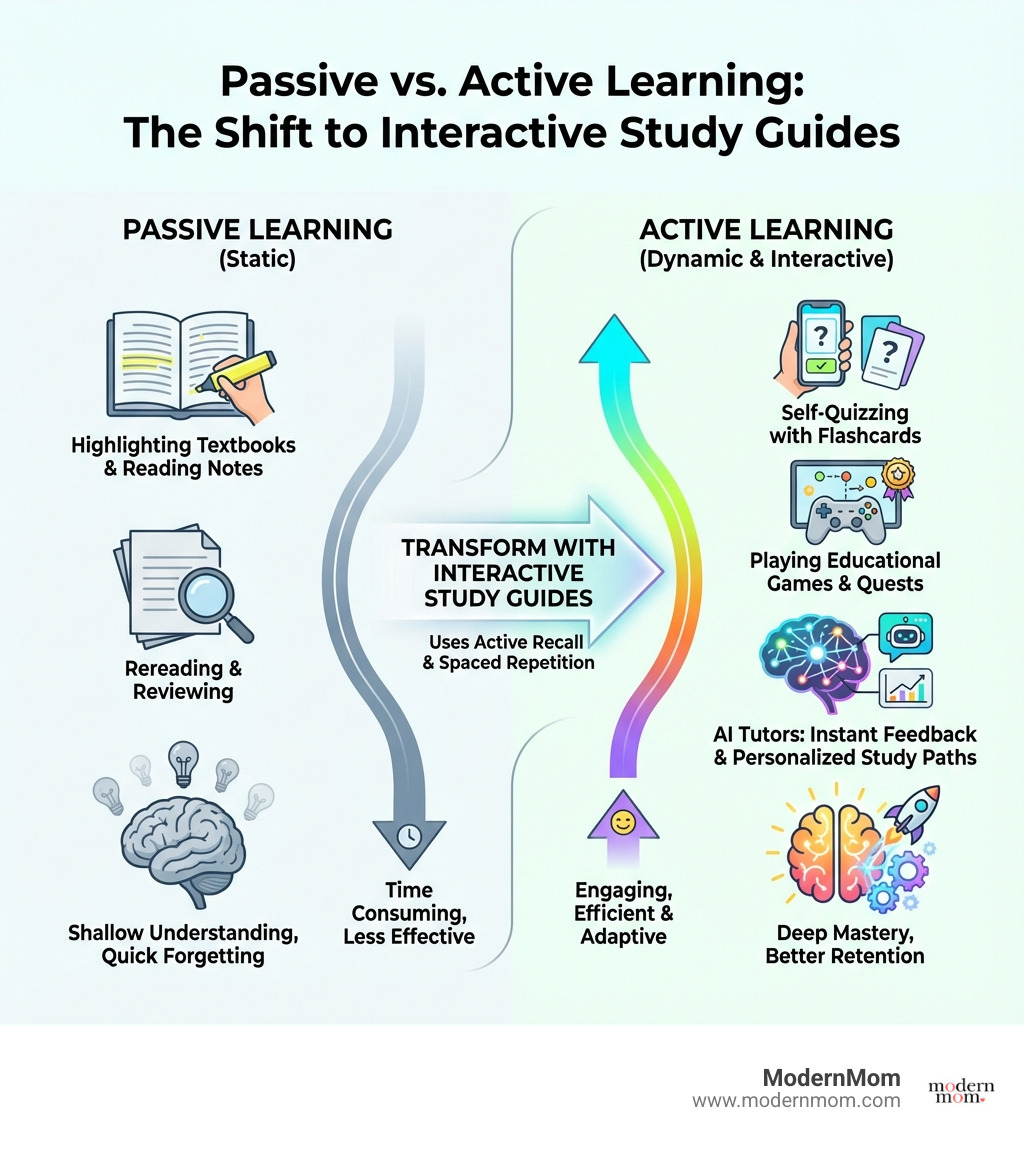
That’s where interactive study guides come in. These are digital or app-based learning tools that turn passive reading into active engagement through quizzes, flashcards, games, videos, and AI-powered tutoring. Instead of staring at a page, your child is clicking, answering, choosing, and creating.
Unlike static notes, interactive guides can adjust to your child’s pace and level. They help studying feel less like a chore and more like a game, which can be a major relief for moms trying to juggle dinner, siblings, and tomorrow’s to-do list.
What makes them different:
- Active learning: Kids answer questions, play games, and get instant feedback instead of just rereading notes.
- Personalized paths: AI adjusts to what your child knows and what still needs practice.
- Built-in motivation: Points, badges, and progress tracking keep kids engaged.
- Always available: 24/7 digital help means no waiting for office hours or pricey last-minute tutors.
Millions of students now use platforms like Quizlet, NotebookLM, and similar tools to study smarter, not harder, and many say these tools improve their understanding and confidence. For busy families, that can mean fewer tears, less nagging, and a calmer evening routine.
The secret is that these platforms use proven learning methods like active recall and spaced repetition to help information actually stick. Instead of cramming and forgetting, kids build real mastery over time. And when learning feels more like a game than a grind, everyone in the house wins.
Interactive study guides glossary:
From Static to Dynamic: What Are Interactive Study Guides?
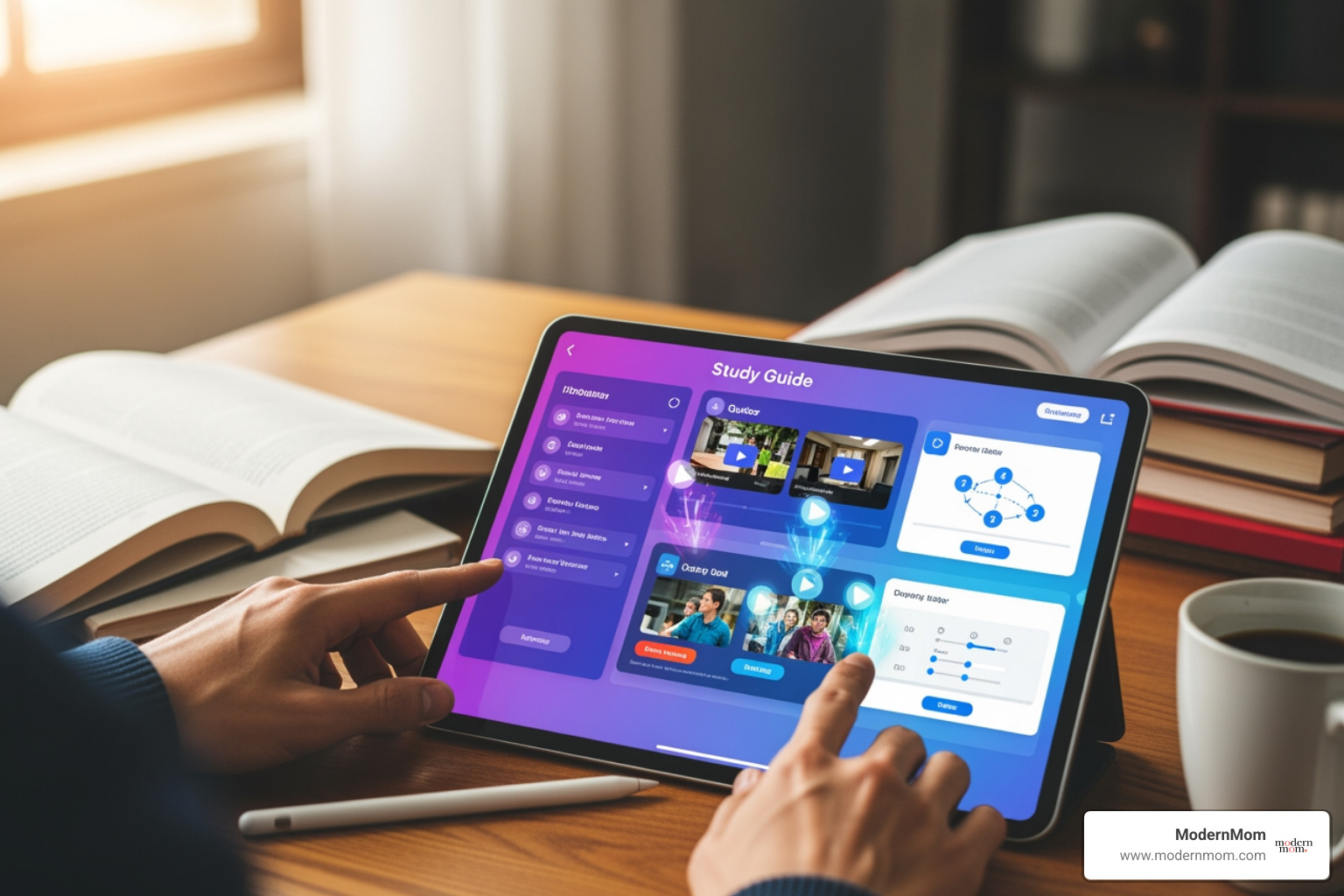
Traditional study guides often mean reading and memorizing. They might be a stack of notes, a textbook chapter, or a printed handout. Interactive study guides, on the other hand, turn learning into an engaging experience that actively involves your child. They move beyond rote memorization to foster deeper understanding.
Instead of passively absorbing information, these digital tools encourage active participation. Think of it like the difference between watching a cooking show and actually getting into the kitchen to bake a cake yourself – the hands-on experience leads to much better retention. This shift from passive learning to active engagement is crucial for effective study.
- Passive learning vs. active engagement: With traditional methods, kids might simply reread notes or highlight text, which often gives a false sense of knowing. Interactive guides demand interaction through questions, problem-solving, and creation. This active involvement strengthens memory pathways.
- The science of retention: active recall and spaced repetition: Many interactive platforms are built on scientific principles. Active recall is when your child retrieves information directly from memory, like answering a quiz question without looking at notes. Spaced repetition involves reviewing material at increasing intervals, ensuring long-term retention. Tools like Thea and Quizlet leverage these methods to optimize learning.
- How interaction boosts motivation: When learning is interactive, it feels less like a chore. Immediate feedback, progress tracking, and gamified elements make studying more rewarding. This positive reinforcement keeps children motivated to continue learning.
- Making learning feel like play: For many children, especially younger ones, if it feels like a game, they’re more likely to do it. Interactive guides can transform dry subjects into exciting challenges, making study time something they actually look forward to.
Why They Work: The Brain Science Behind Interactive Learning
The effectiveness of interactive study guides isn’t just anecdotal; it’s rooted in how our brains learn best. We know that simply reading something once rarely leads to lasting knowledge. Our brains thrive on engagement, challenge, and connection.
- Neuroscience principles: how the brain learns best: Research shows that engaging multiple senses and actively processing information creates stronger neural connections. Interactive tools encourage this by requiring decisions, problem-solving, and varied responses, rather than just passive input.
- Dopamine and rewards: why fun matters: When your child successfully answers a question, earns points, or completes a challenge in an interactive guide, their brain releases dopamine. This “feel-good” chemical reinforces the learning behavior, making them more likely to seek out similar positive experiences in the future. It’s why gamification is so effective.
- Building stronger neural pathways: Each time your child actively recalls a piece of information or solves a problem, they strengthen the neural pathways associated with that knowledge. This makes it easier and faster to access that information in the future. The more varied the interaction, the more robust these pathways become.
- Reducing cognitive overload: Complex topics can be overwhelming. Many interactive study guides break down material into “byte-sized lessons” or manageable chunks, reducing cognitive load. This allows your child’s brain to process and integrate new information more effectively without feeling swamped.
- Moving from memorization to true mastery: Instead of just memorizing facts for a test, interactive tools encourage understanding. By applying concepts in quizzes, simulations, or problem-solving scenarios, children move beyond surface-level recall to a deeper, more flexible understanding of the material.
- The psychology of gamification: Gamification taps into our natural desire for achievement, competition, and progress. Features like points, levels, leaderboards, and virtual rewards transform studying into an engaging activity. This makes learning less intimidating and more motivating, helping kids build strong study habits.
Traditional vs. Interactive Study Guides
To truly appreciate the power of interactive study guides, it’s helpful to see how they stack up against the methods many of us grew up with.
| Traditional Study Guides | Interactive Study Guides |
|---|---|
| Static text | Dynamic content |
| Rote memorization | Active recall |
| One-size-fits-all | Personalized paths |
| Low engagement | High engagement |
| Delayed feedback | Instant feedback |
Traditional methods often rely on passive reading and rereading, which can be inefficient and boring. They don’t adapt to individual learning speeds or styles, and feedback is usually delayed until a test or assignment is graded.
Interactive study guides, however, offer dynamic content that changes based on your child’s performance. They actively prompt recall, personalize the learning journey, keep engagement levels high, and provide immediate feedback so mistakes can be corrected right away. This difference is key to improving retention and making learning more effective.
Key Features to Look For in an Effective Tool
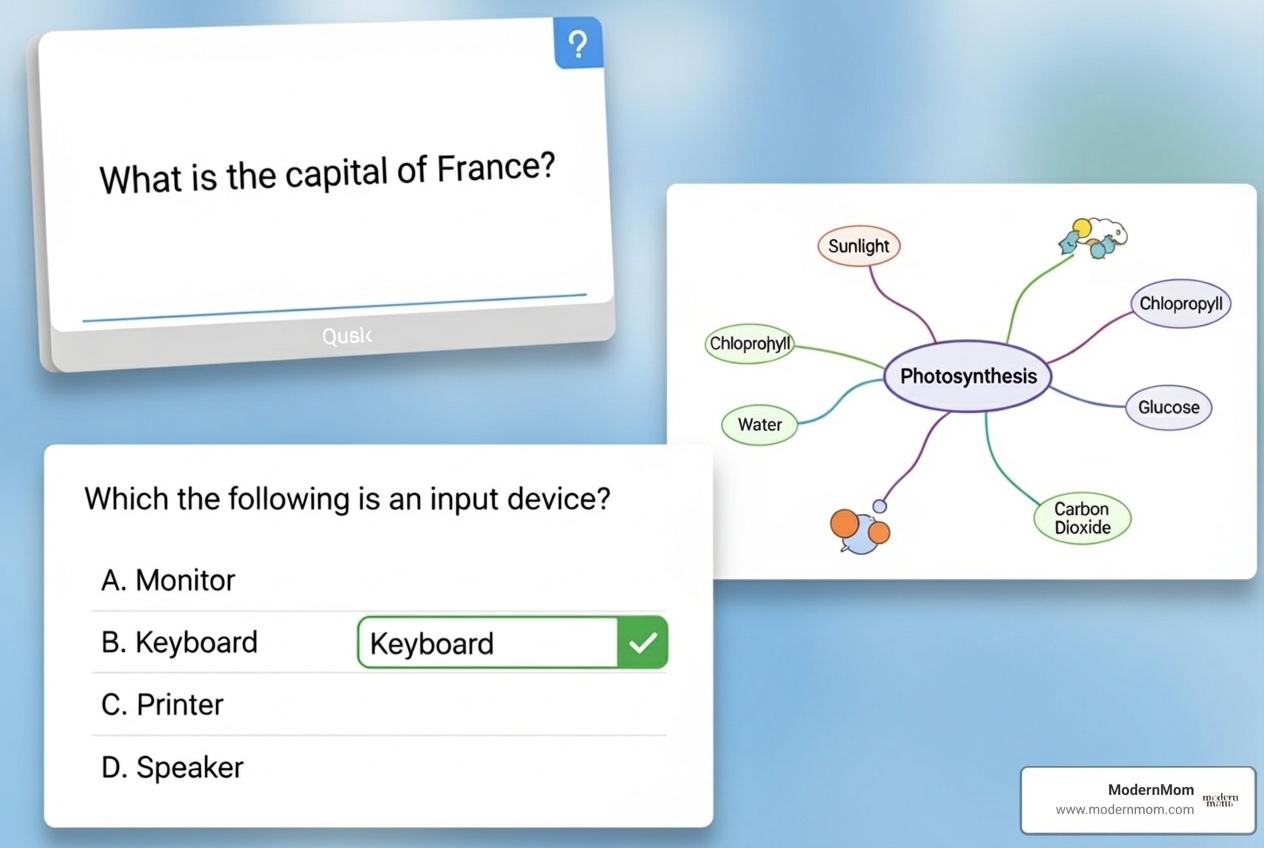
When exploring interactive study guides, you’ll find a wide array of features designed to improve learning. Knowing what to look for can help you choose the best fit for your family. The most effective tools combine a mix of engaging activities, smart assistance, and rich media.
Quizzes, Flashcards, and Games
These are often the bread and butter of interactive learning, changing passive review into active practice.
- Self-quizzing: This is a cornerstone of active recall. Platforms like Quizlet and Thea provide varied question formats, from multiple-choice to true/false, helping your child test their knowledge and identify areas needing more attention. Penseum even offers AI-generated questions.
- Digital flashcards: Far more versatile than paper cards, digital flashcards allow for multimedia integration (images, audio) and often incorporate spaced repetition algorithms to optimize review schedules. They’re fantastic for vocabulary, facts, and quick definitions.
- Points, badges, and friendly competition: Gamification elements like earning points for correct answers, open uping badges for completing modules, or even competing on leaderboards (with friends or classmates) can significantly boost motivation. This makes studying feel like a game rather than a chore.
- Matching games and fill-in-the-blanks: These simple yet effective games reinforce connections between concepts and test recall in a fun, low-pressure environment. Thea, for example, offers new games to keep children engaged while boosting retention.
Smart Assistance and Personalization
The integration of Artificial Intelligence (AI) has revolutionized interactive study guides, allowing for unprecedented levels of personalization and support.
- Digital tutors and chat help: Tools like Studley AI offer 24/7 virtual tutors that can explain complex topics, answer questions, and provide instant feedback, much like a human tutor but without the high cost. NotebookLM also provides personalized chat help alongside traditional study tools.
- Summarization tools: For busy students, distilling lengthy textbooks or lecture notes into concise summaries is invaluable. Platforms like Thea and NotebookLM can generate one-click summaries, helping your child grasp key concepts quickly.
- Question generation: Beyond pre-made quizzes, some AI tools can generate custom questions based on your child’s uploaded materials, ensuring practice is custom to their specific curriculum. Penseum can instantly create AI study guides, flashcards, and quizzes from various materials.
- Adaptive learning paths: The most advanced interactive study guides use AI to track your child’s progress, identify their strengths and weaknesses, and then adapt the learning path accordingly. This means they spend more time on topics they struggle with and less on what they’ve already mastered. Studley AI and Thea both emphasize personalized study sessions that adjust to what a user knows.
- Learn more about how AI can support studying by changing your course material into dynamic study sets.
Rich Media and Simulations
Engaging multiple senses and providing context can significantly improve understanding and retention.
- Embedded videos: Visual learners benefit immensely from videos that explain concepts or demonstrate processes. Many interactive study guides allow for embedding educational videos directly within the material. NotebookLM can even transform uploaded YouTube URLs into study aids.
- Audio summaries: For auditory learners or those on the go, audio summaries are a game-changer. NotebookLM can generate “Audio Overviews” from study content, allowing your child to listen and learn anywhere. Studley AI also offers AI-generated audio podcasts.
- Interactive diagrams: Instead of static images, interactive diagrams allow students to click on different parts to reveal information, watch animations, or explore concepts in more detail, making complex visuals easier to understand.
- Virtual labs and real-world scenarios: For subjects like science or engineering, virtual labs can provide a safe and accessible way to conduct experiments. Simulations allow students to apply theoretical knowledge to real-world problems, fostering critical thinking and problem-solving skills.
How to Bring Interactive Learning Home
Bringing interactive study guides into your home can be a fantastic way to support your child’s education. But like any new tool, it’s most effective when chosen thoughtfully and integrated strategically into your family’s routine.
How to Choose the Right Tool for Your Child
With so many options available, finding the perfect fit can seem daunting. Here’s what to consider:
- Consider age and grade level: A tool designed for a high schooler might be too complex for a middle schooler, and vice-versa. Look for platforms that specify their target age range and adapt content appropriately. Shmoop, for example, offers resources for various levels, from middle school essays to college prep.
- Match learning styles (visual, auditory, kinesthetic): Does your child learn best by seeing, hearing, or doing? Visual learners might prefer tools with lots of diagrams and videos, auditory learners will love audio summaries, and kinesthetic learners will thrive with quizzes and simulations. Studley AI, for instance, offers diverse formats like flashcards, audio podcasts, and written tests.
- Focus on subject matter needs: Some platforms specialize in specific subjects, like LearnPython.org for coding or Oxford Learner’s Dictionaries for grammar. Others, like Quizlet or Penseum, are broad-spectrum. Consider your child’s current academic challenges.
- Compare free vs. paid plans: Many excellent interactive study guides offer free basic features. Quizlet, Thea, and Penseum all provide free access with options to upgrade for more advanced tools. Evaluate what you get for free before committing to a subscription, which can range from a few dollars a month (like Penseum’s $9.99 premium) to more.
- Look for ease of use and family-friendly features: A tool won’t be used if it’s too complicated. Opt for intuitive interfaces. For younger children, consider features that allow for parental oversight or progress tracking.
How to Integrate interactive study guides into Your Routine
Once you’ve chosen a tool, integrating it effectively into your child’s study habits is key.
- Set clear goals together: Discuss what your child hopes to achieve with the guide—whether it’s mastering a specific chapter, preparing for an exam, or improving a particular skill. This shared understanding fosters accountability.
- Schedule regular, short study sessions: Consistent, shorter sessions are often more effective than long, infrequent cramming. Aim for 15-30 minute bursts, especially when using tools that leverage spaced repetition. This aligns with the idea of “byte-sized lessons” offered by platforms like Penseum.
- Use tools for homework help and exam prep: Leverage interactive study guides to turn homework assignments into practice opportunities. For exams, they can be invaluable for creating custom quizzes and flashcards from lecture notes, as highlighted by Penseum’s ability to convert notes, PDFs, and videos into study sets.
- Encourage breaks and avoid distractions: Even the most engaging digital tools need to be balanced with breaks. Encourage your child to step away from the screen regularly. Minimize notifications and other digital distractions during study time to maximize focus.
- Learn about educational scaffolding for kids to understand how temporary support can help your child master new skills, a principle often built into adaptive learning platforms.
Navigating the Challenges of Digital Learning
While interactive study guides offer incredible benefits, it’s also smart to be mindful of potential pitfalls. Here’s how to navigate the challenges of digital learning and keep things balanced.
- Manage screen time as a family: Digital tools mean more screen time. Establish clear family guidelines for screen use, ensuring a healthy balance with physical activity, social interaction, and offline learning.
- Double-check AI-generated answers for accuracy: AI tools are getting smarter, but they aren’t perfect. It’s a good practice to encourage kids to fact-check AI-generated answers, especially for important assignments. This also helps build their critical thinking skills.
- Talk about academic integrity: It’s crucial to distinguish between using tools to learn and using them to cheat. Discuss what constitutes plagiarism and how to properly cite sources. Many platforms, like Studley AI, explicitly state, “We help you study. Not cheat.”
- Avoid over-reliance on digital tools: While powerful, these tools should complement, not replace, fundamental learning skills like critical reading, note-taking, and independent problem-solving. Encourage your child to articulate concepts in their own words, even after using an interactive guide.
- Stay aware of data privacy: When using online platforms, be mindful of privacy policies and what data is collected. Ensure your child’s personal information and academic progress are protected.
Frequently Asked Questions about Interactive Study Tools
It’s natural to have questions about bringing new educational technology into your home. Here are answers to some of the most common concerns about interactive study guides.
Are these tools considered cheating?
This is a valid and important question. The answer largely depends on how your child uses them.
- Focus on learning, not just getting answers: The purpose of interactive study guides is to help your child understand and retain information, not to simply provide answers to assignments. If a tool is used to deepen comprehension and practice skills, it’s a valuable learning aid.
- Understand your school’s policies: Every school has its own rules on using external study aids. It’s always a good idea to check your child’s school handbook or chat with their teachers to make sure you’re on the same page.
- Use tools to build understanding, not to plagiarize: If an AI tool generates an essay or answers specific homework questions without your child engaging with the material, that crosses the line into academic dishonesty. The goal is to use the tool to learn the content so they can then produce their own original work.
- Many platforms emphasize “We help you study. Not cheat.”: Reputable platforms are clear about their intent. Studley AI, for example, directly addresses this, positioning itself as a tool for accelerated learning and skill development.
Can interactive tools really replace a human tutor?
While interactive study guides offer incredible advancements, they typically serve a different, albeit complementary, role to human tutors.
- AI tutors offer 24/7 help and can be more affordable: Digital tutors, like those found on Studley AI and Penseum, provide instant answers, personalized explanations, and practice questions anytime, anywhere. This accessibility and lower cost can be a huge advantage, especially for quick questions or late-night study sessions.
- There are limits—human connection still matters: A human tutor can offer nuanced emotional support, adapt to complex social cues, provide mentorship, and engage in deeper, open-ended discussions that AI tools aren’t yet capable of. They can also identify learning disabilities or emotional blocks that an algorithm might miss.
- A hybrid approach often works best: For many families, the ideal solution combines the best of both worlds. Interactive study guides can handle routine practice, fact recall, and initial concept explanations, freeing up human tutors for more complex problem-solving, personalized feedback on essays, or addressing specific learning challenges.
How much do these platforms typically cost?
The cost of interactive study guides varies widely, from completely free resources to premium subscription models.
- Many offer free basic features: Most platforms, including Quizlet, Thea, and Penseum, provide a robust free tier. This often includes access to flashcards, basic quizzes, and content creation tools. This is a great way to try out a platform before committing financially.
- Premium subscriptions add more options: Paid plans typically open up advanced features like ad-free experiences, unlimited content creation, specialized study modes (like Quizlet Plus’s premium modes), detailed analytics, and increased usage limits for AI features. Penseum offers a premium subscription for $9.99, while Studley AI has an unlimited plan for a weekly fee.
- Look for student discounts and family plans: Some platforms offer reduced rates for students or bundles for multiple users. Always check for these options to make the most of your budget. Platforms like Studley AI highlight that they can be significantly more cost-effective than an “overpriced tutor.”
Conclusion: Boost Confidence and Make Learning Fun
The world of education is constantly evolving, and interactive study guides are at the forefront of this exciting change. They offer a powerful way to transform traditional, often tedious, study habits into engaging, effective, and even fun learning experiences. By leveraging the science of how we learn and the power of technology, these tools can empower your child to build confidence, achieve academic success, and truly master their subjects.
Juggling daily life while trying to give our kids the best opportunities is a familiar challenge. Investing in an interactive study guide can mean a smarter, less stressful approach to homework for the whole family. Remember, you’re not alone in this, and there are great tools out there to make the journey a little easier.
Find more ways to help your student stay organized with our guide to the best planners and apps
The post Study Smarter, Not Harder: Your Guide to Interactive Learning Tools appeared first on ModernMom.