


Why Your Merit Scholarship Search Matters More Than You Think
Merit scholarship search doesn’t have to be overwhelming. Here’s what you need to know right now:
Where to Start Your Merit Scholarship Search:
- Online platforms – Scholarships.com, Bold.org, BigFuture Scholarship Search
- Your high school – Guidance counselors have lists of local opportunities
- Colleges directly – Most schools offer institutional merit awards
- Community organizations – Local foundations, employers, religious groups
- Professional associations – Field-specific scholarships in your child’s area of interest
Quick Eligibility Check:
- Most merit scholarships require a 3.0 to 3.5 GPA (not a perfect 4.0!)
- Extracurricular involvement counts as much as grades
- Leadership, community service, and unique talents all qualify
- Many scholarships focus on specific demographics, fields of study, or interests
If you’re staring at college costs and feeling that pit in your stomach, you’re not alone. Over $100 billion in scholarship money is available each year, but finding the right opportunities for your child can feel like searching for a needle in a haystack.
Here’s the good news: merit scholarships aren’t just for valedictorians. They’re awarded based on achievement—whether that’s academic performance, athletic ability, artistic talent, leadership experience, or even niche interests like entrepreneurship or animal advocacy. And unlike need-based aid, they don’t require proof of financial hardship.
The average undergraduate scholarship winner at a four-year college earns $15,750. That’s real money that doesn’t need to be paid back. But with nearly 1.6 million students entering just one scholarship program (the National Merit Scholarship Program) each year, the key is knowing where to look and how to make your child’s application stand out.
This guide will walk you through everything you need to know about merit scholarship search—from understanding what qualifies as “merit” to finding hidden opportunities that match your child’s unique strengths. Whether your teen is a straight-A student, a dedicated volunteer, or a passionate artist, there’s funding out there for them.
As a mom myself, I’ve helped families steer the overwhelming world of college planning and financial strategy. Through years of supporting parents in finding practical solutions to complex challenges, I’ve learned that a successful merit scholarship search is less about perfection and more about finding the right fit for your child’s unique story and strengths.
Quick Merit scholarship search definitions:
What is a Merit Scholarship (and Why It’s Not Just for Geniuses!)
A merit scholarship is a financial award given to students based on their achievements, talents, or specific qualities, rather than their financial need. Think of it as a reward for all the hard work your child has put in, whether that’s acing exams, leading a club, or excelling on the field. It’s a fantastic way to help offset the rising costs of higher education.
These scholarships are designed to recognize and encourage excellence. They celebrate students who stand out from the crowd, showcasing their potential to contribute positively to a college community and beyond. What’s truly liberating about merit scholarships is that they don’t require repayment, making them a highly desirable form of financial aid.
The Education Data Initiative highlights that funding may be more available than many realize. While competitive, not all merit scholarships have impossible odds, especially if you know where to look. It’s about finding the right fit, not just the biggest award.
Common Qualifying Criteria
So, what exactly makes a student eligible for a merit scholarship? While specific requirements vary widely, several common criteria pop up frequently in a merit scholarship search:
- Good grades: This is often the first thing people think of. Many merit awards go to students with GPAs over 3.50, though a 3.0 GPA is often sufficient for many opportunities. Some highly competitive programs might look for GPAs closer to 3.8 or above.
- Standardized test scores (SAT/ACT): High scores on these tests can open doors to many academic merit scholarships. Programs like the National Merit Scholarship use PSAT/NMSQT scores as a primary qualifier.
- Extracurricular involvement: Colleges and scholarship committees love to see well-rounded students. Participation in clubs, sports, arts, or other activities demonstrates passion and commitment.
- Leadership roles: Whether it’s captaining a sports team, leading a student organization, or organizing a community event, showing initiative and the ability to guide others is highly valued.
- Community service: Dedication to helping others and making a positive impact in the community is a strong indicator of character and social responsibility.
It’s not just about checking boxes. Scholarship organizations often look for students with real passions and interests, not just perfect scores. Your child’s unique story and how they’ve applied themselves in these areas are what truly make them shine.
How It Differs from Other Financial Aid
Understanding the landscape of financial aid can feel like deciphering a secret code. Merit scholarships are just one piece of the puzzle, and it’s helpful to see how they stack up against other options.
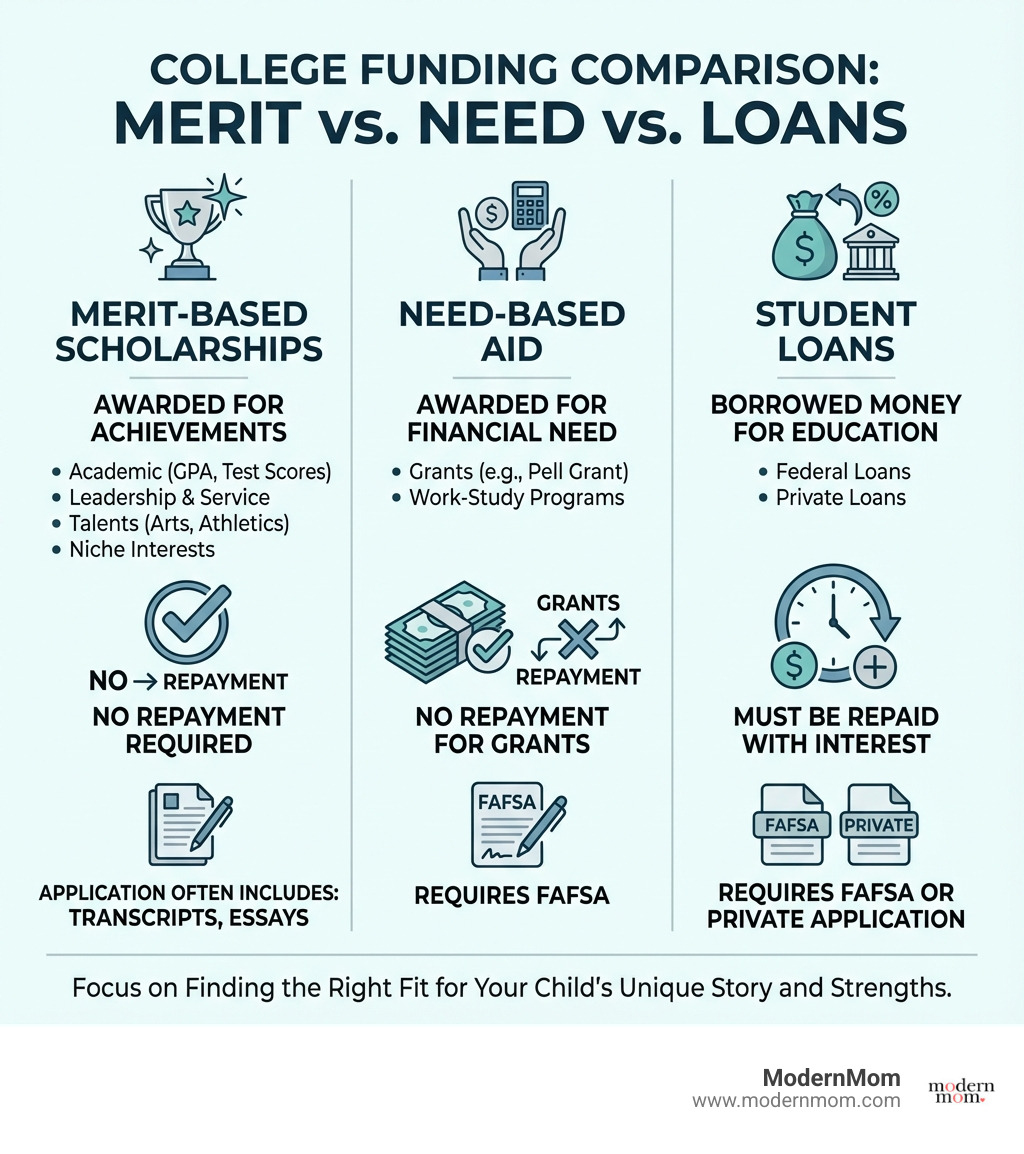
Here’s a quick comparison:
| Type of Aid | Awarded For | Repayment Required | Primary Application |
|---|---|---|---|
| Merit Scholarship | Achievements (academic, talent, leadership) | No | Scholarship-specific forms, essays, transcripts, recommendations |
| Need-Based Grant | Demonstrated financial need | No | FAFSA, CSS Profile |
| Student Loan | Money borrowed for education | Yes (with interest) | FAFSA (for federal), Lender application (for private) |
While merit scholarships are based on achievement, need-based grants, like the Pell Grant, are awarded because your family demonstrates a financial inability to pay for college. These typically require completing the Free Application for Federal Student Aid (FAFSA) and sometimes the CSS Profile, which assesses your family’s financial situation.
Student loans, on the other hand, are money you borrow and must pay back, often with interest. While they can bridge funding gaps, they add to your child’s future financial burden. That’s why a focused merit scholarship search is so valuable – it’s money earned, not borrowed.
Finding Their Niche: The Different Types of Merit Scholarships
Merit scholarships aren’t a one-size-fits-all solution. In fact, their diversity is one of their greatest strengths! Your child’s unique talents and interests can be the key to open uping funding. Finding their niche is all about matching their strengths to the right opportunity.

When you start on your merit scholarship search, you’ll find categories like:
- Academic scholarships: For excellent grades, test scores, and intellectual curiosity.
- Athletic scholarships: For standout athletes who excel in a particular sport.
- Artistic scholarships: For talented performers, artists, musicians, and writers.
- Community service awards: For students dedicated to volunteering and making a difference.
- Field-of-study scholarships: For those pursuing specific majors, like engineering, nursing, or education.
- Demographic-based scholarships: For students from particular backgrounds, ethnicities, or regions.
The key is to look beyond just the most obvious academic awards and explore every avenue that aligns with your child’s profile.
Academic and Leadership Awards
These are perhaps the most recognized forms of merit scholarships. They celebrate intellectual prowess and the ability to inspire and guide others.
- National Merit Scholarship Program: This is a highly prestigious academic contest. Nearly 1.6 million high school students enter this competition each year, with 50,000 students qualifying as semifinalists based on their PSAT/NMSQT scores taken in their junior year. By the end, a select group receives scholarships totaling nearly $35 million. Even being a commended student or finalist can boost college applications. You can learn more about the National Merit Scholarship Program here.
- GPA-based scholarships: Many colleges offer automatic merit scholarships based on incoming students’ GPAs and test scores. These are often awarded directly by the institution.
- Leadership experience: Scholarships often reward students who have held significant leadership roles, whether in student government, clubs, or community initiatives. They look for individuals who can take initiative and drive change.
- Prestigious international awards: For those aiming for the very top, programs like The Rhodes Scholarship offer full funding for postgraduate study at Oxford University, recognizing exceptional intellect, character, leadership, and commitment to service.
Talent-Based and Special Interest Scholarships
Not every student is a straight-A academic, and that’s perfectly fine! There are countless scholarships designed to reward talent and passion in other areas.
- Athletic ability: If your child excels in a particular sport, they might qualify for athletic scholarships from colleges. These can cover a significant portion of tuition and expenses.
- Artistic portfolios: For the creative types, scholarships are available for those showcasing talent in music, art, dance, theater, creative writing, and more. This often involves submitting a portfolio, audition, or written piece. For example, the A. A. Milne creative writing scholarship encourages students to share a 3-5 sentence story to express something about themselves.
- Unique hobbies and niche interests: This is where the merit scholarship search gets really interesting. Are they passionate about robotics? Do they have a knack for competitive gaming? Are they an avid birdwatcher? There are scholarships for almost every interest imaginable. Don’t overlook these smaller, often less competitive awards!
Your Strategic Merit Scholarship Search: Where to Find the Hidden Gems
Finding scholarships can feel like a treasure hunt, but with a strategic approach, you can uncover those hidden gems. It’s not just about knowing where to look, but also knowing how to look effectively.

Your merit scholarship search should be multi-faceted, utilizing various resources:
- Online search engines: These are powerful tools to cast a wide net.
- High school counselors: They often have lists of local and regional opportunities, and can sometimes connect students with specific programs.
- College financial aid offices: Many colleges offer their own institutional merit scholarships, so check with each school your child is interested in.
- Community foundations: Local organizations often have scholarships for students from their specific area.
- Employer affiliations: Many companies offer scholarships for employees’ children. Don’t forget to check with current or past employers of family members.
Top Platforms for Your Merit Scholarship Search
To make your merit scholarship search more efficient, we recommend starting with these popular platforms:
- BigFuture by College Board: This robust tool allows you to search for more than 9,500 scholarships, fellowships, grants, and other financial aid award opportunities. You can filter by keyword, award type, level of study, location, and even affiliation. It’s a great starting point for a comprehensive search. You can begin your Scholarship Search – BigFuture | College Board here.
- Scholarships.com: This platform simplifies the search by matching students with scholarships based on their profile. It’s known for having a vast database and helping students find merit-based awards custom to their achievements.
- Bold.org: This site offers exclusive scholarships not found elsewhere, with over $40 million awarded to its members. They even have “no-essay” scholarships awarded based on your profile. The platform found 10,000 awards based on various criteria, showing the sheer volume of opportunities.
- Niche-specific sites: Don’t forget to look for scholarship search engines related to your child’s specific field of study, ethnicity, or unique interests. These often yield less competitive, highly targeted awards.
When using these platforms, make sure your child’s profile is as complete and detailed as possible. The more information they provide, the better the matching algorithm will work.
Prestigious Programs to Keep on Your Radar
While smaller, niche scholarships are fantastic, it’s also worth knowing about some of the more prominent merit scholarship programs. These are highly competitive but offer substantial awards and recognition.
- The National Merit Scholarship Program: As mentioned earlier, this program is a gold standard for academic achievement. It recognizes students with outstanding PSAT/NMSQT scores and can lead to significant scholarship money. Fifty thousand students qualify as semifinalists every year, with a select group receiving scholarships totaling nearly $35 million.
- The Gates Scholarship: This incredibly generous scholarship, funded by the Bill & Melinda Gates Foundation, is designed for outstanding minority high school seniors from low-income households. It’s a full-ride scholarship, covering the full cost of attendance (tuition, fees, room and board, books, transportation) for undergraduate study. While it considers financial need, it primarily seeks academic excellence and leadership potential.
- The Fulbright Program: For students dreaming of international study after their undergraduate degree, the Fulbright Program is a prestigious opportunity. Sponsored by the U.S. government, it offers scholarships for U.S. citizens to study, conduct research, or teach abroad, fostering mutual understanding between countries. It’s a fantastic option for those seeking global experiences.
Helping Them Shine: How to Craft a Winning Application
Once you’ve identified potential scholarships through your merit scholarship search, the next step is crafting an application that truly shines. This is where your child’s unique story and hard work come together. It’s not just about listing accomplishments; it’s about presenting them in a compelling way.
The application process typically involves gathering several key documents, writing insightful essays, and securing strong letters of recommendation. Staying organized is paramount to avoid missing deadlines or overlooking crucial details.
As you start on this journey, applying for scholarships is a bit like preparing for a big family event—it requires planning, attention to detail, and sometimes, a little help from others. And speaking of planning, remember to get a head start on financial planning for the holidays too, with tips like those in our Holiday budget prep: 3 things you should do now article.
Tips for a Successful Merit Scholarship Search and Application
Navigating multiple scholarship applications can feel like a juggling act. Here are our top tips to help your child stay on track and maximize their chances of success:
- Create a calendar and track deadlines: This is non-negotiable. Use a digital calendar or a physical planner to note every deadline, required document, and submission method. Many scholarship sponsors may change deadlines, so always confirm directly on their websites.
- Tailor each application: Resist the urge to use a generic essay or activity list for every scholarship. Each application should be customized to highlight how your child meets that specific scholarship’s criteria and values.
- Gather documents early: Request transcripts, test scores, and letters of recommendation well in advance. Teachers and counselors are busy, so give them plenty of time.
- Proofread everything: A polished application reflects attention to detail. Grammar and spelling errors can detract from even the most impressive achievements. Have fresh eyes (like yours!) review it.
- Showcase uniqueness: What makes your child truly special? Their passions, their challenges, their dreams. Don’t be afraid to let their personality shine through. Scholarship committees aren’t looking for cookie-cutter students; they want individuals with real passions and unique perspectives.
The Art of the Scholarship Essay
The scholarship essay is often your child’s best opportunity to stand out from a pool of qualified applicants. It’s more than just a writing sample; it’s a chance to tell their story and connect with the committee on a personal level.
- Personal statement: This is their moment to introduce themselves beyond grades and test scores. What experiences have shaped them? What lessons have they learned?
- Tell a compelling story: Instead of simply stating achievements, weave them into a narrative. For example, instead of saying “I volunteered at a soup kitchen,” describe a specific interaction or moment that had a profound impact.
- Show, don’t tell: Use vivid language and concrete examples to illustrate their qualities. If they’re resilient, describe a time they overcame a challenge.
- Explain extenuating circumstances: If there were periods where grades or extracurriculars suffered due to unforeseen circumstances (like family responsibilities or personal challenges), the essay is the perfect place to explain this. Committees are often understanding if a valid reason is provided.
- Connect experiences to future goals: How have their past achievements and experiences prepared them for their chosen field of study or future aspirations? How will this scholarship help them achieve those goals and make a positive impact on society? This demonstrates maturity and foresight.
A strong essay can make all the difference, changing an applicant from a list of impressive stats into a memorable individual.
Frequently Asked Questions about Merit Scholarships
We know you have questions, and we’re here to answer some of the most common ones that pop up during a merit scholarship search.
Do you need a perfect 4.0 GPA to win?
Absolutely not! While a high GPA is certainly an asset, it’s a common misconception that only students with perfect grades win merit scholarships. Many scholarships require a 3.0 or 3.5 GPA, which is very achievable for many students.
Scholarship organizations often look beyond just grades. They want to see a well-rounded individual with passions, interests, and leadership potential. Extracurricular involvement, community service, unique talents, and a compelling personal story often carry significant weight.
If your child’s GPA isn’t perfect, don’t despair. The scholarship essay is a fantastic place to explain any extenuating circumstances that might have affected their grades. Demonstrating resilience and growth can be just as impactful as a perfect transcript.
Are scholarships renewable every year?
It depends on the scholarship! Some merit scholarships are one-time awards, meaning they’re a single payment for one academic year or semester. Others are renewable, meaning they can be received each year your child is enrolled in college, provided they meet certain criteria.
For renewable scholarships, students typically need to maintain a certain GPA (e.g., a 2.5 or 3.0), remain in good academic standing, or demonstrate Satisfactory Academic Progress (SAP) as defined by the institution. Always check the renewal requirements carefully when applying to understand the long-term benefits and obligations.
What are the real odds of winning a scholarship?
This is a question many parents ask, and the answer isn’t straightforward, but it’s generally more optimistic than you might think. While highly prestigious national scholarships (like the National Merit or Gates Scholarship) are incredibly competitive, the vast majority of scholarships are not.
- Competition levels vary: Scholarships from local organizations, smaller community groups, or niche fields of study often have fewer applicants, increasing your child’s odds.
- Strategic application: Applying for scholarships where your child is a strong match for all the criteria, rather than just some, significantly improves their chances.
- It’s worth the time: The Education Data Initiative emphasizes that while scholarships are competitive, funding may be more available than realized. Even small scholarships add up, and the time invested can yield significant returns compared to the time spent earning minimum wage.
Don’t let the fear of competition deter you. Every application is a chance to win money that doesn’t need to be paid back. Think of it as a numbers game: the more qualified scholarships your child applies for, the better their odds of winning at least one.
Conclusion: You’ve Got This!
Navigating the college funding landscape can feel like a marathon, not a sprint, but with a focused merit scholarship search, you and your child are well on your way to securing their future. We’ve walked through what merit scholarships are, how they differ from other aid, where to find them, and how to craft an application that truly shines.
It’s not just about perfect grades; it’s about finding the right fit for your child’s unique talents, passions, and story. Every achievement—academic, athletic, artistic, or community-minded—can be a key to open uping valuable funding.
We know you’re doing everything you can to support your child’s dreams, and that dedication is invaluable. Keep encouraging them, help them stay organized, and remind them that their unique qualities are their greatest assets. With persistence and a smart strategy, those scholarships are within reach.
For more helpful advice and resources on everything from education to family finance, explore more education tips and resources for your family. We’re here to support you every step of the way.
The post Beyond the Grades: How to Find Scholarships That Fit You appeared first on ModernMom.